
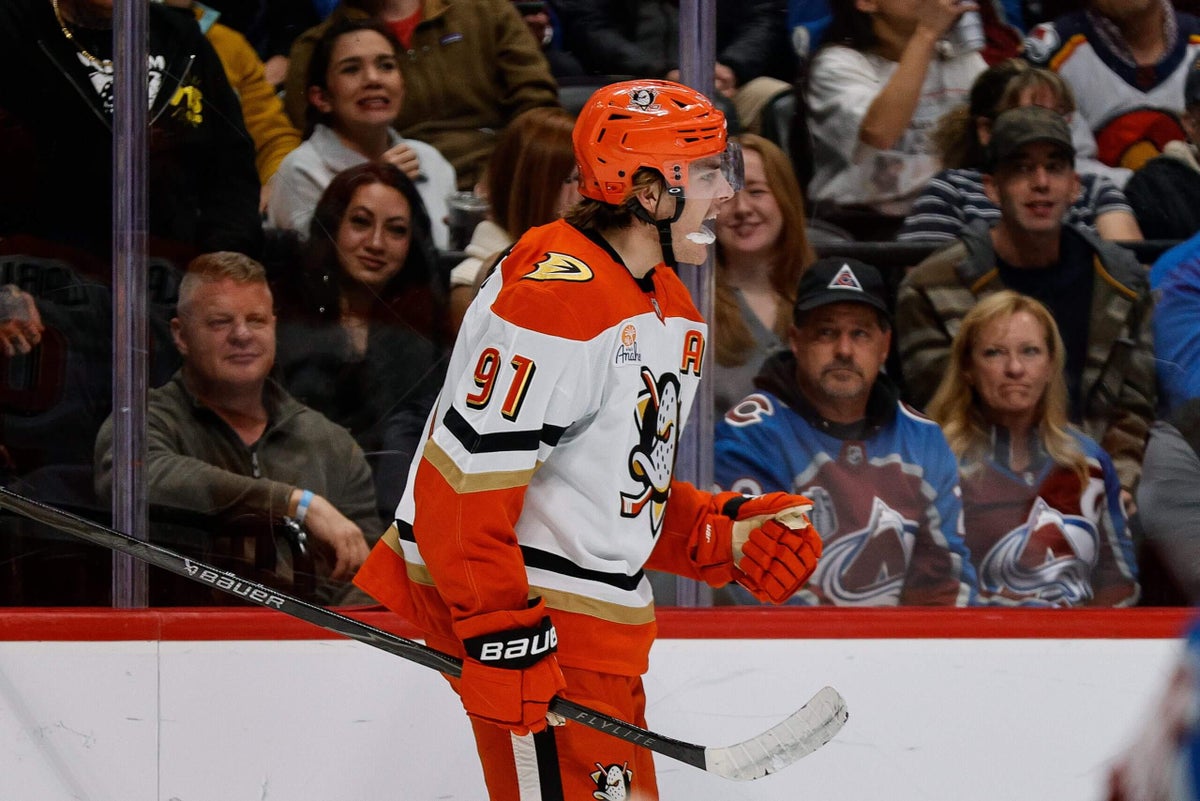
Leo Carlsson’s offensive explosion this season has been a delight to watch.
Especially if you’re the head coach of Sweden’s national team.
“I mean, we’re enjoying everything we’re seeing about Leo,” Sam Hallam told The Athletic this week from his home in Växjö, Sweden. “I also think we picked him as an 18-year-old for the World Championship three years ago. The feeling after that tournament was, ‘This kid is something different.’ Now he’s starting to show what we’ve been seeing from the beginning.
“Of course, it’s huge for us. In an Olympic tournament, to have players that build from a season the way he’s started this year, it’s huge.”
Carlsson, who turns 21 next month, appeared in just one game at the best-on-best 4 Nations Face-Off in February but put up four goals and 10 points in 10 games at the World Championship in May. As for the 2023 World Championship that Hallam is referring to, Carlsson had three goals and five points in eight games.
Adrian Kempe, who played with Carlsson at 4 Nations, came away impressed. “He’s a big body, still developing, still maturing, all that kind of stuff,” he said. “But you can see all the highlights this year and how he’s producing — you can see how good of a player he’s going to be. He’s a big part of the future for Swedish hockey.”
And a big part of the Olympics in Milan.
Veteran Gabriel Landeskog will be part of the mix for Sweden there, too — one of six players already named to the team in June, along with Adrian Kempe, William Nylander, Rasmus Dahlin, Victor Hedman and Lucas Raymond.
It was somewhat surprising that Landeskog was named so early, not because his stature or talent didn’t warrant it, but because he had just come back from a three-year injury absence.
But those five playoff games for the Colorado Avalanche were enough for Hallam.
“As soon as we saw him coming back, we waited until the season ended, but in talking to Gabe, he felt good,” Hallam said. “When we talked in June, he said, ‘I’m practicing to be better, not just to be healthy.’ And now he’s played pretty much every game and I think he’s picking up both his feel for the game, his instincts and his speed, pretty much every week. The way he plays the game, everybody wants that kind of player on their team.
“It’s a heavy game he plays. And also the leadership he brings and the character he brings to the room. We wanted to send a message right away that he was one of our leaders.”
Landeskog scored his first goal of the season this past week (he had scored twice before, but both were called back for being offside). The sense within the Avs is that the captain has been really good defensively this season while the offensive side and pace of play are coming along slowly but surely. He’s ramping up the way one would imagine after missing all that time.
He will be a core leadership voice on a Swedish team that has a legitimate shot at gold.
It’s easy to forget that Sweden was one point away from the championship game at 4 Nations, the only of the four entries not to lose in regulation (1-0-2), tying eventual champion Canada with five points in the standings but losing the tiebreaker on the head-to-head result with the Swedes falling 4-3 in overtime to Team Canada.
“We were disappointed with the end result, but on the other side of it, we didn’t lose a single game in regulation,” Kempe said Thursday. “It obviously sucks when you don’t do that (lose in regulation) and you don’t move forward to the final game, but it is what it is. Overall, we were pretty happy. We played some good games. We played a real good game against Canada. We beat USA last game. It was good to get the players together for a tournament like that, especially before the Olympics.”
And how is that team’s play factoring into the Olympic roster-selection process?
“I think we weigh both (the 4 Nations and the World Championship), but of course, the 4 Nations has a heavy weight to it since it’s the teams you’re going to have to play against if you’re going to win the Olympics and on the same rink size,” said Hallam. (In Sweden, the coach selects the team, not a general manager.) “So that’s pretty much where we start (with the 4 Nations roster) with our team. And then things happen — injuries. But we also had some players that played at the worlds for us who had some really good games and have improved themselves, so that weighs in as well.”
Don’t expect big changes, though.
“It could be two to three changes,” Hallam said. “It could be four to six changes. I think we need to give the players opportunity to play for it and that we don’t lock in too early. It’s a short tournament. Form and being in the zone is one thing. So we need to be ready to have some spots open and not judge too quickly here. But we’re following all the games closely. We have a couple of meetings a week with our staff.”
Kempe contract progress
Kempe is arguably the most talented player left in an otherwise-depleted unrestricted-free-agent pool for July 1.
The mutual goal is to further deplete that pool by agreeing to an extension.
“My feeling on a negotiation is either you got a deal done or you’re negotiating,” Kings GM Ken Holland told The Athletic after the GMs meeting in Toronto on Tuesday.
Between the GMs meeting and the Kings playing in Toronto on Thursday, Holland was in Kempe’s agent’s orbit, as J.P. Barry of CAA Sports is based in Toronto. According to league sources, they did meet Thursday afternoon.
By all accounts, it’s been a slow grind in talks, but they’ve kept at it, also speaking last week. All of which is to say, at least this hasn’t been a highly contentious negotiation where one side takes its ball and goes home. It’s an open dialogue.
“Certainly we want to keep him,” Holland said. “I certainly believe he wants to be a King. I don’t think it’s been acrimonious or there’s been any ill-will.”
The Martin Necas extension in Colorado at $11.5 million annually for eight years is a fresh, important comparable, though Kempe is notably two years older at 30.
Neither side will say it, but my sense is that the range being discussed for Kempe is $9.5 million to $11.5 million per year on a long-term deal — and one can guess which side is closer to which number. I think it’s going to have to be double digits.
Kempe doesn’t want to leave, though, and with Anze Kopitar retiring at the end of the season, the Kings can’t afford to lose Kempe, too.
As for Kempe, he’s pretty Zen about it all.
“It’s not weighing on me,” he said Thursday. “My focus right now is just playing. Like I said before, I’m not trying to think about it too much. I’m just focused on the game and let them (his agent and Kings management) do the job. My intention is to stay. I love it (in L.A.).”
Coleman and the trade deadline
With the Calgary Flames last in the West, their trade-deadline approach has more clarity than most teams — even this early.
But it’s not like the Flames have a fire sale coming. They dealt most of their pending UFAs two years ago. Their only one now is Rasmus Andersson, and all signs point to him eventually getting dealt ahead of March 6.
But if the Flames make other moves, they’ll involve players under contract, and that’s not as obvious a proposition.
There’s been a lot of speculation around Nazem Kadri’s future, but my TSN colleague Darren Dreger poured some cold water on that file, at least for now, when he reported on Insider Trading last week that Flames ownership doesn’t want Kadri dealt.
That could change if Kadri wants out, which he hasn’t shown any indication of. But it also begs the question, who else could be in play?
Interestingly, for all the speculation around Andersson and Kadri, my understanding is that the player who’s received the most attention from other teams is Blake Coleman. Teams are planting a seed, letting Flames GM Craig Conroy know that if he entertains moving Coleman, get in touch.
Let me be clear: In no way is Calgary shopping Coleman. But Conroy can’t control teams reaching out.
The interest makes sense. Coleman, 33, is signed for this season and next at a $4.9 million cap hit, and he’s a playoff-type player who won two Stanley Cups with the Tampa Bay Lightning. He would also be a big leadership loss for the Flames, so it’s no guarantee it happens.
But given where the Flames’ season seems to be heading, Conroy probably has no choice but to listen.
As of now, my understanding is that Coleman’s focus is on trying to turn around Calgary’s season and being part of the solution. The idea of a trade has not been on his radar. He has a modified no-trade with only a small number of teams he can be dealt to, so if things get to that stage closer to March 6, he will have a say in things.

Two-time Cup champ Blake Coleman could be a big prize at the trade deadline. (Carmen Mandato / Getty Images)
Would Nashville move Stamkos, Marchessault?
The short answer: yes, if the Nashville Predators aren’t in playoff contention later in the season, they would consider moving Steven Stamkos and Jonathan Marchessault. But it’s up to the players whether anything happens.
There’s been some chatter of late regarding Stamkos, but the reality is that it’s still very premature. My understanding is Nashville hasn’t gotten a call from another team on him yet and that the Predators and Stamkos haven’t talked about anything either. Stamkos, 35, has a full no-move and would not waive it for just any team.
Having said that, as we get closer to the deadline, if the Predators aren’t in a playoff spot, I do believe they might take calls on Stamkos.
When I interviewed Stamkos last month, he talked about how Nashville has really grown on him and his family. But obviously, the on-ice part still hasn’t seemed like a good fit. So I do believe there’s a world where Stamkos, who has two and a half years left on his deal at an $8 million cap hit, might be open to a change later this season.
It’s probably more likely that he stays put, but it’s worth keeping an eye on.
Marchessault, 34, is a cheaper cap hit at $5.5 million, but his deal runs an extra year, through 2028-29. He also has total control, with a full no-move clause. So nothing happens unless he and agent Pat Brisson say it happens.
But I will say this: My understanding is that a few teams have already poked around on it, checking in with Preds GM Barry Trotz and perhaps planting a seed for later on. At $5.5 million, does a team see decent value for a guy who had 42 goals two years ago in Vegas — but was down to 21 goals last season in Nashville?
And given how thin the July UFA class looks, does Marchessault for three more years after this season appeal to a team?
On a deeper roster, surrounded by more offensive playmakers, I think both Marchessault and Stamkos still have something to give.