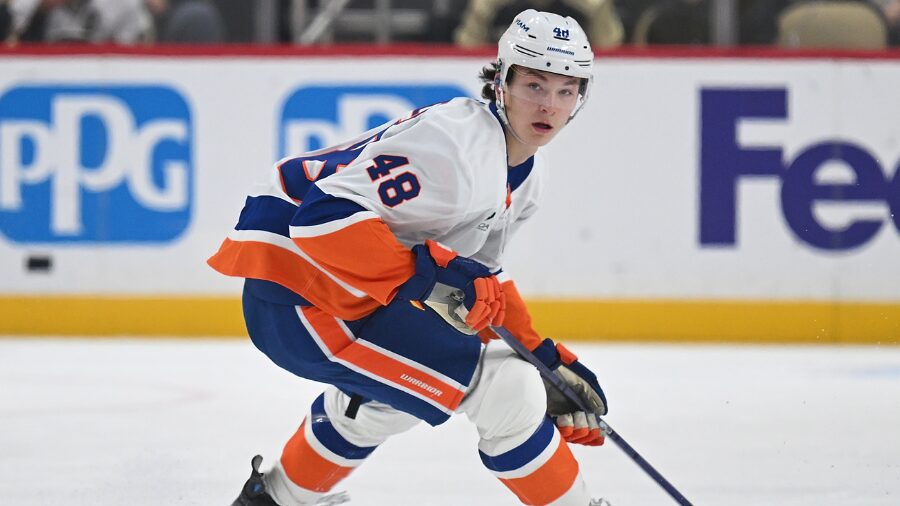
SALT LAKE CITY – Despite leading for a majority of the game and dominating key stretches, the Utah Mammoth lost in overtime on Friday night as 2025 first overall pick Matthew Schaefer recorded his first OT winner for the New York Islanders.
Here are the key takeaways from Utah’s 3-2 loss in OT.
Utah’s power play finally scored but couldn’t put the game away when it mattered most
After failing to convert on their previous 15 power play opportunities and not scoring a goal on the man advantage since October 26 against the Winnipeg Jets (19 days), the Utah Mammoth finally broke through against the New York Islanders to secure a much-needed goal.
But was it enough?
No doubt about that one!
🚨 Gunner makes it 2-1, Mammoth. pic.twitter.com/ypA3ji4TPt
— Utah Mammoth (@utahmammoth) November 15, 2025
Look, there’s no sugarcoating Utah’s power play efforts to this point in the season.
Coming into their matchup with the Islanders, Utah had only connected on eight of 51 opportunities (15.69 percent, No. 27 in the NHL).
Despite an arsenal of firepower on their top unit and registering the eighth most shots on goal in 5-on-4 situations (83), the pucks have simply refused to cross the line.
Enter Dylan Guenther from the left face-off circle.
Immediately after dumping off the puck to Mikhail Sergachev at the point, Guenther went straight to his office, demanded the biscuit and fired an absolute clapper top-shelf.
That’s what he does and that’s where he belongs.
Taking Grade A chances on the top unit and helping Utah find the back of the net.
However, while it was positive to see the puck go in, the Mammoth were just one for six (16.7 percent) throughout the rest of the game and failed to convert on three chances in the third which likely would’ve put the game away.
“Our power play had an opportunity to separate us during the game and we didn’t,” Head Coach Andre Tourigny said. “That’s unfortunate because those were key moments.”
As demonstrated by their shots on goal production at 5-on-4, which ranks top 10 in the league, generating opportunities hasn’t been an issue.
But consistently finding players in their spots and converting on those chances clearly has been.
So, while it was positive that they scored a goal on the power play, they still finished just one for six and a could not put the game away.
That’s a problem, and one that is consistently costing them critical points.
The New York Islanders kicked goal was the right call, but should it be?
Unlike soccer, kicking the puck into the opposing net is generally frowned upon in hockey and usually results in no-goal…or at least one would think.
Against the New York Islanders, the NHL’s kicking rule was put to the test and unfortunately for Utah fans, it appears that the right call was made according to the league’s rulebook.
Who needs sticks when you can just kick the puck pic.twitter.com/PEhUMKXLiD
— Cap’n Cook 🦣 (@JazzePinkman) November 15, 2025
At the 13:44 mark of the third period, the puck ended up in Utah’s net and suddenly the game was tied.
However, immediately after, the officials announced that the puck had been kicked into the goal and therefore would not count.
Jonathan Drouin obviously made contact with the puck via a kicking motion, so it makes sense right?
Let’s drop the puck and play on.
Not so fast.
Upon further review, the officials determined that Utah defenseman Nate Schmidt had “propelled” the puck into his own net, thus negating the kicking motion and resulting in a good goal.
“It’s an instinctual thing, right? In hindsight, do I wish I would have pulled my stick back so they would have called it back? Yeah, but that’s going to be really hard for me to do. You’re trying to get it out then I almost step on Vejmelka in the process,” Schmidt explained.
According to section 49.2 of the NHL rulebook, “A kicked puck that deflects off the stick of any player (excluding the goalkeeper’s stick) shall be ruled a good goal.”
Unfortunately, the puck did deflect off of Schmidt’s stick which means, that was the right call.
But should it be?
Avoiding even the appearance of kicking the puck into the net is a major emphasis in the NHL but there’s some inconsistency in their ruling.
If a kicked puck goes off a body part of a defender, according to the rulebook, it will not count.
But a stick? That’s apparently a good goal.
How is that justifiable?
If the point is to avoid kicking the puck in net, why is it rewarded if it goes off a twig but not a body part?
It would make more sense if it was seen more as an own goal where an opposing player, under his own power, attempts to play a kicked puck and accidentally, causes the puck to change directions which then propels it into the net.
But in this instance, Schmidt attempts to play it but does not impact the direction as it deflected off his twig and into the net.
Essentially, that puck was going in regardless of Schmidt’s attempt and was still kicked by Drouin, so why reward that?
Also, why aren’t more players just kicking at pucks in the crease area with the hope that they deflect off a stick and go in?
Like I said, a good goal by NHL standards, but a silly inconsistency.
Possession is everything in the NHL’s OT format
Three-on-three hockey is simply a different beast in the NHL.
With more space and fewer bodies, odd-man rushes are plentiful which is exactly what the league wants.
Rather than resulting in a skills competition (shootout), games can be determined relatively quickly following the slightest mistakes.
How do you avoid those mistakes on your end?
Possess the puck and if you can’t do that, provide sound coverage.
To my recollection, Utah never once possessed the puck in OT as they lost every face off and couldn’t generate a turnover.
Not to say that their effort was poor by any means, but with an inability to ever recover the puck, all they could do was defend.
Unfortunately, the Islanders then exploited a miscommunication of coverage and first overall pick Matthew Schaefer netted his first OT goal.
SCHAEF IS THE REAL DEAL ‼️
Matthew Schaefer scores his first career Subway Canada OT winner to give the Isles the win in Salt Lake City pic.twitter.com/KqZ2g2Pv5G
— Sportsnet (@Sportsnet) November 15, 2025
“Yeah, I mean, just coverage, right? You know, we knew that Barzal (Matthew Barzal) and Horvat (Bo Horvat) would be coming over the boards at some point. So, yeah, when you don’t have the puck, it’s all about coverage, communication, and making sure you’re not getting tested,” Lawson Crouse explained.
Like Crouse pointed out, coverage is the most important aspect when you don’t have the puck in OT.
That means switching properly when opposing players try to shake their defensemen, which is exactly what Utah failed to do.
Rather than staying with the puck carrier, JJ Peterka peeled off the wrong direction which forced Crouse to step up, thus opening space for Schaefer to score.
It’s a great product, but tough when your team is on the losing end, especially when the game shouldn’t have reached that point in the first place.
What’s next for the Utah Mammoth?
The Utah Mammoth will face the Anaheim Ducks on the road on Monday night at 8 p.m. MT.
The game will be available on Mammoth+.
Cole Bagley is the Utah Mammoth insider for KSL Sports. Keep up with him on X here. You can hear Cole break down the team on KSL Sports Zone and KSL 5 TV.
Take us with you, wherever you go.