
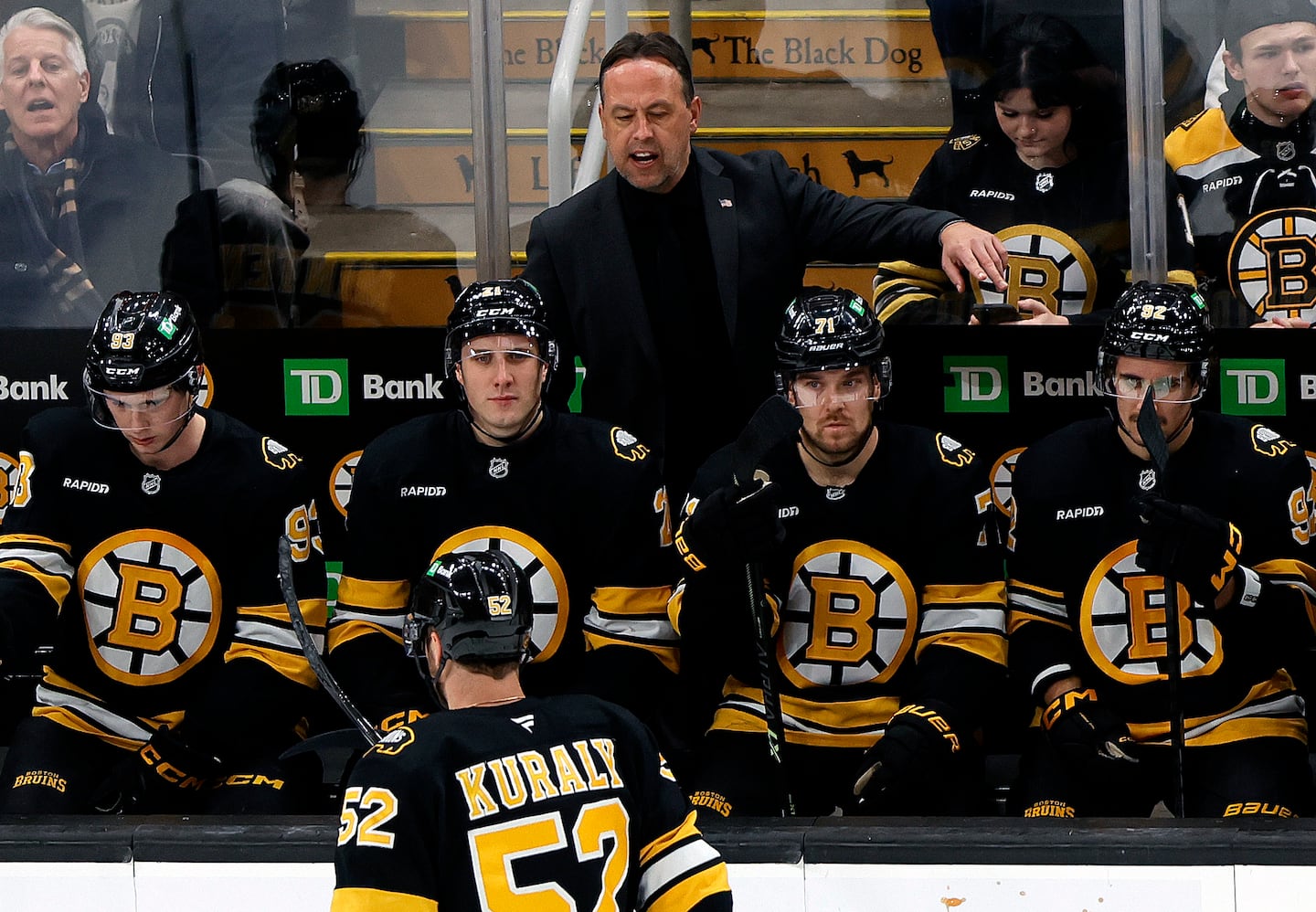
Just shy of a quarter of the way through the regular season (Game 20 being Saturday night in Montreal), it looks as though that Oct. 27 drubbing could end up being the season’s low point. Please note “could.” It’s a long haul between now and the April 14 regular-season closer, with no way of knowing the level of riches-turned-rags we’ll see in February after that 24-day interruption for the return to Olympus.
So for now, what to make of it? Are the Bruins more the discombobulated bunch that lost six straight in October or the confident lot that arrived in Ottawa the other night hotter than grandma’s stove you once used to sculpt that plastic street hockey blade (“Car!).
The answer: somewhere in between, which is also to say not so bad, all things considered.
The points percentage offers some promise. That .579 pace over the full 82-game trek for the Bruins would deliver 95 points. Last season, two of the eight seeds in the East finished with fewer — New Jersey (91) and Montreal (91).
The Stanley Cup-winning Panthers finished with only a .591 points percentage. Reminder: Tiptoe above the DNQ line and anything can happen once the great Cup chase begins.
The simple math to qualify for the postseason: Win 50 percent of the games, worth 82 points, and chisel a dozen overtime “loser” points out of the 41 losses. A foolproof method, no, but the formula historically holds true.
The 11 victories the Bruins carried into Centre Bell against the Canadiens guaranteed nothing, but the early haul did place the rebuilding Black and Gold in far better position than where the majority of preseason punters placed them.
Is it sustainable? The view form here is yes, albeit with a few essential points to keep in mind as the Bruins near the second quarter of the schedule:
▪ The power play
To date, this has been an astounding reversal, the chief reason they’ve built some early equity in the standings.
David Pastrnak’s PPG on Thursday was the club’s 16th. The Bruins scored (cover eyes here) only 35 times on the advantage for all of 2024-25, finishing 29th in the league at 15.2 percent. As of Friday morning, they ranked No. 6 overall with a 25.8 percent success rate. Only the Stars (21) and Wild (19) owned more PPGs. Steve Spott, the PP specialist hired on as an assistant to Sturm, has fashioned wine out of whine. To underscore how thin margins are here: had the Bruins scored even, say, 12-15 more PPGs last season, for a total of upward of 50, the difference could have translated to 16-18 more points in the standings and pushed them into the playoffs. When we said last season the power play was killing them, it did.
▪ Goaltending/defense
Though hardly unexpected, Jeremy Swayman and Joonas Korpisalo have been sharp, and have gained traction of late. They’ll have to be even sharper, which points mainly to the need of team defense to button down Sturm’s new scheme (life without layers). As of Friday, the goalies’ combined goals-against average was 3.37, while the Bruins had scored at the exact same rate. The Keystone Kops coverage boo boos diminished considerably during the seven-game win streak. They’ll never be eliminated, but it’s essential the Bruins get the back end coverage down rote in order to remain in the thick of the playoff hunt.
▪ Formation of the top six
General manager Don Sweeney’s free agent acquisitions of Mikey Eyssimont and Tanner Jeannot as bottom-six booster shots have proven to be what the doctor ordered: points and sandpaper. The top six remains a work in fits ‘n’ starts, particularly with the recent absence of No. 1 pivot Elias Lindholm (4-5–9 in 12-plus games before exiting with a knee injury). Of late, Marat Khusnutdinov has shown some curious promise and fit in Lindholm’s spot between top scorers Morgan Geekie and Pastrnak. For the long haul, however, Sturm will want to have Lindholm back at the top of the order, and perhaps have Khusnutdinov drop into the Line 2 mix regularly with Pavel Zacha and Viktor Arvidsson.
▪ Secondary scoring
What we are seeing, on a magnitude approaching the surprise around the revived power play, is improved, balanced secondary scoring. A half-dozen forwards, including Casey Mittelstadt, Mark Kastelic, Fraser Minten, Eyssimnont, Jeannot, and Arvidisson put up 22 goals in the first 19 games. As a group, that tracks for 15-16 goals each. Such output is in lockstep with a half-dozen secondary scorers who helped the Bruins roll up the historic mark of 65-12-5 in 2022-23. The names then were Nick Foligno (10), David Krejci (16), Charlie Coyle (16), Taylor Hall (16), Trent Frederic (17), and Zacha (21). Average: 16 goals.
▪ Back end goal scoring
Bruins defensemen the past four seasons averaged 31 goals and 159 points. As of Friday, this year’s six pack owned four goals and 41 points. Overall (largely due to Charlie McAvoy’s 14 assists) offensive contribution was right on par, but more shooting and more goals from back there largely remain untapped resources. If the goals are going to come, it’s up to Hampus Lindholm and McAvoy. More goals from those guys, or anyone back there (Mason Lohrei?) could make for easier passage into the Round of 16.
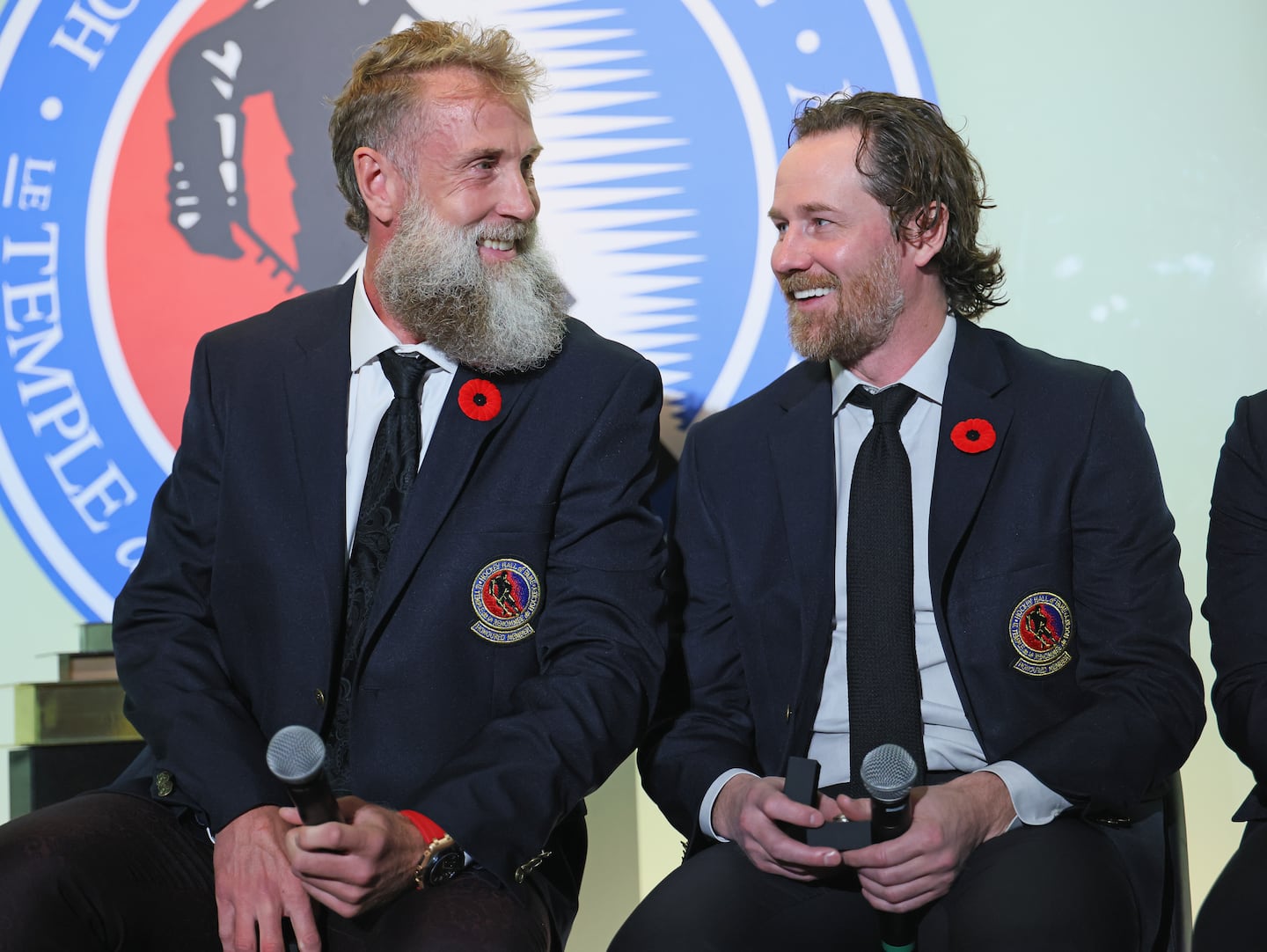 Duncan Keith (right) shared a laugh at his Hall of Fame induction with fellow inductee and former Bruins captain Joe Thornton.Bruce Bennett/Getty
SKINNY ON D-MAN
Blackhawks’ Keith had one Hall of a career
Duncan Keith’s long NHL career, all but one season of it spent in Chicago, included putting his name on the Stanley Cup three times with the Blackhawks and winning two Olympic gold medals with Team Canada.
He also was named twice as the Norris Trophy winner (2010, ’14) as the league’s best defenseman and then the Conn Smythe winner as playoff MVP in 2015, when the Blackhawks won the Cup for a third time in a six-year span.
“That skinny kid,” as he referred to himself from his childhood days in northwest Manitoba, ended up doing OK, a career capped by his induction Monday night in the Hockey Hall of Fame in Toronto.
Keith, who played two seasons at Michigan State and then a junior season for Kelowna of the Western Hockey League, was still considered somewhat undersized and a bit of a project when he first suited up for the Blackhawks at age 22 in the autumn of 2005.
It was then-Chicago coach Trent Yawney who saw Keith for his gifts rather than his deficiencies. Some 20 years later, while making his induction speech inside the Great Hall, Keith choked back tears at the memory of his coach’s encouraging words.
“I am forever grateful for Trent helping me,” said Keith, as he held back his emotions. “He not only taught me small details about playing defense that I used as a foundation for the rest of my career. But just as important, if not more, he believed in me — that I could use my speed and quickness as offsets to defend.”
A dynamic skater, with a keen sense of when to jump into offensive opportunities (a sublime skill, rarely mastered), Keith’s presence and place in the game might have been somewhat overshadowed by legends Nicklas Lidstrom and the towering Zdeno Chara. The fact he was elected to the Hall in his first year of eligibility, along with Big Zee, underscored what he meant to the Hawks and the sport itself.
“Hockey will always be the ultimate team game,” Keith said at the podium. “You can’t chase the dream alone and you don’t lift the Cup or wear a gold medal on your own. You lift it with everybody that ever lifted you.”
GREAT LOSS
‘Brooksie’ will forever be missed on hockey beat
In the grind that is day-to-day sports print journalism, the demand to deliver news, facts, and opinion rather than hot takes, no one put up better numbers in his decades in the craft than the New York Post’s inimitable Larry Brooks. “Brooksie” died on Thursday at 75, following a brief battle with cancer.
During the Bruins’ preseason stop in New York on Sept. 23, we shared a long pregame chat in the Madison Square Garden press room. The two of us shared our usual barrel full of laments and nonsense about how dramatically the business has changed, how access to players, coaches, and management has winnowed, how gambling has taken the game’s narrative hostage, how much the fun of reporting and writing about the game we love has been diminished for reasons we agreed we didn’t understand.
“But, hey, they keep asking me to keep going,” said Brooks, referring to his NYP bosses, and by extension his readers. “They treat me right, and I still love the writing, so …”
His Sunday “Slapshots” column, routinely chock o’ block full of news, and informed opinion, for decades was an NYP cornerstone. He was always a must read, but “Slapshots” was his raison d’etre and one of the crown jewels in the paper’s Sunday section.
The job also allowed him, noted Brooks, time for his great new passion, to be in Connecticut with son Jordan, daughter-in-law Joanna, and grandchildren Scott and Reese. It was abundantly clear he was living happy as Larry, a proud and doting grandfather.
Less than a month after that chat at MSG, when word broke that Brooks had to step away for health reasons, I texted him, offering support and wishing my friend of 40-plus years a speedy recovery. I never doubted he’d be right back because, well, because Brooksie.
“Oh man, Dupes,” he texted back, “I have been knocked on my [rear end]. Facing a battle, but I’m up for it.”
I share his response here because no one in the biz loved a battle more than Brooks. He led with his chin and wrote with conviction, a combination all but vanishing in today’s journalism, particularly in politics and sports. He was Exhibit A: truth needs no varnish.
It’s easier this morning to conceive of the Rangers winning the Stanley Cup this year than to think Brooksie, notepad in hand, forever leaning into a media gaggle to hear the answer to what he asked, ultimately was forced to take on a battle that proved too big.
The game Saturday night in Montreal marks the 20th the Bruins played in a span of 39 days. Exhausting. We often see that pace in the postseason, but typically no team is forced to do it across all four rounds. If the Bruins were to start the season again Oct. 8 and play at that same 20-in-39 pace, without the need for an Olympic pause, their 82nd regular season game would be March 16, the full schedule compressed into 160 days. Hand up here to start the playoffs on St. Patrick’s Day, but not at the cost of the rank and file being turned into sawdust on the factory floor … Keith noted with due pride that he and Brent Seabrook, a fellow three-Cup winner in Chicago, were the first NHL tandem to play 1,000 games as backline partners. Seabrook, he noted, constantly hounded him to be on time for practices and catch the club’s charter flights. “My absolute favorite moments,” he said, “might have been after games on the road, sitting around in Seabers’ room or Sharpie’s room (Patrick Sharp), and we’d order chicken fingers, fries, and Diet Coke, and we’d be talking about hockey until two or three in the morning — sometimes later. I said I liked to train, not diet or get much sleep.” … Defenseman Mitchell Miller, whose tenure with the Bruins was over before it started, connected for a hat trick the other night in the KHL, lifting his team-high scoring line to 9-13–22 with Kazan Ak-Bars. His troubled youth ultimately made Miller persona non grata here, after general manager Don Sweeney signed him as a free agent. He will celebrate his 24th birthday next month. That’s young enough to be a college junior or senior in North America, and possibly young enough still for another Original 32 team to give him a shot, particularly after the league cleared the path for clubs to sign any of the five Hockey Canada players who were acquitted of sexual assault, following some atrocious testimony, during their World Junior days. To wit: Vegas signing goalie Carter Hart … Count your old, faithful puck chronicler among those who thoroughly enjoyed seeing David Pastrnak’s teammates pile over the Bruins bench and surround him with a group hug Tuesday night when he potted career goal No. 400 (soon followed on the same scoresheet by No. 401). Good, they were genuinely excited for a very popular teammate who just reached an impressive milestone, one accomplished by only five other Bruins in the franchise’s century-plus history. Works for me. Far better than the ski-goggle-and-champagne lovefests we see when clubs secure an MLB wild-card berth, often only a prelude to them getting thoroughly trounced and sent home for the season before the smell of bubbly can be washed from their unis … Zdeno Chara wrapped up his Hockey Hall of Fame induction speech by saying, “Lastly, I would like to thank the game itself,” and from there named a long list of players league-wide, including former teammate Pastrnak, all of whom left him feeling fortunate to have shared the ice within his era. “I gave everything I had in this game and it gave me more than I could have ever imagined,” he added. “I am forever grateful for this opportunity. Hockey will always be the greatest game.” Though circumstances and context were vastly different, the finish of Chara’s heartfelt speech had a tone that might have reminded listeners of Lou Gehrig’s “Luckiest Man” farewell speech on July 4, 1939. “Today,” the brave 36-year-old said in front of a solemn, packed Yankee Stadium that afternoon, his words of courage, grace and dignity to echo in perpetuity, “I consider myself the luckiest man on the face of the earth.”
Kevin Paul Dupont can be reached at kevin.dupont@globe.com.