

In a 2024-25 campaign of miserable seasons for pretty much any Bruin not named David, Morgan, or Nikita, Beecher’s misery flew under the radar.
Of course, it wasn’t always that way. Beecher actually began his second season as a full-time NHLer with two goals and five points, along with a plus-9 rating, in the first five games. But over the next 73 games, Beecher recorded just one goal and six points, along with a minus-18 for Boston. It made Beecher the first Bruins forward to have a stretch of just a single goal in 73 games in a season since Shawn Thornton in 2009-10, and just the third in franchise history, with Beecher and Thornton joined by 1997-98 Ken Baumgartner there.
Both Thornton and Baumgartner used their hands for other things, sure. And that much was true for Beecher, too. The Bruins weren’t asking Beecher to score goals and put up eye-popping point totals. But they were asking him to kill penalties and add value in the defensive zone. Instead, what they got was an uptick in Beecher’s penalties. Among a group of 322 players with at least 800 minutes played last year, Beecher’s 0.89 minors per 60 was the 50th-highest rate. You can’t be a penalty-killing specialist when you’re the one in the box serving the penalty. Beecher also struggled getting the puck up and out of his zone, and his 3.34 giveaways per 60 ranked 58th among that group of 322.
Beecher, whose confidence surely took a hit throughout this run, was unintentionally doing the exact opposite of what the Bruins asked out of him. It even hit the points where the Bruins scratched him for the final two games of the regular season, which… when you’re a tanking team… is not a good sign.
Still, the Bruins brought Beecher back on a one-year, $900,000 deal.
… And then they seemingly immediately replaced him on their NHL roster. The Bruins brought Sean Kuraly back to Boston. Even at 32, Kuraly is still a superior option to Beecher as a speedy, lefty-shooting faceoff and penalty-killing specialist, and has been exactly that for Boston’s fourth line. The Bruins even replaced Beecher on the wing, with Mikey Eyssimont signed as a free agent.
It got increasingly difficult to envision Beecher making this team, and that was back in July. And, hell, had it not been for a camp-saving performance in Philadelphia during the preseason slate, there’s a strong chance that the 24-year-old Beecher doesn’t even make the team out of training camp.
So, why now?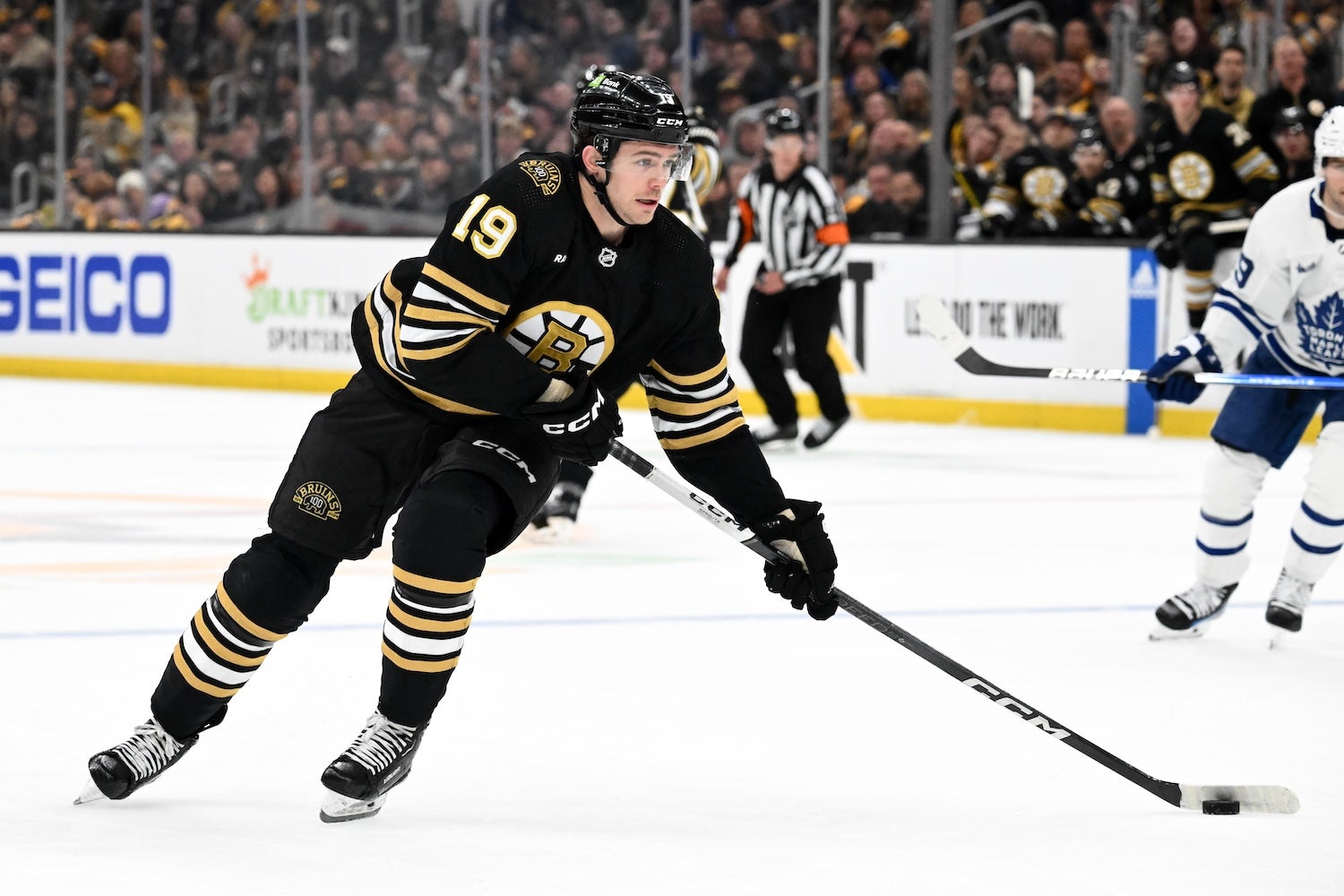
BOSTON, MASSACHUSETTS – APRIL 20: John Beecher #19 of the Bruins skates with the puck against the Maple Leafs during Game 1 of the 2024 Stanley Cup Playoffs. (Brian Fluharty/Getty Images)
One thing I think the Bruins have tried their best to preserve out of the gate this season has been their depth and lineup versatility.
They know the schedule, and they know there’s going to be injuries. They also know that with a ‘P&V’ lineup as Bruins president Cam Neely called it, penalties were going on the rise, and that the team might need as many killers as possible. That is obviously where a Beecher at his best brings value.
And that was true out of the gate this season. Beecher was on the ice for over eight minutes of shorthanded time on ice this season, and had yet to be on the ice for a power-play goal against. The Bruins, as a whole, have gone a strong 17-for-18 (94.4%) on the kill when Beecher’s been in their lineup this year.
But the Bruins have steadily incorporated players like Tanner Jeannot and Fraser Minten into the penalty kill, and both have been able to ‘hang’ and earn regular reps in that mix. Their success on the kill is perhaps the No. 1 reason why the Bruins played Beecher just six games this year before waiving him.
And elsewhere on the B’s roster, the Bruins are hurting. The club remains without Elias Lindholm, and placed forwards Viktor Arvidsson and Casey Mittelstadt on injured reserve on Monday morning. The team also transferred Jordan Harris from the injured reserve to the long-term injured reserve to have the cap space necessary to call up two players from the minors on Monday. They’re still waiting to hear how long they’ll be without Charlie McAvoy, too.
Now, Beecher was dealing with an upper-body injury last we knew. But he’s remained skating, meaning he was not a candidate to get Harrised onto the long-term injured reserve. The Bruins also planned on leaving for California on Tuesday, too, and it’s hard to imagine them wanting to make that trek without an extra defenseman. Oh, and they did not want to officially rule Elias Lindholm out from returning to action at some point during that trip.
In other words, the clock was ticking on a roster decision somewhere.
But will a team claim Beecher?
Dec 12, 2024; Seattle, Washington, USA; Bruins center John Beecher (19) advances the puck against the Kraken during the second period at Climate Pledge Arena. (Steven Bisig-Imagn Images)
Now, the obvious next question here is will a team out there take a chance on Beecher? These things are always so hard to predict, especially considering I was almost certain the Bruins were going to lose at least two guys to the waiver wire at the end of training camp. But if I were a betting man, I’d say yes.
One team that immediately comes to mind is the Canucks.
Vancouver may have just added David Kampf to their roster, but the Canucks have struggled on the penalty kill all season long (they’re a league-worst 67.2 percent on the year), and have also struggled to get wins at the dot (46.3 percent success rate as a team). Another team with similar problems in that respect is Seattle, and the Kraken have shown a willingness to take chances on former first-round picks, especially if they’re free.
Honestly, there’s countless teams that could probably some a little of what Beecher brings to the table. And, again, it helps when he’s not your first-round pick (like the Bruins taking a chance on Oliver Wahlstrom last season). The Flyers, Canadiens, Maple Leafs, and even Golden Knights come to find as potential fits for one reason or another. Another little something working in his favor? He’s making $900,000 and he’s a restricted free agent at the end of the season. Teams love themselves some cheap, controllable depth.
A look at B’s depth without Beecher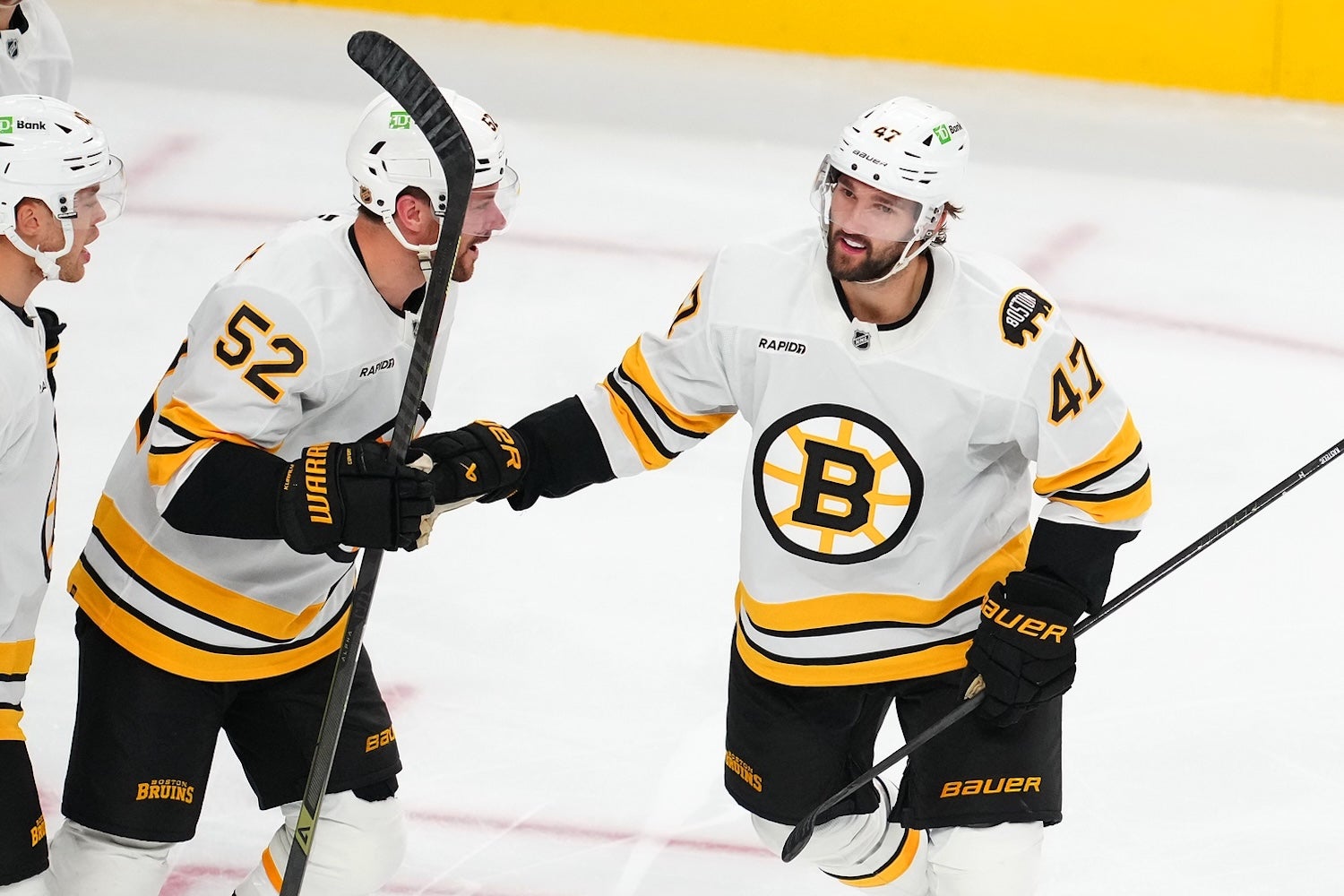
Oct 16, 2025; Las Vegas, Nevada, USA; Bruins center Mark Kastelic (47) celebrates with forward Sean Kuraly (52) after scoring a goal against the Golden Knights. (Stephen R. Sylvanie-Imagn Images)
If Beecher is claimed, or even if he isn’t claimed for that matter, one thing his departure from the NHL roster does do is increase the workload for guys like Kuraly and Minten, as well as Pavel Zacha. This trifecta makes up the Bruins’ options as left-handed faceoff options. And to be honest, that’s pretty much it for the entire organization, with Casey Mittelstadt (a player the Bruins want to keep out of the defensive zone and sometimes out of the center position all together) and Riley Tufte considered the next-best options.
To this point, the Bruins have leaned on Kuraly (66 shorthanded minutes) and Minten (41 shorthanded minutes) as their top lefty options when down a man, while Kuraly has taken the most defensive-zone faceoffs among all Bruins, with 112. That’s a 30-faceoff lead over second-place Mark Kastelic, and a staggering 38-faceoff lead over the next-closest lefty option (Zacha).
That’s a lot of pressure on Kuraly to stay healthy, and to stay healthy while logging the hardest minutes of almost any other player on the roster.
Now, should the success of a season hinge on the health of a fourth-line center? Of course not. But one of the secrets to the Bruins’ success out of the gate this season has been their penalty kill, which is the 10th-best unit in the league entering Thursday. The Bruins can’t afford for that to go sideways on them, and potentially losing Beecher hurts the overall depth of that unit.
Another first-round miss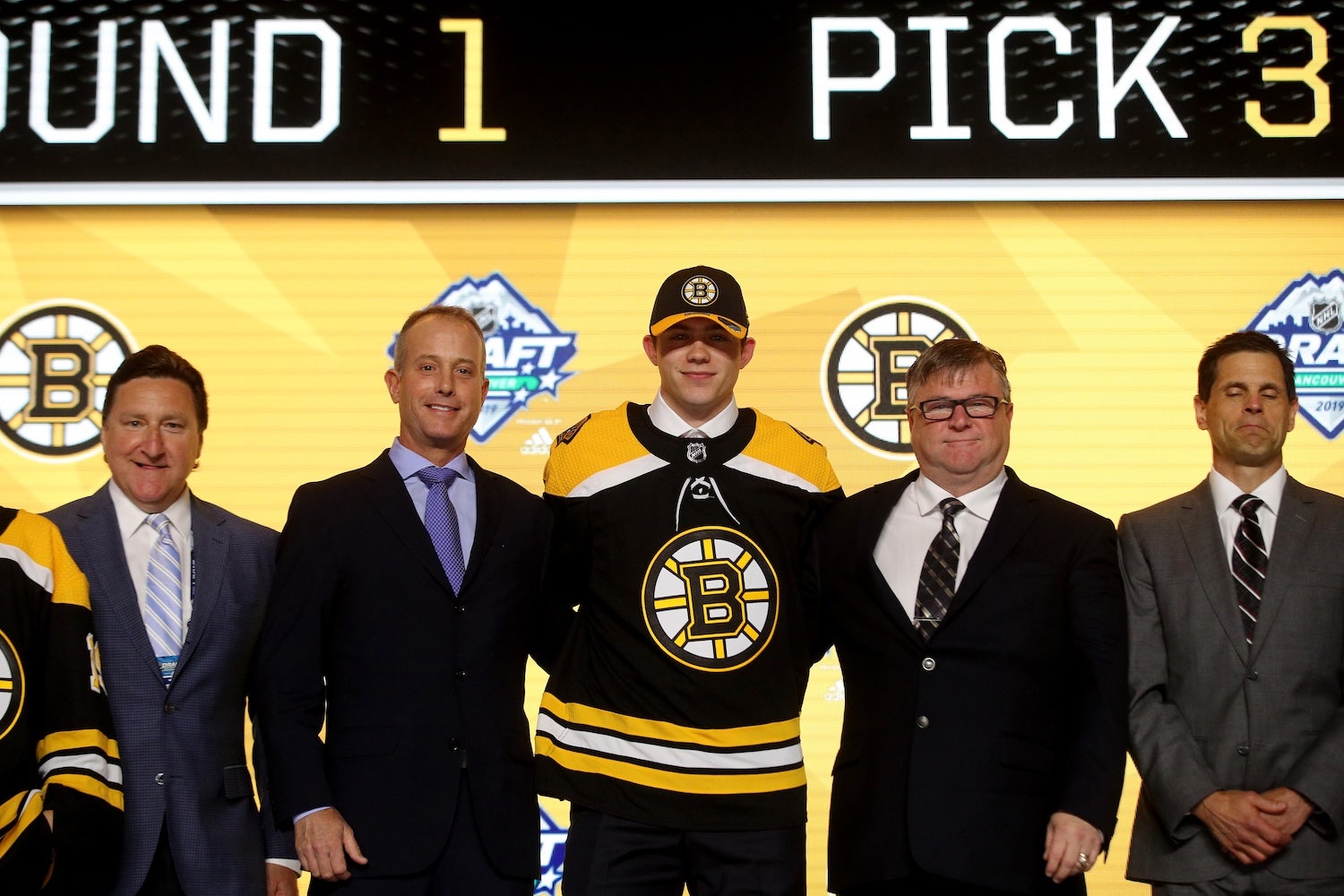
VANCOUVER, BRITISH COLUMBIA – JUNE 21: John Beecher reacts after being selected 30th overall by the Bruins in the 2019 NHL Draft at Rogers Arena on June 21, 2019. (Bruce Bennett/Getty Images)
No matter what happens here though, and at the risk of stating the absolute obvious here, waiving a first-round pick is never a sign that your first-round pick has panned out as you envisioned it. So, consider Beecher yet another round-one miss by the Black and Gold’s front office.
Taken with the 30th overall pick in 2019, the Bruins envisioned Beecher being a third-line player for their team. He never got above the fourth line. Their problem was probably in their thinking that Beecher would produce more as he moved up the lineup of his respective teams after skating on stacked teams. It was similar to their thinking when they picked Zach Senyshyn in 2015. But Beecher never seemed to move up any lineup on any team he played on throughout his amateur career, and you rarely saw it in his pro career.
Ultimately, and as they have so often, the Bruins openly opted for a safer floor than a higher ceiling with this pick, which in Boston maxed out on an NHL fourth line. The good news is that the Bruins have shown signs of breaking out of this trend with their recent first-round picks, going with the talent and upside in first-round picks like Fabian Lysell (2021), Dean Letourneau (2024), and James Hagens (2025). Even if those players do not hit, you can take some comfort in knowing that it’s proper way to approach the first round of a draft.
But the Beecher pick represented everything that seemingly haunted Boston for a three-year draft window. From 2017 through 2019, the Bruins made 16 picks. Goaltender Jeremy Swayman is the only Bruins regular to come out of that 16-pick group, with Jakub Lauko considered the second-best pick.
And another twist of the knife, just for good measure? It was known that the Bruins wanted to move David Backes. The Bruins had scratched Backes in Game 7 of the 2019 Stanley Cup Final and there was no saving face on that contract. It was also known that the going rate to move that contract would’ve been a first-round pick. The Bruins opted not to move that first-round pick (it’s hard to trade a first-round pick worse than 30th overall), and instead attached a first-round pick and move to Backes less than a calendar year later.