
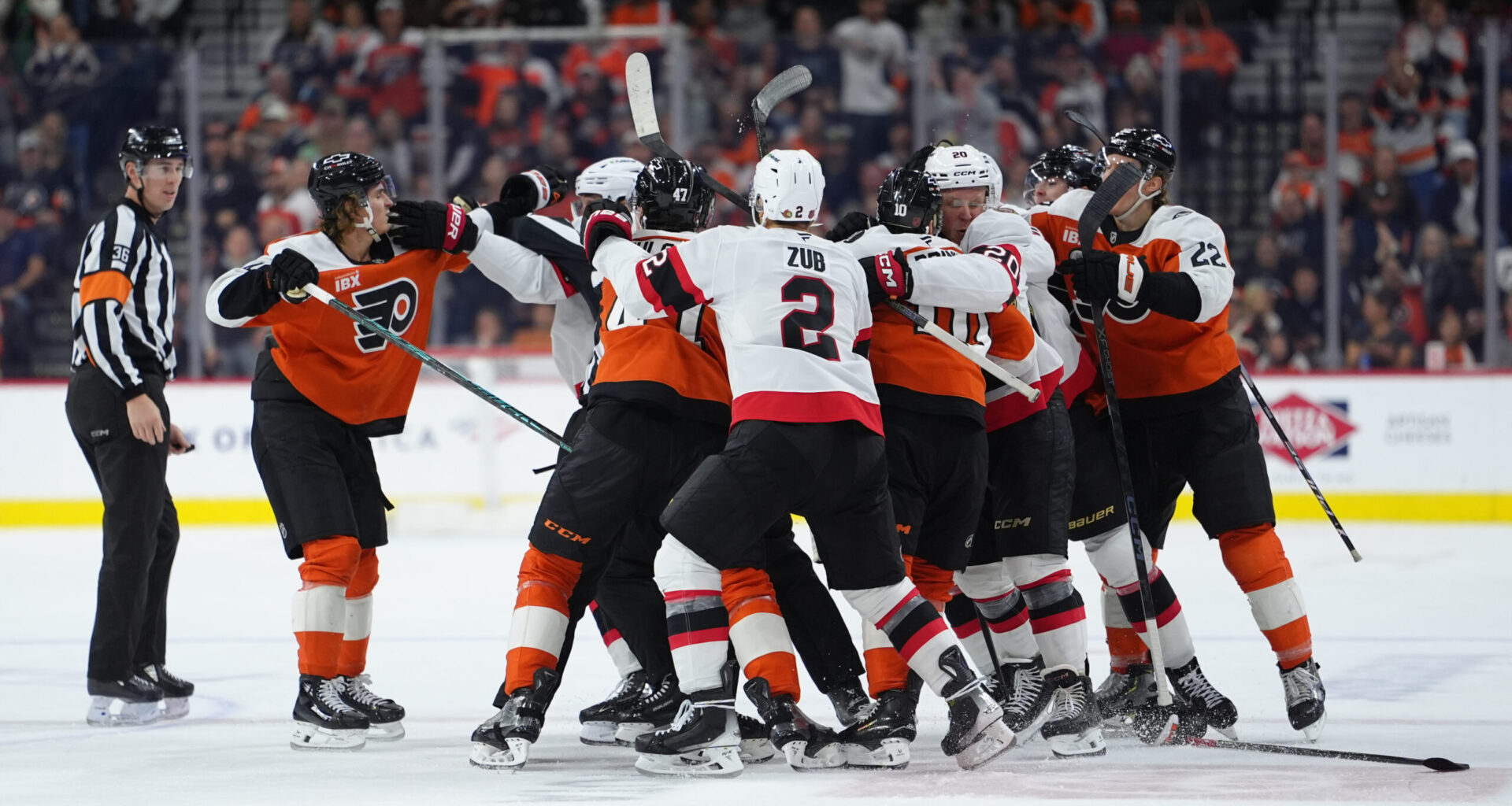
We’re close to the quarter-pole of the season, and already the Flyers are out of the gate a little bit better than some anticipated. It’s an extremely tight batch in the standings in the Eastern Conference, with a two-game winning streak possibly putting you into the top three of the Metropolitan. Or a two-game streak of regulation losses putting you near the cellar. Philadelphia has been good in some respects but needing to improve a lot in others. And while the Flyers are being praised for showing some character and resilience (they have seven comeback wins), there are some other causes for concern, namely not quite getting off to even decent starts on a regular basis.
If you were to quickly recall this season there’s probably only one first period that stands out. The start in Montreal, where the Flyers jumped out to a quick 3-0 lead, was the exception to what has been the rule: they’re slow starters. Sometimes ridiculously so. Considering Philadelphia has generally had a less than arduous schedule with 11 of the first 18 at home, and just two back-to-backs roughly six weeks into the campaign, that could pose a problem moving on. A team whose margin for success is razor thin when everything is going in the right direction can’t simply coast through the opening 10 or 20 minutes before trying to turn it on.
Slow starts? Absolutely
So, while you can credit the Flyers for battling back often throughout games, the starts have been an issue. The basic numbers are not great. Of the first 18 contests, they’ve scored the first goal just six times. That number gets worse when you realize two of the first three games of the season (Carolina, the second Florida game) they took the lead, meaning just four of the last 15 games they’ve opened the scoring. Additionally, the first period is their worst period scoring with just 13 goals so far (with almost a quarter of those coming against the Habs). Given this info, it shouldn’t come as a big surprise that they’ve only come back to tie the game in the first period just three times (against Seattle, Pittsburgh, and St. Louis).
Naturally, the scarcity of goals often result from not generating many shots. And here is where the is proof the Flyers often don’t start games on time. They show up physically, but mentally or emotionally they don’t seem to be as engaged as their opponent. Out of the 18 games so far, the Flyers have outshot their opponents in the first period seven times. On three occasions they’ve managed to get 10 or more shots in the opening 20 minutes while allowing 10 or more shots eight times. And only three times have they outshot the opposition in the first two periods of a game. As well, while managing shootout wins, the Flyers have never had a shots advantage in the overtime frame. They matched the same overtime shot total that both Montreal and Minnesota had against them. Otherwise they’ve been outshot in those extra sessions, meaning either Dan Vladar or Sam Ersson has had to come up big.
This tends to be a vicious circle of sorts as if you can’t score and can’t generate chances, odds are you get behind early. Fortunately for Philadelphia, they’ve come back to tie the game five times in the second period and seven times in the third. So the resilience is apparent. They may look like they’re sleepwalking in the opening 10 to 15 minutes of play, but they are in full gear or look awake in the closing 10 to 15 minutes of regulation. Which leads into the idea of this team — which isn’t loaded with ample high end talent at any position — being a team that battles and stays in the fight. This is especially true considering 11 of the 18 games have been one-goal affairs. That’s a lot of tight hockey being played, with very few favorable or unfavorable laughers so far.
Resilient? Yes, but…..
“We’re resilient,” Tocchet said earlier in the month after blowing the 3-0 lead to Montreal yet winning in a shootout and then defeating Nashville. “That’s important to build culture and identity, is to have resiliency. You’re not going to have your A game. Can you win on your B game or your C game? That takes resolve, and I saw that on this trip.”
The Flyers have had their “C” game too many times this year to start while attempting to salvage a point or two with their “A” game during the homestretch of most games. It’s great to know a team has that switch that they can hit that extra gear the longer the game goes on. Yet it’s frustrating to know that same spark is absent most nights after the opening faceoff. The lone saving grace might be the fact the Flyers seem to be more productive with each passing period. They’ve scored 13 goals in the first period, 16 in the middle frame, and 18 in the final 20 minutes of regulation. Philadelphia has also been on the plus side of the third period shot total in 10 of those 18 games, a definite plus considering just how few shots they’ve been managed most of the year.
However, if you’re chasing the game as much as Philadelphia appears to be to start, it makes things that much more difficult for a team that at best is probably a bubble wildcard spot. Especially for a team that is as defensive-minded so far as Philadelphia has been. For Tocchet, an early one-goal lead almost seems like the Flyers have an insurance goal in terms of style of play. His teams know how to shut down opponents. In 2023-24, Tocchet was in Vancouver and the Canucks had a 42-1-4 record when leading after two periods. That’s earning 88 of a possible 94 points. Of course the rosters were different, but Tocchet’s system appears to work in shutting down teams in the third period. But it’s impossible to hold down a lead when you’re trailing going during the second intermission. That much I do know.
Walking a tightrope
Unfortunately, the Flyers are essentially letting the rock roll down the hill each game before they stop the momentum and start pushing back. It’s doable from time to time, and it’s a feather in their cap when they earn two points after being down. The notion that it’s sustainable for 82 games is foolish. And Tocchet and the players would probably be the first ones to state that. Particularly given the Flyers have it tough the rest of the way regarding strength of schedule where they have the sixth-toughest slate among the 32 teams.
Granted, any team that isn’t very good is going to have a tough 64-game schedule remaining. Which makes it a double-edged sword of sorts for the Flyers 18 games in. They have shown the moxie to come back a combined 15 times to tie things up in that timespan. That’s a credit to their mental toughness, from Vladar and Ersson in the extra frame and shootouts on down to the forwards and defense. They don’t simply give up. If Philadelphia can somehow make life a lot easier on themselves by getting the lead early a bit more often than currently, that resiliency won’t be put to the test game after game.
The elite teams can afford sometimes to go down a goal or two before they flip the switch and wipe the floor with the opposition. The Flyers have years to go before they enter that realm. For now they’ve shown a lot of grit being three games over .500 (the NHL version of .500) with just four wins in regulation. And should be applauded for that. But they are playing with fire if they believe they can routinely withstand one-goal or two-goal deficits early in a hockey game. Philadelphia appears to be in enough of a hole as far as generating offense five-on-five so far. Trailing as much as they have is just giving them a bigger shovel. Or throwing dirt on them.