
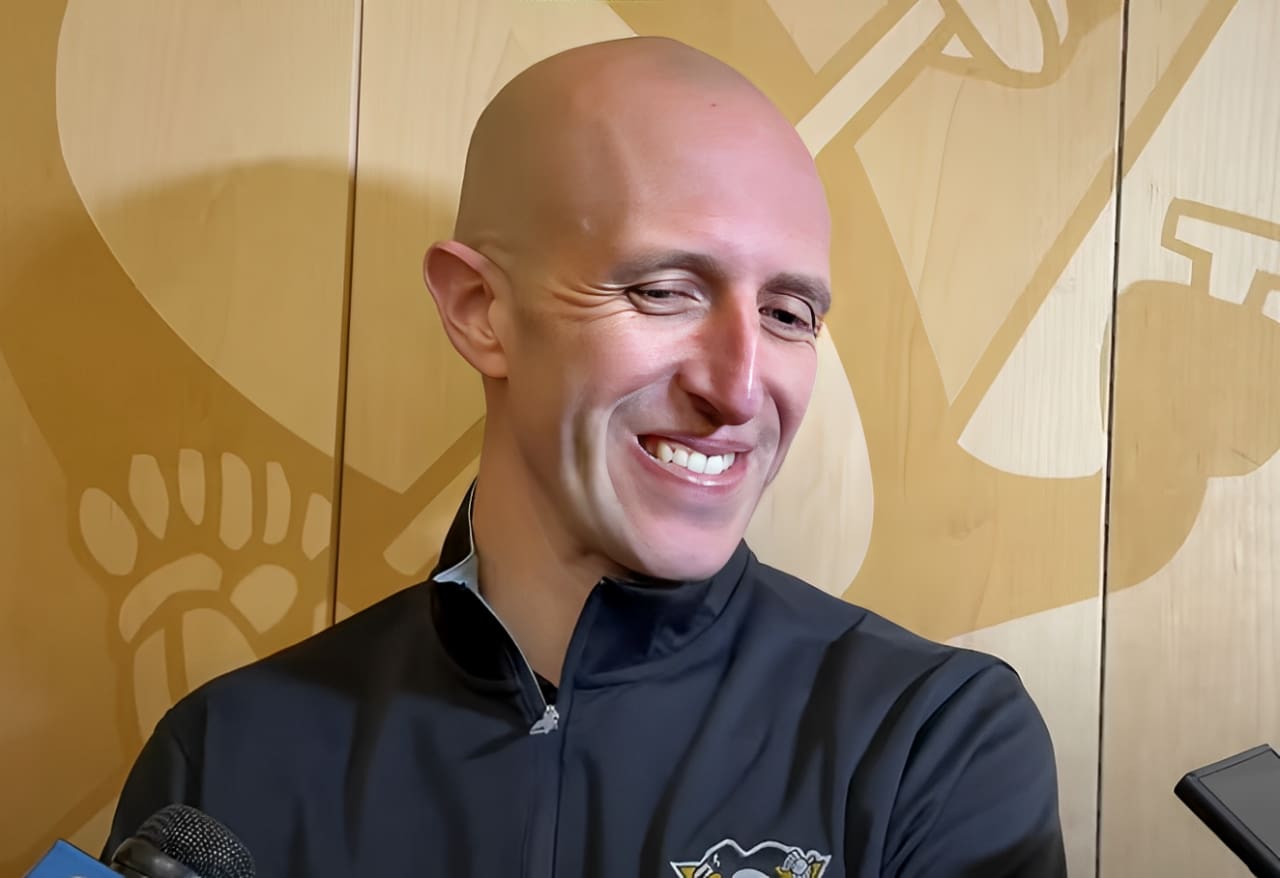
Before the first game of the NHL season and Dan Muse’s head coaching debut, when Pittsburgh Hockey Now asked Muse for a good lunch recommendation around Madison Square Garden, he kind of shrugged. Despite a couple of years as an assistant coach with the New York Rangers, Muse didn’t leave the arena for lunch.
The same is true of Pittsburgh. If you need to find the head coach of the Pittsburgh Penguins, look no further than the rink.
For more than 20 years running, hockey has been the 43-year-old Muse’s passion. In a moment of truth, hockey tapped Muse on the shoulder, and he wasn’t afraid to start at the bottom, actually, a few rungs below the bottom.
The epiphany that set about this life and current position happened as the rest of his life beckoned. After a year of studying for the LSATs to attend law school, he was strolling through an open house for Suffolk Law School. That’s when inspiration struck, and he simply walked out. He called his Dad to say he wasn’t going to law school, and the hockey journey began in earnest.
“And so I ended up going through that process to go to law school. I was already at an open house for it, and it just kind of hit me,” said Muse. “I’m like, I really like coaching. I really like being in a classroom. And so I’m not going to do this. I walked out of the open house for Suffolk Law School, and I remember calling my Father. ‘Yeah, I’m not doing this.’”
To say Muse started at the bottom of the coaching world would be an understatement. After previously coaching a squirt hockey team and a high school team, he latched on as an assistant coach at Division III at Williams College.
Sitting under the soft fluorescent lights of the Penguins’ offices at the UPMC Lemieux Complex, across a cubicle desk from PHN on Thursday, Muse humorously stressed that he made almost no money but was given a lot of opportunity.
“As close to nothing as you could imagine,” he said as he motioned with his hands. But he had heard the calling, and the rink rat was born.
The coach at Williams heaped responsibility on Muse, who absorbed it quickly. He was already a self-taught teacher who dissected the process of teaching to be effective, and now the boy who grew up playing street hockey in Alabama and Northern California before getting to play ice hockey in Alabama and then in high school in Boston was on his way.
There was also some serendipity along the way. Before then, he lucked into a teaching job at a Massachusetts Catholic school, despite having no teaching training or experience, and helped coach the junior varsity team.
But in retrospect, it seems the fates were already guiding him, even if the path wasn’t clear.
“So the next year, I became a full-time teacher at a Catholic school outside of Boston, which will hire, it turns out, people without any kind of teaching background or certificates or anything else. And so, I didn’t know what I was doing, like I had never been in a classroom. I had never taken an education class,” Muse said with a smile of some disbelief. “I was a criminal justice major teaching high school history. And so that, honestly, was what pushed me. I was thinking, all right, I’ll be a teacher and a coach. This (situation) was one year after college. I’ve got it all figured out. And so I loved it, like it was probably one of the most–of all the years in coaching–that was probably one of the most influential because I had to learn to teach myself how to teach. And that’s what coaching is like.”
That’s where the seeds were planted that ultimately led to the epiphany.
Pittsburgh Hockey Now also had a bit more to the story of how Muse made his jump from Chicago of the USHL to Nashville of the NHL in 2017-18. In fact, Muse didn’t know our side of the story.
Whether it is a legend that has grown or is pretty close to reality, we’ll have to leave it to your imagination and his. Friends of Muse told us that he had some ardent supporters in hockey circles who pushed Nashville coach Peter Laviolette to interview Muse, still a rising figure in the junior ranks, for an assistant coach position.
Muse showed up to the interview with an extensive and thoroughly prepared presentation. Laviolette was so impressed, he essentially hired Muse on the spot.
Muse looked a little surprised as we recounted that side of the story.
“Well, it was quick. Yeah, they called the next day,” he admitted.
But his nonchalant, slightly incredulous reaction that his presentation was anything out of the ordinary was what we’re quickly learning as vintage Muse.
His reaction essentially said, like, yeah, what else would I do?
And that’s why he had almost immediate buy-in from a veteran-heavy Penguins team that has been sometimes difficult, if not impossible, to coach. And that’s probably why the Penguins had 10 wins and four overtime points in 19 games, and are in a playoff spot.
You can listen to the full Dan Muse interview as a bonus episode of the No Pucks Given podcast.
The Dan Muse Interview
Q: I was listening to Kyle Dubas on a podcast this summer, and he talked about the moments he realized he wouldn’t be an NHL player but wanted to be in the game. When was your moment, and when did you know you wanted to be a coach?
“…Then we moved to Massachusetts when I was going into eighth grade. And I mean, I was behind the eight ball like it was. I had to work really hard to–I played public high school hockey. We were good. It was a good team. Very good. And even then, I had to work each year just to kind of (earn) my way. I had to work really hard just to play Division III hockey … it probably didn’t look like (pro hockey) was in the cards … I was fine with that. And I’m proud of working hard to get to that point, to be a Division III player.
From there, I was originally going to go to law school. So, my first thought after college, I knew I wanted to coach hockey in some capacity. So I spent a year–my first year out of college–I was planning on studying for the LSATs, and I needed to work. And so I actually–just to get health insurance and because I wanted to do something where I could be coaching and studying for the LSAT and going through that whole process–It ended up, my mother was a speech teacher in Canton, and so she told me there was an opening for a paraprofessional aide, which would have you get health insurance. And yeah, the timing would work great. So I’m like, all right, this makes sense. So I was an aide in a special ed classroom that first year. And then I got an opportunity to be an assistant coach at a prep school, which, I mean, that was like, for me, it was like it was kind of a home run because I wasn’t expecting that.
…And then I ended up being an assistant coach at the prep school, Milton Academy, which was huge at the time. I was like, This is amazing. And so I ended up going through that process to go to law school.
I was already at the open house for it, and it just kind of hit me. I’m like, I really like, you know, I really like coaching. I really like being in a classroom. And so I’m not going to do this. I walked out of the open house for Suffolk Law School, and I remember calling my Father. ‘Yeah, I’m not doing this.’”
Muse said his Father’s reaction was great. He was a huge supporter of the coaching move. However, telling his uncle, who is a lawyer, was a little more intimidating, but his uncle was even more supportive.
Q: I heard a legend. I mean, when you got hired in Nashville–A lot of people you’ve come in contact with over the years, hanging out at rinks during the day, coming up through junior and and all of that—I heard the story that you got the job in Nashville with (Peter Laviolette) because you came in with a massive presentation detailed beyond anyone’s expectation. Kind of like a giant binder, essentially, of a presentation. Is that story taking on greater legs or reality?
“It’s like, you’re right, I’m sure I came in with stuff, prepared. I don’t know if it was any different than anyone else.”
Q: The story was that Laviolette was so impressed that he hired you almost on the spot.
Yeah, it was quickly after. It was the next day that they offered me the job. You get an opportunity to interview for something, you come prepared.
…I think any job that I’ve ever had–I got interviewed to be a high school teacher, I put together a big presentation for that. Like, coming prepared if you want to (succeed) … I always feel like you put together, you put your best foot forward to be able to present. And that takes preparation.”
Q: What do you think of your team? An open-ended question. No specifics. What do you feel? What do you think of where they are at right now?
I think it’s coming together. I think we’re taking steps. I think that’s the biggest thing. One, I really enjoy working with this group. I really enjoy working–I think the whole staff feels that way. I like the feel of where things are at right now. I think it shows progress … You know, things don’t suddenly change in this league. There’s always going to be days when there are steps back, and you want to see how you’re going to react on those steps back. I really like our group, I like I like the direction we’re going.
Q: One thing I noticed Sunday (a 4-0 win over Nashville), it looked like the F3s were really engaged in terms of staying on top of the zone. And even in the third period, maybe some guys who like to play offense more than defense were making a very concerted effort to read the play and make sure they were in the proper defensive position. That spoke to me about buy-in to your system.
Coming into this job. I mean, you look at a Hall of Fame-loaded roster, and they might not have been the easiest to coach in some past circumstances. How worried were you about buying in, and how long do you think it took before you felt that momentum and that sort of feeling where everyone was rowing in the same direction?
I mean, no concern. You start, for me, it’s just about getting to know the guys, guys getting to know me, and that takes some time. That’s kind of the first step. And then I mean, they come together, we put together a plan, what we wanted to have as a starting point, and you make adjustments as you go. But I don’t know if it was something necessarily like (I was) concerned.
These guys want to win. These guys want to be–you don’t do what they’ve been doing. For our veteran guys, you don’t do what they’ve been doing for this long unless there’s an extreme inner drive to be great. And you need individual greatness, but they want to have team success. They want to be great at all of it. They’re competitors, competitive as they come. I didn’t need any conversations. I’ve seen that firsthand from coaching against them, from watching the league, knowing the league. That wasn’t a concern.
Q: One more. You’re kind of a noted rink rat. I mean, I asked you for lunch recommendations in New York, and you answered, ‘The arena.’ I mean, that was disappointing to me, I must say. I love New York City food.
Yeah, I don’t get out too much outside of the rink.
So what is it? What is it that you love so much about the industry or the coaching job in general that you would spend all day at the rink? What do you love?
“Yeah, I love the game. I love teaching, I love coaching. It’s a little bit of the same thing. I love watching hockey. It’s never once have I felt like I work. It’s not once, I’ve woken up in the morning, driven in, and think like I’m going to work. Like I’m excited. I wake up excited and ready to go. And I go to bed excited about the next thing. Like, I love this. I love the game, and I love the people in the game. And you know, just talking about the game, all that. So this is it. I also love the idea of building and getting better, improving. And I think in order to do that, you’ve got to look at things and you’ve got to have conversations and you’ve got to make sure no rocks are unturned. You’ve got to look and find ways to learn, watching other teams, other sports, there are lots of ways to get better.
Tags: dan muse system Pittsburgh Penguins
Categorized: Penguins Locker Room PHN Exclusive