
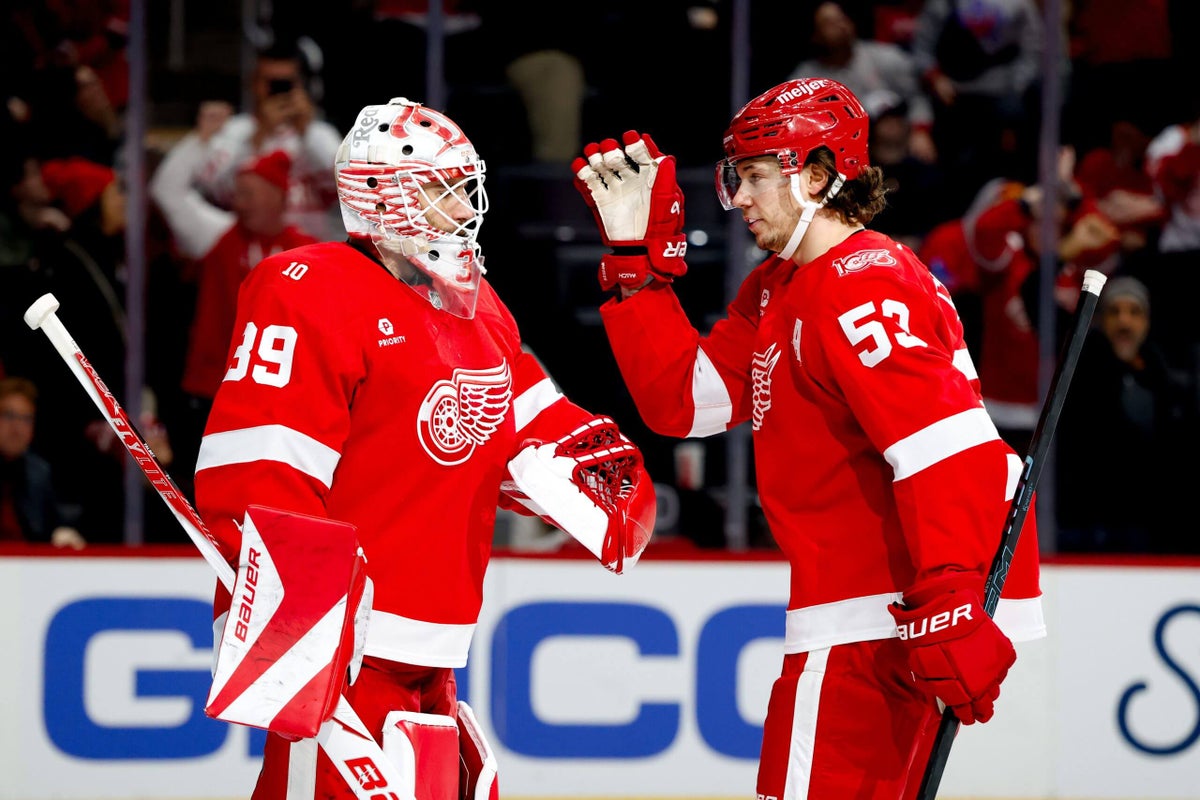
DETROIT — Say this much about the Detroit Red Wings: They know how to respond. They proved that once again Saturday — in two different ways, really.
First it was with the way they started, coming out after a 5-0 home loss to the New York Islanders Thursday night and putting all kinds of pressure on the Columbus Blue Jackets early. Detroit buzzed around the offensive zone and had some great looks at the goal mouth, including three separate big chances for rookie forward Emmitt Finnie.
But when all that early zone time, and the scoring chances that came with it, didn’t yield anything, and the Blue Jackets instead struck first — and then led for most of the game — Detroit had to respond another way: coming back from down 3-1 to pull out a 4-3 overtime victory.
“Obviously, you don’t want to come back every game,” forward Alex DeBrincat said, “but we have that in our toolbox, and we just keep battling to the last whistle.”
The Red Wings have, indeed, shown an aptitude for the art of the comeback to begin this season. They did it in their second game of the season, storming back from down 2-0 to beat the Maple Leafs 6-3, and they did it most dramatically against the St. Louis Blues, when they overcame a 4-0 deficit to win 6-4. They’ve also shown they can turn the page on a bad loss — which is no less important over the course of a season.
It’s all part of the evolution Detroit is trying to make this season, developing a resilience that has too often been absent in recent seasons.
“Last year, up until Christmas, maybe January, I don’t think that we come back with these kind of performances,” goaltender Cam Talbot said. “We tend(ed) to let things linger a little bit, and you could tell this is a different group in here, mentally. So, we know that we can come back after performances like that, and tonight was another good indication of that.”
Here’s how they did it, and what else stood out from the win.
1. Talbot has come up big for the Red Wings in key spots all season, and that was no different Saturday.
In this case, the biggest moment came in the game’s final eight minutes, when Blue Jackets forward Sean Monahan got loose for a short-handed breakaway.
Detroit had just cut the Columbus lead down to 3-2 and drawn a power play with a chance to tie it. But when Axel Sandin-Pellikka stumbled at the offensive blue line, Blue Jackets forward Brendan Gaunce made a great diving sweep to spring Monahan all alone on Talbot.
“With six, seven minutes left, that’s a save that you need to make,” Talbot said. “If you go down 4-2 there, game’s probably over. So just trying to stay patient, make the save there, and give us a chance to come back.”
That’s what he did, and sure enough, 40 seconds later, Moritz Seider tied the game on a wrister from the point. It was a massive swing moment in the game.
“I think the whole bench kind of felt that,” Talbot said. “You could tell there was a lot of elation off the bench and in the stands. So, it was a huge momentum boost.”
2. If Talbot kept the game alive for the Red Wings, it was DeBrincat who went out and won it.
In overtime, DeBrincat wound up in the defensive zone and then skated down the right side and found the narrowest of windows to beat Columbus netminder Jet Greaves for the win.
DeBrincat said he saw Greaves down on the post as he was going by Blue Jackets forward Adam Fantilli and, figuring it was likely his last rush look of the game, put it on net trying to create something. He did a little better than that, tucking it under the bar.
THE CAT CALLS GAME. #LGRW pic.twitter.com/NTsGFpy7Ob
— Detroit Red Wings (@DetroitRedWings) November 22, 2025
NHL.com’s Nick Cotsonika had a great article this week about DeBrincat’s case to make Team USA’s Olympic roster this winter. And the winger faces an uphill path, after he wasn’t part of the team’s Olympic Orientation camp in the summer. But he’s done just about everything he can to at least make it a conversation with how he’s played so far.
As of Saturday afternoon, only four American NHLers had more points than DeBrincat’s 24. And it’s not just the production: he’s consistently noticeable shift to shift, plays at a high pace and isn’t afraid to mix it up a bit despite his 5-foot-8 stature — which could make him more versatile than some other scoring forwards looking to make the team.
The competition for a spot in Milan will be stiff, but DeBrincat’s certainly doing his part and making it interesting.
3. One more player who earned some shine in the win: Ben Chiarot.
Coming off a rocky night against the Islanders, in which he got caught out of position on a goal against after chasing a big hit at the blue line, Chiarot was highly impactful against the Blue Jackets — including offensively.
While scoring isn’t usually the main part of his job description, Chiarot jumped on a loose puck after a blocked shot and ripped it past Greaves for Detroit’s second goal, and then had the primary assist on DeBrincat’s winner. He tilted the ice for the better part of the night when he was out there, and led all Red Wings by playing 25:14.
McLellan said the staff had challenged Chiarot after his showing against the Islanders, and just like the team as a whole, he responded.
“I thought he played a heavy, hard game,” McLellan said. “They have some real big bodies in and around the net that you have to find ways to control. We had some size out of the lineup tonight (with Simon Edvinsson out sick), so that was going to be a bit of a concern, but Benny responded really well. … He does have some offensive instincts, he can shoot the puck, but he knows his primary responsibility is to take care of big bodies and shut people down.”
4. One situation I continue to monitor is how the Red Wings will handle rookie defenseman Sandin-Pellikka. He played 18:20 Saturday, so they’re still giving him legit minutes, but he made a pair of pretty noticeable mistakes out there as well.
In addition to the stumble that led to Monahan’s breakaway, he had a turnover in the second period that led to another great chance for Monahan — which Talbot also denied.
The good news for the Red Wings is that neither mistake cost them. But they’re piling up a bit for the rookie in the early going, which leaves Detroit to figure out how to proceed. They can keep him up and try to work through any issues as they go, or they could send him down to Grand Rapids to try and get a reset, as they did with Michael Brandsegg-Nygård.
McLellan recently entrusted him with the top power-play unit, and his 18 minutes Saturday seem to indicate the staff is willing to live with some mistakes, but it was also noticeable he wasn’t out there in overtime.
It’s perfectly normal for a rookie defenseman — especially one getting used to the North American game — to have some hiccups, and Sandin-Pellikka clearly has a bright future ahead of him. It’s just all about how the Red Wings want to manage him in the short term.
5. McLellan reunited DeBrincat and Patrick Kane on Saturday, and Kane promptly tallied a pair of assists.
It’s hard to argue against DeBrincat being up with Larkin and Lucas Raymond on Detroit’s top line, as the trio is hard to match up against, but it does seem like DeBrincat brings the best out of Kane, and that tends to mean good things for the Red Wings as a whole.
Lines are, of course, an ever-changing picture, between injuries and the ebbs and flows of a season. They’ll change many more times before it’s all said and done. But keeping that pair together on the second line should probably be Detroit’s default as often as possible.