Those who played in The Aud through the decades remember their journey into the building, a walk through the parking lot that exposed players to the harsh Buffalo winters.
Gerry Meehan (forward, 1970-74) – “Absolutely, both as a player and as a general manager, I remember very well what it was like. And there wasn’t any crew out there cleaning it up. Of course, how could you? It’s ice and snow falling from the skyway. It was an experience, but we got through it and walked in that side door and went off to play.”
Robert: “We had to walk through mud to get to the rink.”
The quirks didn’t end once inside. The home dressing room was cramped, true for many of the era. A tightly wound spiral staircase led up to the team’s weight room.
Stanfield:”The locker room wasn’t very big then, so we were very close and we were kind of jammed in. They had the windy stairs for the weight room. It had a lot of character to it, but we were used to small dressing rooms then. I started with original six, so you didn’t have a big room. So I felt at home in that dressing room at The Aud.”
Robert:”Our dressing room was not the Waldorf Astoria by any means. We had a spiral stairway that went upstairs to where our little gym was. We had holes in one cement wall where the rats would come in and feed. It was pretty interesting.”
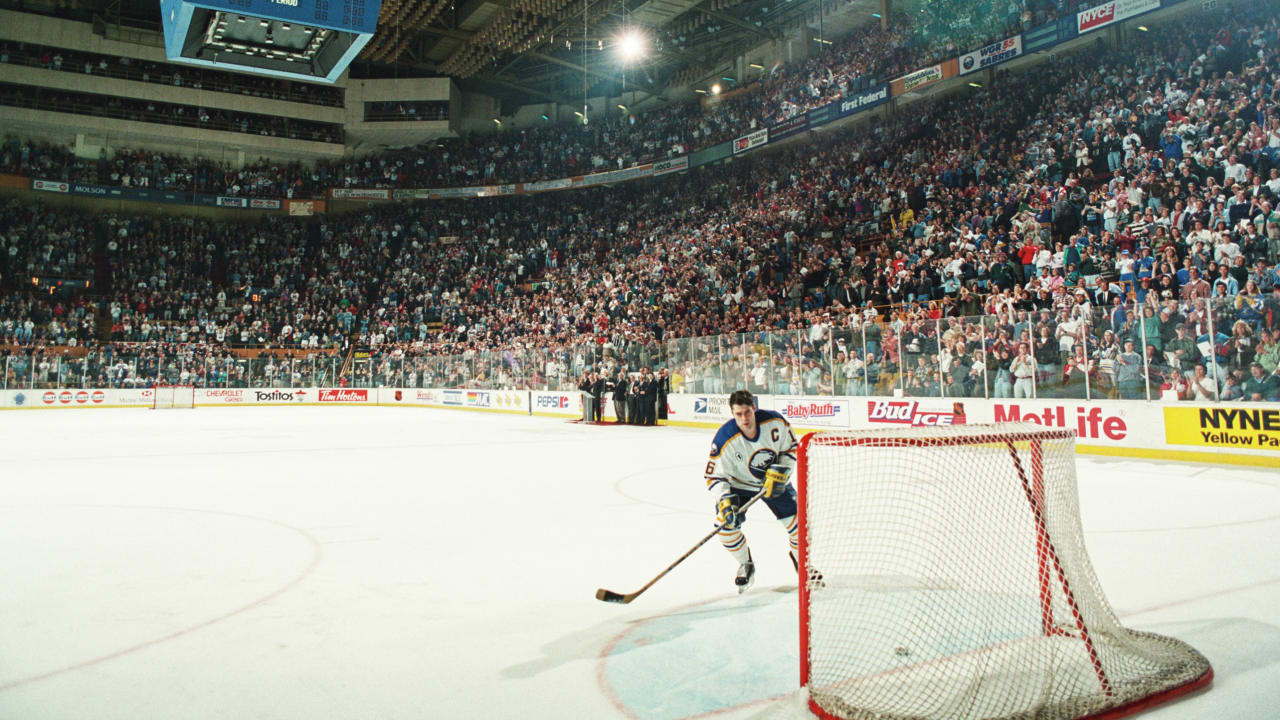
On the ice, the Sabres used the building’s oddities to their advantage. The ice surface was smaller than the traditional 200 x 185 dimensions, which not only suited a large defense corps featuring names like Jerry Korab and Jim Schoenfeld but also forced the Sabres to learn to play quickly, which translated well to larger rinks on the road.
Meehan:”I had played my entire development career on a regulation sized rink, which was 200×85. The Aud was, I think, 194 or 195 by 85 or 83, whatever it might’ve been. But that little difference made a fair amount of difference and put a real focus and an emphasis on being able to move the puck quickly and handle the puck in traffic and things like that.”
Gare: “We’d go on the road and you’d get a few more feet on each end. That’s why we used to beat Montreal, I always felt, or Toronto, because we were such a good skating team and that little extra feet would give you that extra room to get to the net or be open, whatever it was.”
The glass, meanwhile, swayed upon impact, allowing players to bounce off hits into the boards. Craig Ramsay suggested the glass at The Aud helped him set the franchise record for consecutive games played (776).
Ramsay (forward, 1971 – 1985) – “The glass moved a lot. I’d move into glass and it’d take the hit and fling me back out again. That’s how I survived some of the big hits. Saved me some injuries.”
Luce: “It probably swayed about two feet, a foot and a half, something like that. It was considerable. But it actually it probably was safer for us then, to help absorb the checks and stuff. It wasn’t a bad thing. The boards now are so stiff and hard, you really get hammered when you get hammered into the boards nowadays.”
The most infamous feature was a spot along the boards that could be kicked out from behind, a tactic taken advantage of by a member of the team’s equipment staff, Encil “Porky” Palmer. By most accounts, Palmer would kick that spot as the puck skipped by to send it toward the slot for a scoring chance.
Gare:”When the puck would go around the boards behind the net, he’d press on a dasher where the board came out. He’d put his foot on it and it’d come out about a quarter inch. The puck would hit it and it’d come out to the front of the net, and we scored a lot of goals like that. It was a set play.”
Robitaille: “Porky Palmer was a bit of a dancer, you know? Back there, he’d just give it a kick at the right time. You’d only have to move it maybe a half an inch, quarter inch, and that was enough to catch the puck. I mean, there were a lot of little tricks that were going on. This happened in the NHL for many, many years, all kinds of little tricks like that. Like, you know, turning off the ice machine to slow the ice down for a fast team. Montreal’s coming in, you don’t give them blazing fast ice. You slow it, down slow them down to our speed. They were always thinking. Imlach was pretty crafty like that. He had a lot of little tricks.”