

The parallels are quite striking. Except in one case there was a bag skate, and in the other case it was a difficult meeting. At the heart of both were the Washington Capitals.
After the Canadiens lost 8-4 to the Capitals at home, coach Martin St. Louis said he had a similar feeling to when the Canadiens lost 6-3 to the Capitals on the road on Halloween last year. Same time of year, same opposing team, same feeling.
Last year, St. Louis punished his players with a bag skate in Washington the day after the game. It was one of the turning points of that season, even if it took the Canadiens some time to get results out of that bag skate, losing their next four games to run their losing streak to seven.
After practice Friday, the day after this year’s loss to Washington, St. Louis spoke to the media quickly after leaving the ice, and it was a relatively short session. The team had a meeting, so the players would be available to the media only after that.
This scenario is not all that unusual. It happens sometimes. Except this time, it took a little more than a half hour before the players were made available.
The meeting, as it turns out, was blunt. There was video shown, there was honestly delivered, the Canadiens were shown things not all that pleasant to see.
“He’s being honest with us, he’s telling us what we need to hear right now,” Lane Hutson said of St. Louis, though he was answering a more general question about St. Louis’ approach and not the meeting itself.
Still, his reaction was telling in retrospect, since it was only revealed after the Canadiens’ 5-2 win against the Toronto Maple Leafs on Saturday night how direct the meeting was.
“He could scream and shout and he wasn’t doing that,” Hutson continued. “We know how passionate he is. We want to be better for our team, for ourselves, and for him because he pours a lot into this team.”
Two coaching methods used a year apart after similarly disappointing losses to the same team. Will that meeting Friday, with reporters standing outside the doors of the dressing room — so we can confirm there was no screaming and shouting — become this season’s version of the turning point bag skate?
We’ll see.
“It was something that you don’t want to see, but that you need to see,” Josh Anderson said Saturday night. “You kind of have to look at yourself in the mirror and ask yourself, can you get a little bit better? I thought a lot of guys contributed tonight.”
Another change Saturday was the Canadiens holding a full morning skate, complete with line rushes and everything. The Canadiens almost never hold a full morning skate, particularly on a day after a full practice. The change in routine was deemed necessary because the existing routine was not delivering results.
“We were together,” St. Louis explained that morning. “I think that’s what you need when you’re going through something like this, to be together.”
After beating Toronto, St. Louis again went to the same well in explaining the result.
“We did it together,” he said. “It was time for us to go get a win, and we did it together.”
How Lane Hutson processes opportunities
With the Canadiens trailing the Capitals 5-4 late in the third period, there was a puck battle going on along the side wall in the Washington zone. Cole Caufield was there. Zack Bolduc was there. And Capitals defenceman Jakob Chychrun was there.
Lane Hutson was observing the whole thing, hoping the puck would pop out to him. It did, and the result of the play was the Capitals getting a three-on-one break the other way and scoring the dagger goal that made it 6-4. It appeared a misguided pass by Hutson was at the source of that odd-man rush.
It appeared that way because that’s what happened.
“It’s a misread by me, I think,” Hutson said Friday.
Except it’s not that simple, and Hutson’s read was not bad at all. During that puck battle, Hutson saw that Chychrun had broken his stick. Advantage Canadiens.
“I see a guy break a stick, and I’m like, let’s go,” Hutson said. “Let’s try to tie this thing up.”
The puck pops out to Hutson and he quickly goes into attack mode, skating the puck to the other side of the ice and processing the situation, knowing Chychrun has no stick.
This is the moment Hutson first looks over to the weak side. What he sees is Bolduc heading to the back post and, most importantly, Chychrun chasing him, without his stick.

And this is the moment Hutson decides to attempt the pass. He has held on to the puck long enough for a passing lane to emerge, Bolduc is waiting for the pass (though he is not exposing the backhand of his stick for a tap-in) and Chychrun is helplessly chasing. If the pass gets through, at the very least Chychrun will have to take a penalty. But best-case scenario here is a tap-in for Bolduc.
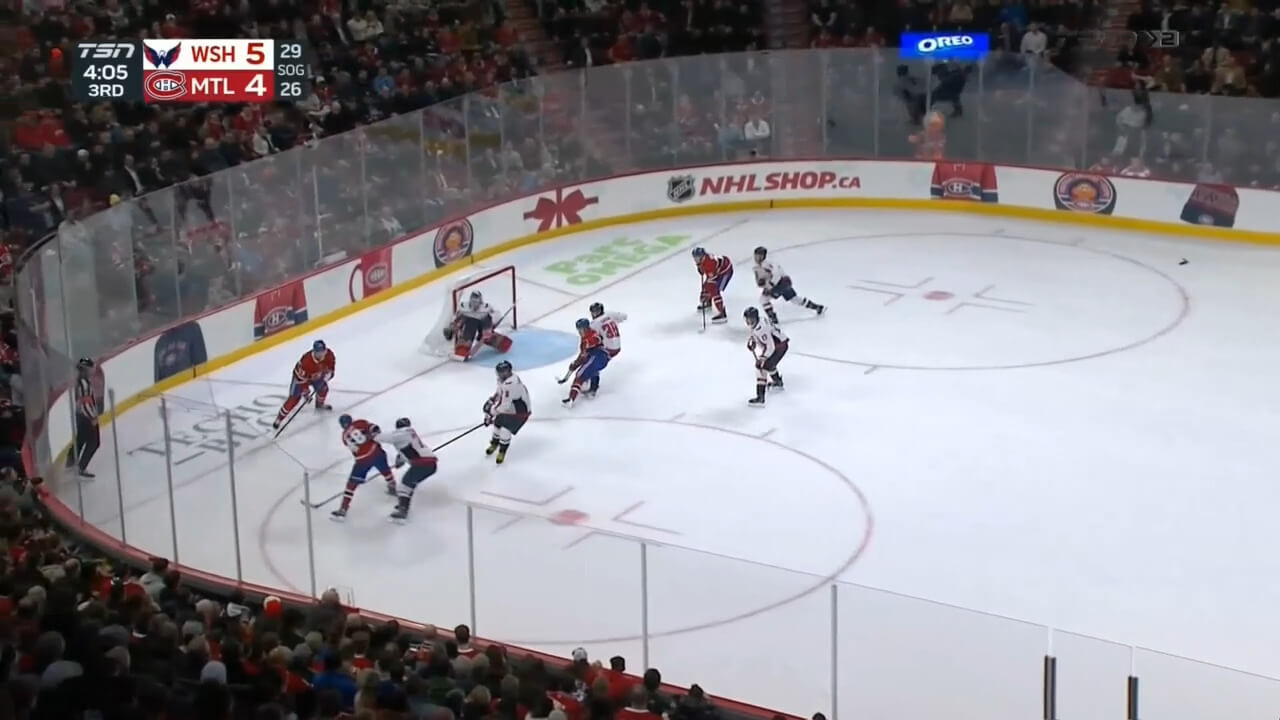
Except the pass did not get through.
“He was free, but it was just that (Dylan) Strome got his stick in my arm and I missed the pass,” Hutson said. “But the pass was there to be made. At least I think so. Then they got a chance the other way.”
It actually wasn’t Strome, and it wasn’t a stick that got in Hutson’s arm. It was Anthony Beauvillier tugging at Hutson and changing the trajectory of the pass. A few seconds later Alex Ovechkin scored the dagger.
9️⃣0️⃣6️⃣ pic.twitter.com/aghvjtoa2u
— Washington Capitals (@Capitals) November 21, 2025
Still, this play is an example of just how much information a player — and more specifically, Hutson — takes in before making a decision in a critical situation in the game. This was a game state that called for risk, but Hutson still made a calculated one.
It wasn’t simply a blind pass into space that didn’t work out. And it certainly wasn’t a misread. The result was terrible, but the intent was not.
The tip of the cap to Pascal Vincent
When St. Louis was asked after the game against the Maple Leafs about the impact Florian Xhekaj had in his NHL debut — a goal away from a Gordie Howe hat trick — his initial instinct was to shout out Pascal Vincent’s staff with the Laval Rocket.
“I tip my hat to the staff in Laval,” he said. “Because we’ve had a lot of call-ups recently, and the guys come, they look ready. They don’t look out of place. And I know there are other players knocking on the door down there. Our staff in Laval has done a great job in facilitating the transition.”
Xhekaj’s transition was smooth, but so was Jared Davidson’s three games earlier. Davidson provided some insight into what’s behind St. Louis’ tip of the cap to Vincent and his AHL staff.
“He demands a lot, but I think he’s earned the respect of every guy in that room,” Davidson said after practice Wednesday. “I think that’s why he demands so much, and I think everyone knows he demands so much just to make you better. He wants everyone to move on, whether that’s playing in the NHL here or somewhere else, he wants everyone to move on.”
Vincent has the ability to identify what a player’s identity will be in the NHL and focus on that, instead of focusing on how a player can help him in the AHL. Sometimes those two things align, but oftentimes it doesn’t.
“He doesn’t want you playing a different way down there than you would here,” Davidson said. “He also doesn’t want you playing a different way in the regular season than you would in the playoffs. I think that’s why we’ve had such a good team in Laval with him, is because everything is detail-oriented with him. He doesn’t want you making a selfish play to produce or maybe cheat the game.
“You might end up with 10 more points in the year, but you’re not going to be as ready to move on.”
One thing Vincent might need to work on, however, is getting players to go to sleep with their ringers on.
When Davidson was called up, he had gone to bed at the team hotel. Xhekaj was in the bed next to his. After five or six attempts to reach Davidson’s cell phone, Vincent had to use the hotel phone to call their room and wake them up.
“We heard the hotel phone ring, and we both got up,” Xhekaj said. “Like, who’s calling the room right now?”
When Xhekaj was called up, he was already down for his game day nap, thinking he would be facing the Belleville Senators on Friday night. His phone was set to ‘do not disturb,’ and so he didn’t hear it. Again, Vincent had to make multiple calls before Xhekaj finally answered, and since he was at home, there was no hotel phone option this time.
“I was in my bed, I was taking my nap,” he said. “It was like 1 p.m., so I was taking my nap for the game.”
A note to Laval Rocket players: when you go to bed, leave your phone on. Good things apparently happen when you’re sleeping.