

When the NCAA lifted its ban in Nov. 2024 on Canadian Hockey League (CHL) players in college, a seismic shift in major-junior hockey had occurred. The CHL would no longer be considered pro athletes, allowing players to join Division I programs beginning in the 2025–26 season. This change guaranteed that there would be player movement between the CHL and NCAA, causing a battle to recruit and retain talent. One eventual outcome that seemed to be set to occur would be a merger of the top junior leagues.
Related: 2025 Under 17 World Hockey Challenge – Gold Medal Game
Le Journal de Quebec reported there have been high-level meetings in New York featuring the NHL, USA Hockey, Hockey Canada, the CHL, and all three of its member leagues. Over the two-day summit, they discussed the future of player development in the NHL and the changing landscape after CHL players became eligible to play in the NCAA this season.
This discussion focused on talks about the United States Hockey League (USHL) becoming part of the CHL, with neither side willing to say that’s anywhere close to becoming reality. Yet if the NHL can broker a merger, it would transform hockey in North America.
The Rule Change
The NCAA rule changes have forced the hands of every junior hockey league in North America to adjust their approach to the sport, recruiting, business, and the players themselves. The new rule is creating a significant shift in hockey, as it opens the door for CHL players to pursue a college career, and not just after their junior careers are done. In some cases, it has caused them to cut their time in the CHL short.
Well-known and highly touted prospects such as Gavin McKenna, Porter Martone, and Keaton Verhoeff have all jumped to the NCAA with several seasons of CHL eligibility remaining.
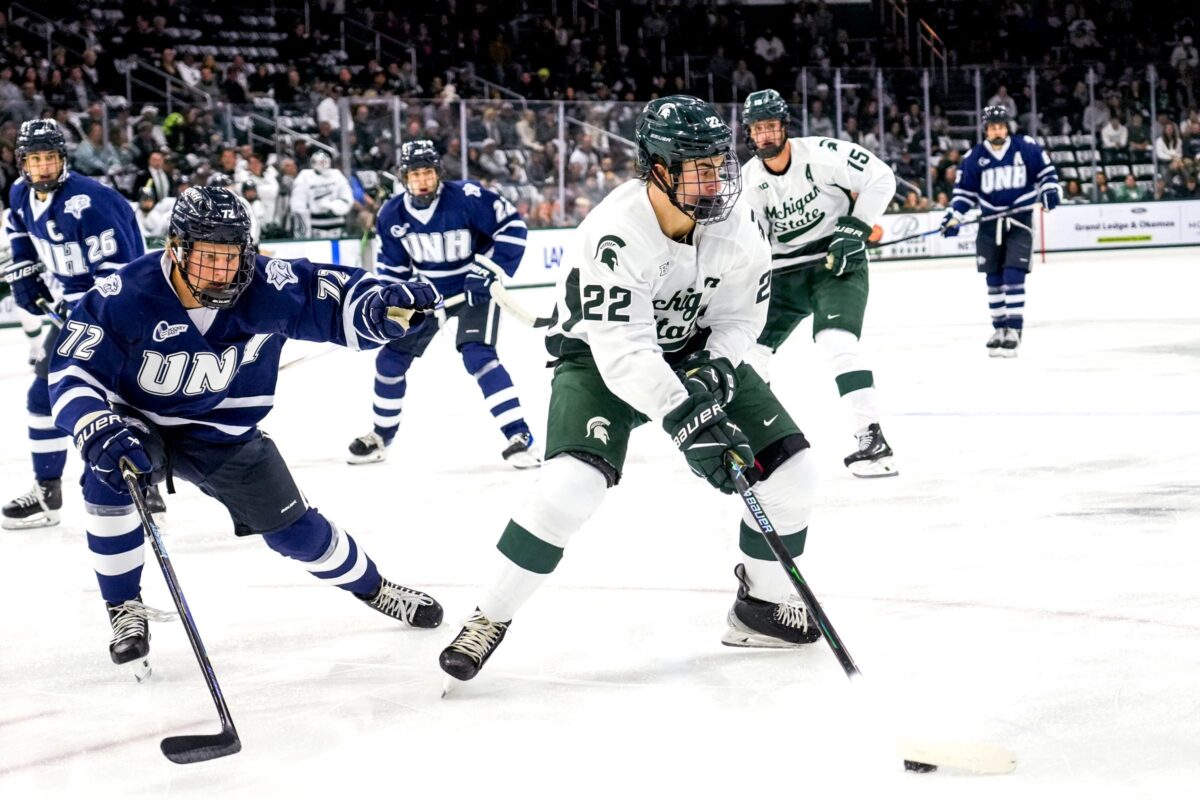 Porter Martone, Michigan State (Syndication: Lansing State Journal)
There are several reasons for the desire to make the change; one major reason is the money. The ability to earn NIL money is a huge factor for players, even with some restrictions on payments to Canadian players on VISAs. This option does mean that top prospects could be facing a decision between earning money immediately or remaining in the traditional pipeline to the NHL and hoping to earn their payday later.
Another reason is the perceived strength of the leagues and their impact on player development. The average age of a CHL player is around 18; in the NCAA, it’s closer to 22. This means that those making the leap to the NCAA will be playing against older players who are up to 23 or 24 years old. They are more mature mentally, physically, and have far more experience.
It’s a challenge for 17- and 18-year-olds from the CHL, facing players who can effectively play a professional style of game and get to do so in NHL-level facilities. All of which is seen as an advantage in the development of the younger, more elite prospects.
Add to this their more forgiving schedule with fewer games, far more practices, and time for training, and many younger players begin to see advantages for their physical development. Historically, the NCAA and the CHL have been adversarial, competing for the same players. That is still kind of how it is, but now (with the rule change) it’s a brand-new process that has many unknowns, so it helps to open the lines of communication.
The Merger
To be clear, it’s very much in the NHL’s best interest that junior hockey in both the US and Canada is strong. They wouldn’t want to see the USHL totally weakened. They also give the CHL a lot of money, and presumably, the CHL does not want to lose that money.
So a merger is in the NHL’s best interest, and because they’re the end goal for the players, and provide funding for the leagues feeding them their greatest asset, those leagues are motivated to find a solution as well, and a merger to streamline and create a standard set of rules.
This fundamental change to the sport’s business is still dynamic and has not yet settled into a reliable pattern. There is still work going on behind the scenes as the NCAA recruiters build their relationships with CHL front office staff, player agents, and others.
According to one of my sources in NCAA recruiting, they are “building relationships with as many executives and coaches as (they) can to avoid animosity as (they) dip into the deepest junior prospect pool. It’s more than just explaining to CHL players the eligibility implications of the sport and academics. It’s about selling the approach to the player’s best development path to the NHL in mind.”
A USHL-CHL merger would create a single, dominant development path for most North American teenage hockey prospects, though the effects on player development are complex and multifaceted. The NCAA rule change allowing CHL players college eligibility has already significantly altered the junior hockey landscape, adding further complexity to any potential merger.
The benefits are numerous, such as creating a best-on-best competition by consolidating talent, ensuring that the top North American prospects consistently play against each other. This concentrated competition could accelerate development for elite players. It could also standardize play. A single governing body would be able to enforce consistent standards in rules, coaching, facilities, and player developmental support.
The benefits may be largest for the smaller market teams in the two leagues. An issue that consistently arises is that larger market clubs can easily recruit players, as we have historically seen players drafted to these markets hold out by threatening to go to the other league. By merging, it would eliminate that option. It would unify player rights rules and modernize draft and waiver dispersal systems.
Also, this would benefit smaller markets that currently operate with tighter margins, smaller talent pools, and less brand exposure due to the expanded resources, increased visibility, and competitive balance.
However, there are significant hurdles for USHL clubs to meet, such as operating budgets (staff, travel, arena, marketing) and investments in player development and community programs that meet the rigorous minimum standards required by the CHL to maintain its brand. The USHL’s historic role as the “gateway to college hockey” is now moot.
Players can no longer threaten to go to the USHL to force CHL clubs to trade their rights. This means the CHL benefits as the top 16- and 17-year-old players do have fewer choices. However, once they are 18 and can attend university, players could move more fluidly between the major junior and college systems, giving them more control over their development path once again.
The Possible Negative Impact
The existing two-tiered system has historically provided multiple opportunities for players to find a fit, whether in the major junior or college-affiliated route. A merger could eliminate some of these paths that players like Nate Schmidt of the Utah Mammoth, a Stanley Cup champion with the Florida Panthers last season, and Neal Pionk of the Winnipeg Jets were able to benefit from.
The NCAA (and by extension the USHL) has historically been focused on developing late bloomers, whereas the CHL has been more of a “direct-to-pro” pipeline. Combining the leagues could dilute these unique development philosophies.
 Nate Schmidt, Florida Panthers (Sam Navarro-Imagn Images)
A USHL-CHL merger/partnership would pose a significant challenge to independent leagues like the British Columbia Hockey League (BCHL), which has historically served as a key pathway to the NCAA. There will be a talent drain as a significant number of elite prospects who previously would have chosen the BCHL route will no longer need to opt out of playing CHL.
This will lower their overall quality of play and mean that there will be reduced visibility for the players, as there will be far less of a focus by scouts or recruiters to go to see these players. The snowball effect is that fewer players being recruited means fewer players choosing to take the BCHL path. Their only hope of survival is to assume that role as the feeder league of late bloomers, and to do that, they will need to adapt and make rule changes, such as increasing the age of eligibility.
There will also be geographic complications. The CHL Entry Draft’s regional structure of the existing leagues would pose logistical challenges. For instance, the Western Hockey League (WHL) lays claim to a massive territory that overlaps with USHL teams in the Midwest and Pacific Northwest. A merger would require a massive realignment of geographic territory, but it could also force a difficult realignment of geographical boundaries, which could increase travel burdens for teams and players.
The NHL Draft Model Could Change
The NHL Draft has settled into benefiting from the two competing junior hockey models. A merger would bring significant changes to scouting, drafting strategy, and prospect rights. A merged league would need standardized rules regarding signing windows and player rights. Currently, player rights are held for two years for CHL prospects and four years for NCAA prospects.
NHL clubs will want to eliminate the possibility of losing a player, specifically the option NCAA-drafted players hold in waiting out the four years and signing anywhere as an unrestricted free agent (UFA). If an NHL team fails to sign a drafted NCAA player before their rights expire (typically four years after the draft or 30 days after they leave college), the team may receive a compensatory draft pick only if the player was a first-round selection.
Once the NHL can sort that issue out, scouting and talent evaluation can become simpler. Teams can now scout a unified talent pool and no longer need to make adjustments in their scouting for the level of competition.
A USHL-CHL merger would fundamentally reshape the landscape of North American junior hockey. While it could create a more concentrated and elite development path for top prospects, it would also bring significant challenges regarding player pathways, drafting strategy, and financial stability for junior league franchise owners.
The recent NCAA rule change has already added a new layer of complexity to the junior hockey environment, and any potential merger would have to navigate these new dynamics carefully to ensure the long-term health of junior hockey.
