

To say the Edmonton Oilers needed that victory on Saturday night over the Florida Panthers would be an understatement.
Not only did it snap a nasty winless streak, but their six-goal outburst gave hope that a suspiciously quiet Edmonton offence is primed for a rebound.
It goes without saying that the Oilers can ill afford any sort of offensive regression if they want to return to the Stanley Cup Final for a third consecutive year. Right or wrong, the organization decided to punt on making a meaningful goaltending change this summer, hoping a tandem of Stuart Skinner and Calvin Pickard could be just good enough to survive the regular season.
The Oilers’ goaltending duo has been far from impressive, perhaps not surprisingly – through 24 games, they are stopping just 86.5 per cent of shots in all situations, dead last in the NHL. That sort of stop rate puts immense pressure on the offence to outperform by significant margins to stay afloat in the Western Conference, but that’s not something foreign to this Oilers organization in recent years.
So far, this regular season has been different – and not in a good way. The offence has struggled. Kris Knoblauch’s team is fighting to stay out of the cellar in the Pacific Division, playing to an 85-point pace through a quarter of the season. And a regression in offensive production could not come at a worse time, considering the netminding.
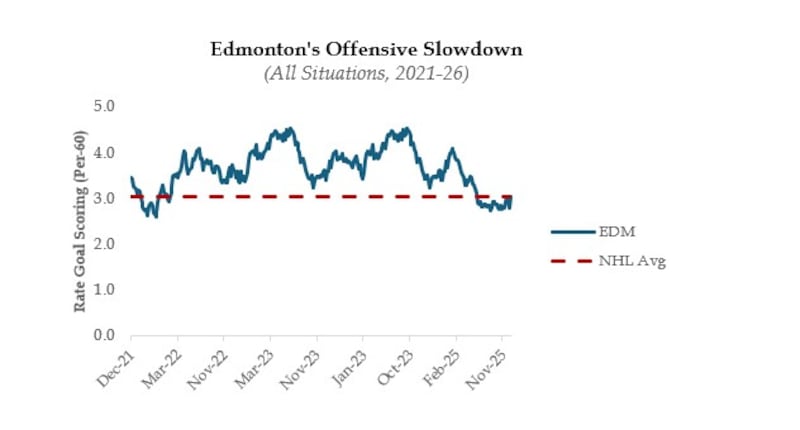
What exactly has happened to the offence, though? The Oilers look like a shell of themselves on the attack. In fact, if you look at Edmonton’s offensive production on a rolling basis, we are at multi-year lows in rate goal scoring and falling behind league averages:
 Yost1
Yost1
It’s been a concerning slowdown and doubly so when you start parsing the all-situations data. Edmonton’s power play has rebounded nicely after a cooler-than-usual 2024-25 season – they are averaging 11.0 goals per 60 minutes on the man advantage, which is still well inside of the top five across the NHL.
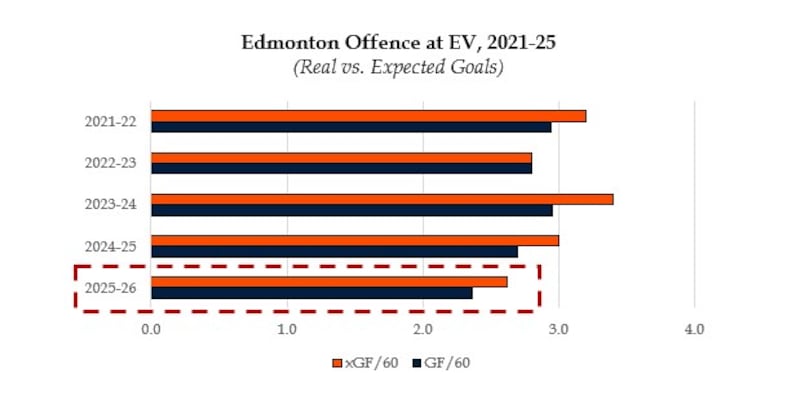
The degradation has entirely happened at even strength, where the Oilers have seen meaningful slippage in real goal-scoring rates and expected goal-scoring rates, both measures correlating sharply with a slowdown in shots (and corresponding scoring chances):
 Yost2
Yost2
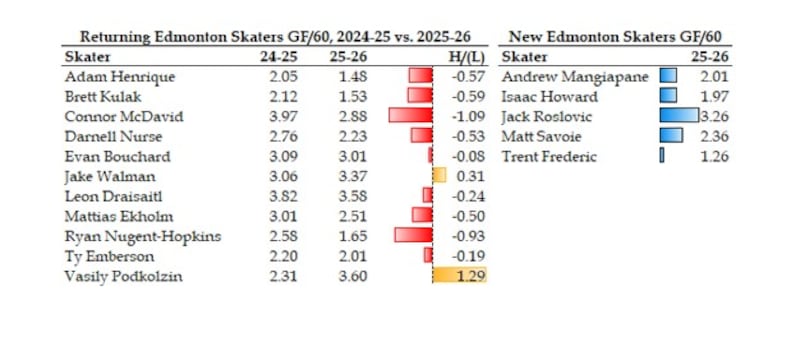
Whenever you see a slowdown like this and there isn’t an obvious explainer (i.e. injuries), it’s important to investigate at the skater level. And unfortunately for the Oilers, the scoring challenges at even strength appear relatively widespread.
Every returning skater, with the exception of forward Vasily Podkolzin and defenceman Jake Walman, is realizing lower scoring rates, and for the new additions to the lineup, only Jack Roslovic has been able to beat the team averages:
 Yost3
Yost3
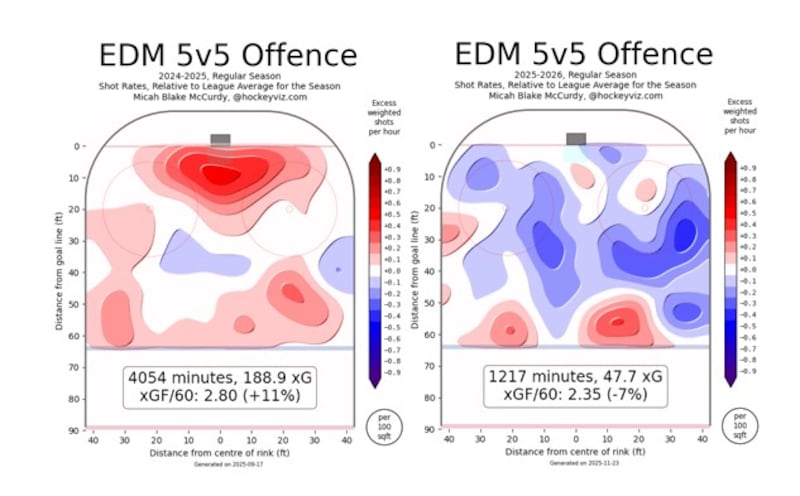
This sort of team-wide shift points to structural issues. If you don’t want to take my word for it, consider the shot profiles year-over-year courtesy HockeyViz. Last season (and just about every season prior in the Connor McDavid and Leon Draisaitl era), Edmonton was able to push into the most dangerous areas of the offensive zone, generating heaps of shots between the circles and in front of the net. Couple that with high-end shooters, and you’ll print goals.
This season, it has been a lot more offence from the point, where scoring rates decline considerably:
 Yost4
Yost4
That’s a scary chart and one that should be printed on the walls of Oilers offices until the offence finds its groove again. Betting on defensive prowess and goaltending outperformance for this team is not a viable path; getting the offence out of this slump and returning as the NHL’s most prolific attack is much more likely considering the talent on the roster.
Edmonton has been able to dig themselves out of scoring slumps before, and betting against their two-headed monster has been a foolish proposition in years past. But if the Oilers are serious about another Stanley Cup run, they need to find their scoring rhythm at even strength, and fast.
Data via Natural Stat Trick, NHL.com, Evolving Hockey, Hockey Reference