
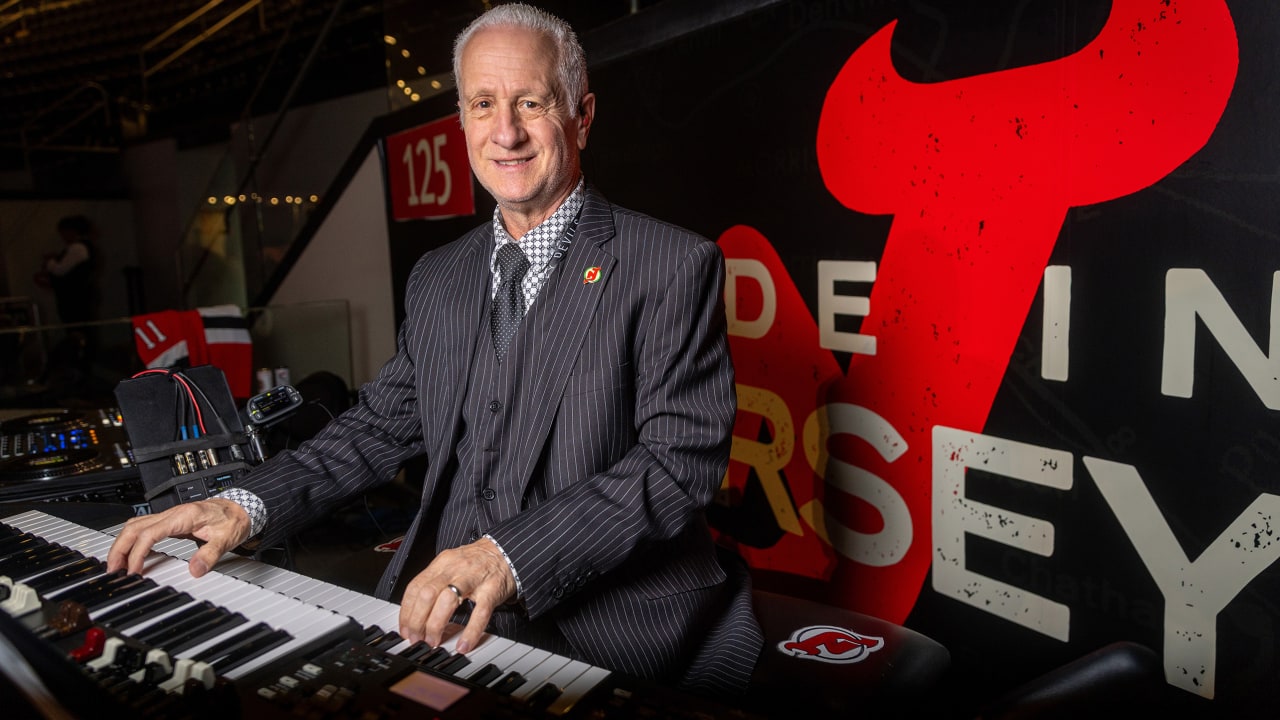
Legendary hockey reporter Stan Fischler writes a weekly scrapbook for NHL.com. Fischler, known as “The Hockey Maven,” shares his humor and insight with readers each Wednesday. This week turns musical, spotlighting revered organists who played at the old Madison Square Garden, Chicago Stadium, Maple Leaf Gardens and other NHL arenas in a previous century.
Music played at NHL arenas these days is a far cry from yester-century when every team employed an organist — and only an organist — for its patrons’ musical pleasure. Fortunately, there remain throwbacks today and one plays for the New Jersey Devils.
Pete Cannarozzi has hit the ivories for the Devils since 2001 and played his 1,000th NHL game when New Jersey defeated the San Jose Sharks 3-1 at Prudential Center on Oct. 24. He credits the gig with saving his professional music life.
“I had made my career and my living just playing music,” Cannarozzi told the Devils website, “until the music business tanked, around 2007. But I was able to stay in it thanks to the Devils and my home studio. I’m blessed that I can do this and still earn a living.”
Hockey music was a lot different during the Original Six era, when organists were as well known as the players. For decades, Gladys Goodding, Al Melgard and John Kiley were household names in New York, Chicago and Boston, respectively.
“We always felt that a (New York) Rangers game couldn’t go on without Gladys at the (old) Garden’s console,” popular jazz historian Ira Gitler, author of “Jazz Masters of the Forties” and “Swing to Bop,” once told me. “We considered her part of the Rangers family.”
The same was true of Kiley, who from 1941 to 1984 played for the Boston Bruins at Boston Garden. Melgard, a fixture at Chicago Stadium, presided over an instrument so large it had to be installed in the arena’s ceiling as part of the arena’s construction.
The “Madhouse on Madison” featured a 3,663-pipe organ, the largest of its kind ever built. Melgard began playing it in 1930 and remained employed until 1974. His work was acclaimed despite losing his left index finger in a childhood accident.
According to Richard Johnson at the Boston Sports Museum, Kiley always greeted the oncoming Bruins with composer Cole Porter’s hit “Paree, Paree,” despite the fact that it was from a 1929 Broadway musical, “50 Million Frenchmen.” Even though the franco-New England geographic link made little sense, “Paree, Paree” became a Beantown hockey standard.
When it came to picking a variety of musical themes, Goodding was the busiest. She not only played at Rangers and New York Americans games (pre-1942) but also at the Garden for Sunday afternoon hockey doubleheaders. They included a 1:30 p.m. Met League game followed by an Eastern Amateur Hockey League game at 3:30 p.m., featuring the Rangers’ farm team, the New York Rovers.
“Then,” Gitler said, “Gladys would return at night for the Rangers. In one day, she’d play tunes for six different teams and prided herself on selecting a meaningful song for each club.”
“‘The Rangers Victory Song,’ was the easiest,” Goodding once told me. “It was composed by J. Fred Coots when the Rangers won the Stanley Cup (in 1940) and he dedicated it to his good friend Lester Patrick, the Rangers (general) manager.
“Another obvious choice was ‘Chicago, Chicago’ for the Black Hawks and ‘Pretty Red Wing’ for (the Detroit Red Wings). Picking a French-Canadian song for Montreal was no problem either — ‘Alouette.'”
By contrast, Kiley preferred “Give My Regards to Broadway” for the Rangers, “My Merry Oldsmobile” for Detroit and “The Maple Leaf Forever” when the Toronto Maple Leafs were in town.
Some NHL organists were multitalented, others enjoyed unexpected hobbies. John Ralph Fraser, who had a 10-year run (1973 to ’83) at Maple Leaf Gardens, was a pianist, vibraphonist, composer and arranger. Eddie Layton, who played for the Rangers and the New York Islanders, was the subject of one of my SportsChannel TV features. Layton insisted that we do the interview on his tugboat berthed in the Hudson River. He also invited me to his Queens apartment for a viewing of his vast electric train collection.
Ray Castoldi, the Rangers organist since 1989, contributed to the “Jock Jams” and “Jock Rock” series of albums. He also wrote “Slapshot,” the song played after the Rangers score a goal, and doubles at Citi Field (and previously Shea Stadium) for the New York Mets. Another, Paul Cartier, can be heard at UBS Arena (Islanders) and Yankee Stadium (New York Yankees).
Irving Rudd, the Brooklyn Dodgers publicist in the early 1950s, wrote in our book, “The Sporting Life: The Duke and Jackie, Pee Wee, Razor Phil, Ali, Mushky, Jackson, and Me,” that the Dodgers were inspired to hire Goodding.
“A Ranger fan, who also was a regular at Ebbets Field, told Dodgers boss Larry MacPhail about Gladys and MacPhail hired her on the spot.”
After Goodding went to work at Ebbets Field, she prompted the oft-told riddle, “Who played for the Rangers, Knicks and Dodgers?” The answer: Gladys Goodding, who by now had become a well-publicized New Yorker. Writing in the Fall 2017 Baseball Research Journal, Rob Edelman described Goodding’s musical style as “cheerful and occasionally mischievous.” As for her mischievous side, Edelman was referring to her notorious musical choices following a Dodgers or Rangers loss at either Ebbets Field or the Garden. She’d open her lamentation with “Blues in the Night.” And for the closer, what could be better — or worse? — than “What Can I Say After I Say I’m Sorry?”