
McKeen’s Hockey: Dynasty Stock Watch
New Jersey Devils Edition
Team Outlook
The New Jersey Devils remain one of the most exciting young cores in the NHL. With Jack Hughes, Nico Hischier, Luke Hughes, and Simon Nemec at the center of their identity, the foundation for long-term contention is already in place. Their roster is built on speed, puck movement, and offensive creativity, and when healthy, they can outscore anyone. Injuries and thin depth have held them back at key moments, which only underscores how important continued internal development will be.
New Jersey is firmly in its contention window, and the organizational needs have shifted. The Devils no longer need bodies, they need impact. Young players must either bring high-end skill or fill defined roles with efficiency. As the roster becomes more competitive, prospects who can complement the core and contribute quickly will be the ones who rise. For dynasty managers, the takeaway is clear, prioritize players with realistic paths to meaningful NHL roles rather than those valued purely on pedigree, because opportunity still exists in New Jersey, but the margin for error is shrinking.
Mikhail Yegorov (G, 19)
Why Buy?
The Devils have been searching for long-term stability in net for years, and Mikhail Yegorov may finally be the prospect who changes that trajectory. His combination of size, poise, and technical control gives him a foundation that already looks near professional ready. He tracks pucks through layers, moves efficiently in his crease, and rarely gets rattled. 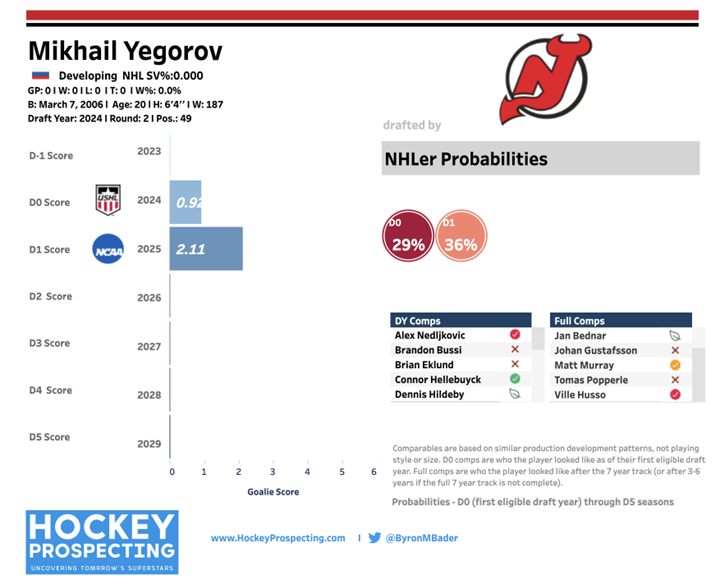
While his raw numbers at Boston University this season have dipped, he continues to outperform his expected goal metrics, which suggests this may be a buy-low opportunity for dynasty managers. The long-term path is wide open. The Devils have cycled through short-term options for years, and none have secured the crease during the team’s contention window. If Yegorov continues on his current trajectory, he has future starter upside and could be the goalie who finally stabilizes the position in the post-Brodeur era. This is a profile worth acquiring now before the price rises.
Simon Nemec (D, 21)
Why Buy?
Nemec has already shown why he was selected second overall. His composure, mobility, and high-end puck-moving ability make him an ideal fit for New Jersey’s aggressive, pace-driven style. Offensively, he reads the ice well, jumps into the rush with confidence, and has added more deception to his playmaking this season. While Dougie Hamilton and Luke Hughes currently share time quarterbacking the top power play, Nemec looks fully capable of producing on a second unit and could earn top-unit looks if the Devils ever want to give him that role. 
His early NHL stint was uneven, and his first 90 games revealed some struggles keeping up with the pace and making quick decisions. This season, however, he looks like a different player. The confidence is unmistakable, and he is leaning into his elite skating far more consistently. His Evolving Hockey player card highlights how dramatically his offensive impacts have improved, even though he still needs support defensively. If that part of his game trends upward at a similar pace, the Devils may finally get the player they envisioned when they drafted him second overall in 2022. For dynasty managers, right-shot defensemen with this combination of skill, opportunity, and long-term upside are rare, and Nemec remains a premium asset with room to grow.
Arseni Gritsyuk (LW/RW, 24)
Why Buy?
Gritsyuk quietly developed into one of the more NHL-ready wingers to arrive from the KHL pipeline, and now that he has transitioned to North America, his game still shows the same blend of pace, skill, and competitiveness that made him stand out overseas. His surface numbers have not fully popped yet, but the underlying metrics tell a different story. His combined on-ice shooting percentage and save percentage (PDO) sits at a very low 948, a number that almost always regresses toward 1,000, suggesting better results are coming. Per HockeyViz, the Devils generate more offense with Gritsyuk in the lineup, reinforcing that the process is strong even if the finishing has lagged. 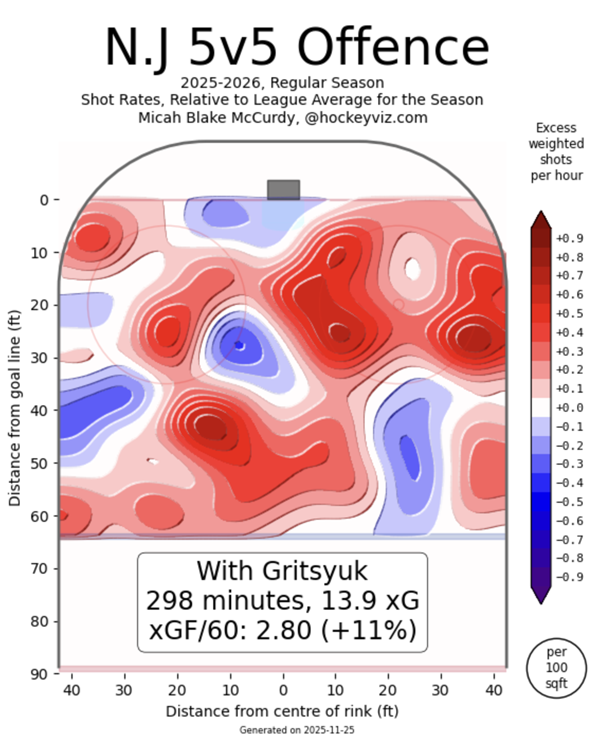
His usage has also been encouraging. Gritsyuk is getting shifts with Timo Meier and Nico Hischier, and he plays a heavy, north-south style that produces more than a hit per game in just under 15 minutes of ice time. His power play opportunities have been limited, but even a small increase in deployment could unlock meaningful scoring. For dynasty managers, he remains an ideal buy-low candidate, because the underlying play driving, the supportive metrics, and the quality of his linemates all point to a player whose production should climb as the season settles.
Seamus Casey (D, 21)
Why Sell?
Casey remains one of the most skilled offensive defensemen in the Devils’ system, with elite mobility, high end puck skills, and the creativity to quarterback play from the blue line. His NCAA production was excellent and showcased everything that made him a coveted prospect. The issue is not talent but fit. With Luke Hughes and Simon Nemec solidly ahead of him on the depth chart as New Jersey’s long term power play drivers, Casey’s path to meaningful minutes is extremely narrow. Unless he drastically adapts his game or the depth chart shifts, he is likely battling for a third pair role without the deployment that fuels fantasy upside. 
The early returns at the NHL level reflect these concerns. Casey has struggled to carve out a stable spot, and his defensive impacts remain well below average, which makes it difficult for coaches to trust him in anything beyond sheltered usage. The offensive instincts are still there, and his Hockey Prospecting star potential suggests that the upside is likely still there, but the reality is that fantasy value depends on opportunity. His name value and pedigree will still attract interest in many leagues, making this the ideal moment to sell. Move him while another manager still believes in the top four outcome, before the organizational logjam and defensive limitations cap his long-term ceiling.
Anton Silayev (D, 19)
Why Sell?
Silayev’s draft year hype exploded thanks to his rare blend of size, reach, and smooth mobility. At 6-foot-7, he covers ice effortlessly and has the kind of physical profile teams dream of in a shutdown defenseman. His skating stride is fluid, he closes quickly in space, and he already looks like someone who can neutralize top competition at the NHL level. The problem for fantasy managers is that, despite all of these tools, Silayev does not naturally drive offense. He is not someone who creates scoring chances, directs play through transition, or activates meaningfully in the offensive zone. His impact is far more functional than dynamic. 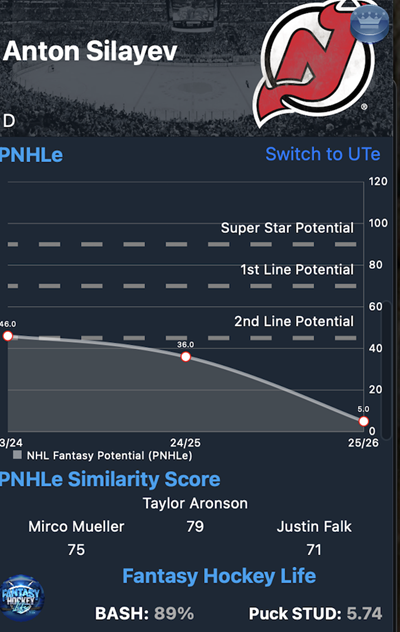
While the real-life value is obvious, the fantasy translation is a different story. Silayev does post strong blocks, shots, and hits, giving him solid BASH peripherals, but those contributions are easy to find on the waiver wire. What differentiates fantasy assets is scoring, and so far, that has not been part of Silayev’s game. Across one hundred fifty-six KHL games, he has only twenty-four points. His pNHLe has cratered to five, which reflects the extremely limited offensive projection. He will almost certainly be an important piece for the Devils and play heavy minutes, but if he is not producing points, his fantasy ceiling remains low. Given the name recognition, draft pedigree, and how excited the Devils are about his role, now is the ideal moment to sell high and acquire a more impactful long-term asset.
Lenni Hämeenaho (RW, 21)
Hämeenaho is a smart and reliable winger whose mature two-way game made him an appealing draft prospect. He reads play well, supports possession, and owns a solid, NHL-level shot. Coaches trust his positioning and decision making, and he still projects as someone who can settle into a middle six role once he fully adjusts to the North American game. The challenge for fantasy managers is that his tools do not necessarily point toward strong offensive upside. He does not drive play with standout speed or high-end creativity, and his profile leans more toward steady than dynamic. 
His transition to the AHL has underscored those concerns. After posting 51 points in 58 games for Ässät in Liiga last season, he has just four points in 14 games with Utica. His Fantasy Hockey Life card paints the same picture: his Fenwick looks decent, but his Corsi is low, his net expected goals impact is underwater, and he is not consistently winning puck battles or recovering loose pucks. His BASH can provide a modest peripheral floor, but if the scoring does not translate, his fantasy ceiling remains limited. Hämeenaho still carries name value and the perception of untapped upside, which makes this an ideal sell window. Move him now, before he settles into the type of depth role that delivers real world value but falls short in fantasy.
Player
Role
Key Insight
Mikhail Yegorov
Buy
Rising goalie prospect with a clear path to future NHL starts
Simon Nemec
Buy
Elite right-shot defenseman with top-four floor and PP upside
Arseni Gritsyuk
Buy
Skilled KHL winger ready to seize a top-six NHL opportunity
Seamus Casey
Sell
Offensive defenseman blocked by Hughes and Nemec
Anton Silayev
Sell
Defensive toolsy blueliner with limited fantasy ceiling
Lenni Hämeenaho
Sell
Safe middle-six projection, low fantasy upside