
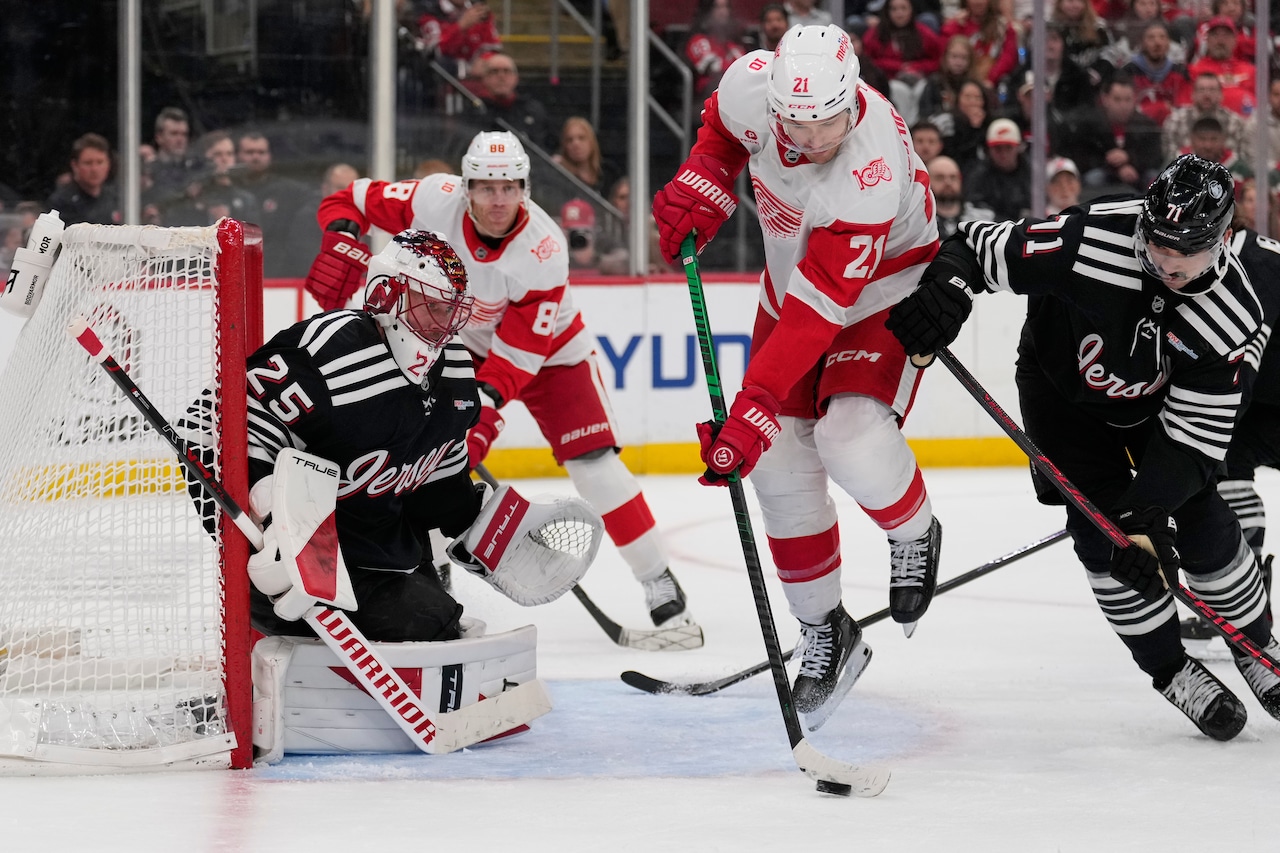
DETROIT – Three players have accounted for 31 of the Detroit Red Wings’ 67 goals. That’s 46 percent of their offense.
They could assemble three full lines of forwards who are struggling to score.
Secondary scoring has been virtually non-existent, and that must change for this team to get anywhere.
“I think I used the words it’s a must or it’s essential,” McLellan said. “It’s virtually impossible to run three or four players all year from an offensive perspective and expect to … In order to get to the promised land, you need run support.”
Dylan Larkin (13 goals), Alex DeBrincat (11 goals) and Lucas Raymond (seven goals) have generated most of their offense.
After that, it’s been bleak:
— Andrew Copp: no goals in the past 21 games.
— Mason Appleton: no goals in 19 games.
— Marco Kasper: no points in 12 games and three goals in 22 games.
— James van Riemsdyk: one goal in 17 games.
— Michael Rasmussen: one goal in 15 games.
— J.T. Compher: no points in eight games and one goal in 14 games.
— Jonatan Berggren no goals in nine games.
— Emmitt Finnie: one goal in 14 games.
— Elmer Soderblom: one goal in 11 games.
— Patrick Kane: one goal in nine games.
As McLellan said last week: “There’s going to be some guys that are pretty excited about their individual numbers and then there’s others that hopefully can’t do math. We’ve been able to win games sometimes without them scoring, but we can’t sustain that.”
McLellan has kept Larkin and Raymond together all season, mostly with Finnie, but juggled the rest of the lines. The Red Wings host Nashville tonight (7 p.m., FanDuel Sports Network Extra) and Kasper could be back at center between DeBrincat and Kane, depending on J.T. Compher’s status (flu, game-time decision).
“We got to find ways to get more pucks to the net, possess the puck a little bit more in the offensive zone,” Copp said. “The rush game can kind of come and go sometimes, but we have to be able to create chances from below their goal line and run the net a little bit more.”
The Red Wings need to generate more offense from their forecheck, blue-collar type goals, instead of relying mostly on the rush.
“We spent some time (a couple of weeks ago) working around the net with deflection screens, feeder shots, rebounds,” McLellan said. “That’s where those goals tend to come from. Forecheck can get a little bit better, spend a little more time in the offensive zone so those things can evolve. We can’t be one-and-done. If you reflect back to momentum shifts, where we get it going and we keep plays alive, you can feel it coming. You get ahead of the other team, and we haven’t had that necessarily from the bottom six lately. They have had some chances, but then the rest of their energy is spent going the other way. So, sustaining it and keeping it alive is important.”
Not a clean hit
Raymond spoke Wednesday of the blindside hit Monday from New Jersey’s Jonas Siegenthaler that led to tension and scraps between the teams after the final horn. Siegenthaler was no penalized and did not receive any discipline from the NHL.
“I was disappointed that nothing came out of it during the game,” Raymond said. “I think after the game, it doesn’t really matter. It’s not going to impact us for the game. It is what it is. Obviously, I don’t think it’s a clean hit, but it’s whatever.”
He added: “I was looking the other way and obviously didn’t see him. So, it’s tough to be prepared, but that’s what it is. It’s fast out there. A lot goes on.”