
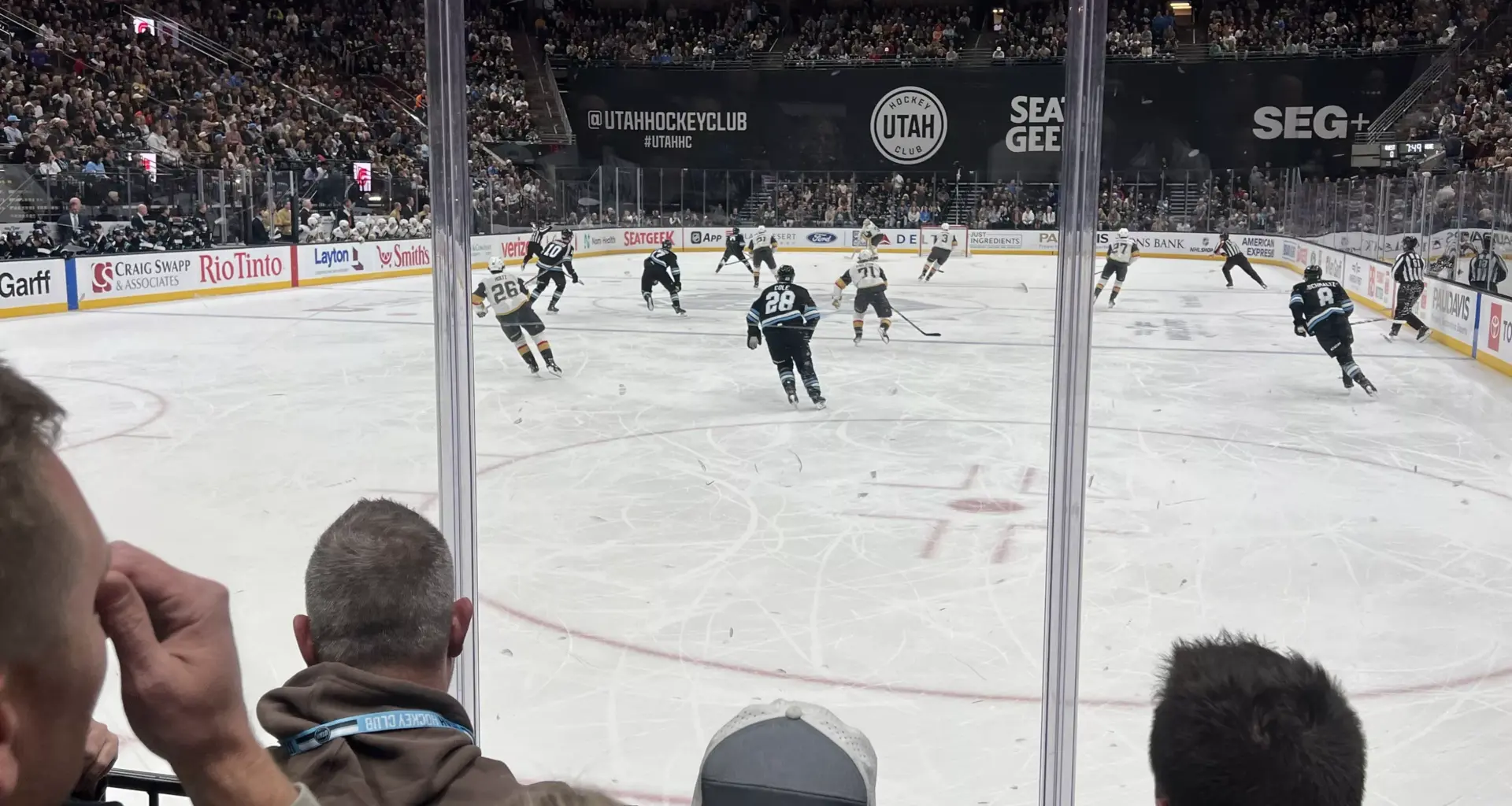
As the Utah Hockey Club closed out a 6-1 drubbing of the Penguins on the road in Pittsburgh last November, a few restless—and likely disgruntled—fans turned their attentions toward razzing the lone UHC fan seated in their section.
To her estimation, Hailee Eckman—a West Jordan native who was working as an athletic trainer in western Pennsylvania at the time—was one of about 100 total UHC fans in attendance at PPG Paints Arena.
“I remember them asking, ‘So, what are you guys going to call the team next year?’” Eckman recalled. “It was all in good fun. I told them I wanted to keep calling [the team] ‘The Clubbers.’”
While the ribbing from the Penguins fans was lighthearted, Eckman did come away from the game with a deepened curiosity for the direction that UHC management would choose for the team’s permanent branding.
And in the end, after 13 months, four rounds of fan surveys and more than 800,000 votes cast online, “Mammoth” was selected as the permanent nickname over the other finalists: “Outlaws” and “Utah Hockey Club.”
When the initial announcement that the Arizona Coyotes NHL franchise had been purchased by Ryan Smith and would be moving to Salt Lake City was made public in April 2024, Eckman was ecstatic about the opportunity to “get in early” on the fandom, she said. She said she closely followed the results of the surveys from the other side of the country.
“It was really cool to get to be a part of that process even though I was living so far away,” Eckman said.
And while Eckman was slightly preferable to the proposed nickname “Yeti,” she was pleased with the name “Mammoth” when the branding was unveiled. She appreciated the hidden motifs within the “Mountain Mammoth” logo—including the shape of the state of Utah in the top left snowcap—and felt that the team’s choice to highlight Utah’s rich paleontology in its branding was a nice way to connect with what makes the state special.
As the team prepares for its second year, and its first season as the Mammoth, local fans are processing and preparing for a new identity in the Delta Center.
All Their Own
As a young hockey fan in Salt Lake City, Tyler Kesten—now a compliance analyst at Goldman Sachs and a part time ice hockey official—chose to embrace the Colorado Avalanche in the absence of a local NHL team. He was skating before he can even remember, he said, and started playing when he was 5-years-old.
Kesten is much more than a fan: He played defense for Utah Valley University’s club hockey team and still plays in adult roller hockey and ice hockey leagues today. He even earned a spot on the Utah Hockey Club’s ice crew, which shovels ice shavings off the rink during stoppages in play.
Rumors of National Hockey League expansion swirled while Kesten was growing up. But they were typically focused on larger metro areas further east, like Atlanta, Houston and the like.
“To hear that there was going to be a team in Salt Lake, and to have it as early as [the 2024-25 season], that was crazy,” Kesten said.
He remembered how the main topic of conversation at his weekend league games centered on what name the team would choose. There were some passionate back-and-forths on the topic.
“I was biased toward Outlaws, so personally I was a little disappointed,” Kesten said. “But at the end of the day, just to have an identity and then hear about how some of the intricacies of the logo came together, it’s growing on me, for sure.”
One evening during the Utah Hockey Club’s first season, Kesten and a few other ice crew members were killing time in the bowels of the Delta Center before their next skate. They ran into a team official (whose name Kesten can’t remember) and asked him about why the team replaced one of the finalist options, Wasatch, with Outlaws before the final round of voting.
The official emphasized how important it was to listen to fans at every stage of the process and said the data showed that fans weren’t responding positively to Wasatch. The team needed to show it was listening, the official told Kesten.
“As a bystander, you look at something like this where a large company says they’re listening to the people, but do you really believe it?” Kesten said. “But after talking to [the team official], it was very evident they did care about the community. They want this team to have Utah’s identity, so they want Utah’s input.”
E Pluribus Unum
Team officials pointed out a potential double entendre in the nickname during its unveiling, noting the dictionary offers two meanings for the word “mammoth”—one refers to the animal and the other is “of very great size.”
Choosing a singular concept as the team nickname–rather than a plural nickname, like the Outlaws or Florida Panthers—keeps the Mammoth in line with the somewhat unusual naming convention of the other two first-division sports teams in the market: the Utah Jazz and Real Salt Lake.
The general consensus online appears positive in regard to the choice to leave the “s” off. But Kesten said he was a bit skeptical at first, wondering how it would sound in practice.
However, Kesten noted that there are a few other NHL teams with nonplural nicknames: Minnesota Wild, Colorado Avalanche, Seattle Kraken and Tampa Bay Lightning. He noticed that these concept-based names blur the line between the fans and the team itself.
“When [team officials] talk about the team, they don’t talk about the Utah fans. They talk about the team as a whole,” Kesten said. “They want the community to feel like this isn’t a team they cheer for, but it’s a team that they can see as their own. Having it be this one Mammoth that you can get behind is really cool.”
Overall, the reaction online has been mostly positive to the new name and the team’s logo. Some fans expressed concern with the simple color scheme of black, light blue and white, preferring a splash of purple to align with the Jazz’s new (and hopefully permanent, for real this time) colors. Others noted that “Mammoth” is perhaps the only nonpluralized animal nickname across American sports, even though evidence shows that actual mammoths traveled in packs.
People seem to be especially high on the team’s alternate logo, a U with a tusk curling in front of it, and on the team’s slogan: “Tusks Up.”
For Eckman, she’s glad that the book has closed on the entire process and she can rep the Mammoth without any half-measures.
Eckman has close family ties in Pennsylvania and grew up as a die-hard Philadelphia Eagles fan. She has family members who root for the Penguins and the Philadelphia Flyers, but hockey just didn’t speak to her the same way.
That all changed in April 2024. Eckman moved back to Salt Lake in June, and she’s excited to root for her favorite hockey team, this time with a real name.
“I’ll definitely miss calling them The Clubbers,” Eckman said with a laugh. “But it does feel good to have something permanent.”
To Kesten, just having a team in the market has been a reason for celebration. In 2022, Kesten bought tickets to the Stanley Cup Final to watch his beloved Colorado Avalanche take on the Tampa Bay Lightning.
Kesten felt like he was experiencing the peak of watching hockey that day, but when he showed up for Utah Hockey Club’s inaugural match against the Chicago Blackhawks last year, it was even better.
“To be at ice level and look up and hear the crowd was unmatched,” Kesten said. “To have it be your own team in your own backyard means so much more than I thought it would.”
The Utah Mammoth will play their first preseason game as Mammoth on Sept. 22 against the Anaheim Ducks. The first home match of the NHL regular season will be on Oct. 15 against the Calgary Flames.