
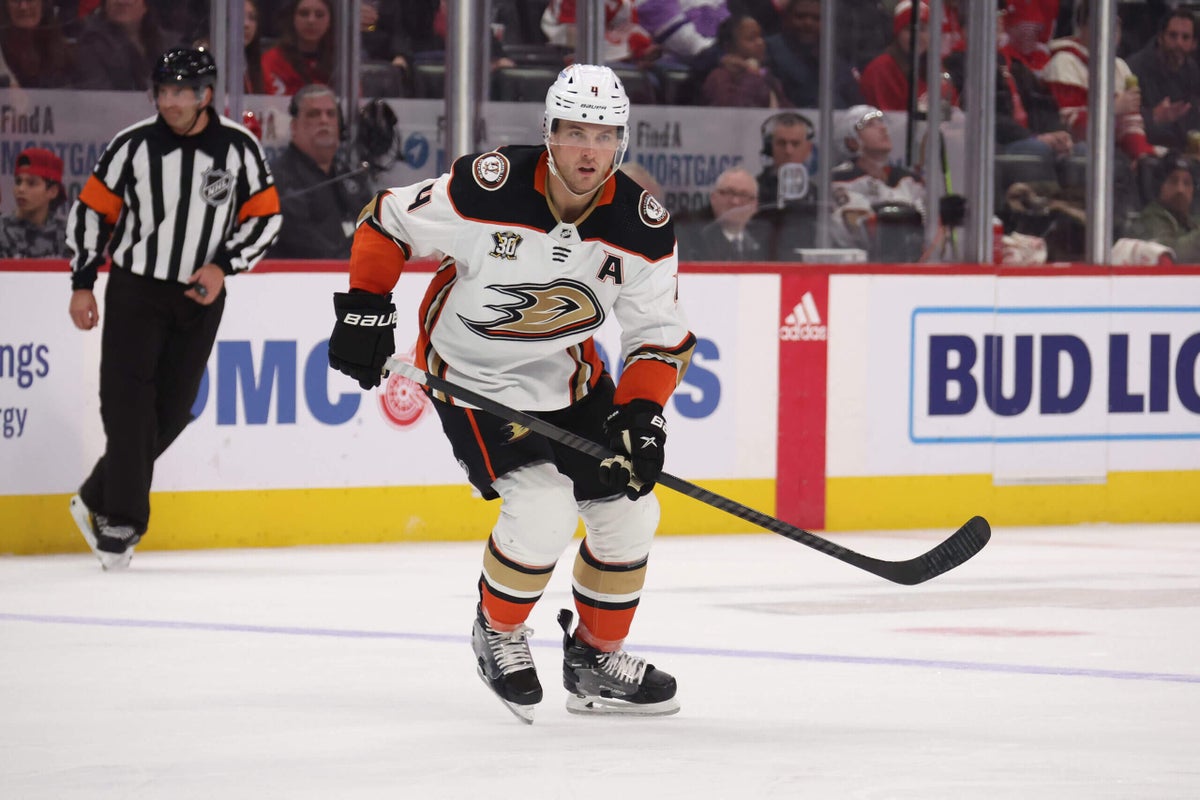
ANAHEIM, Calif. — When he entered the NHL as an 18-year-old straight out of junior hockey, a mere four months after being a first-round draft pick, Cam Fowler joined an Anaheim Ducks club in transition from the Scott Niedermayer-led championship era. And as he matured and became a focal point of their defense, Fowler spent many of his early seasons on a team that was among the best in the NHL.
A Memorial Cup winner with the Windsor Spitfires before he fell into the Ducks’ lap as the No. 12 overall pick in 2010, Fowler was part of a playoff team in his rookie season and soon became a fixture on six straight playoff participants — five of which were division-title teams. He made two runs to the Western Conference final and played on a 2013-14 team that set Ducks records for wins and points.
Winning games with the Ducks was as commonplace as Teemu Selanne scoring goals. Even more so. That’s all Fowler knew throughout his early 20s.
“It’s definitely a proud franchise that, for a long time, was making a steady run in the playoffs and always competitive in the Pacific,” Fowler told The Athletic. “And always a team that you knew other people were saying, ‘They have a great team over there. They have a good chance to win.’ Just the nature of how a team kind of ebbs and flows — the last few years, we’ve obviously been in a rebuilding process. It’s about taking those steps forward to try and get back to that place.”
Nothing lasts forever, and that’s especially so in an NHL that still operates under a hard salary cap. Fowler still plays a lot of minutes – his average of 24 minutes, 25 seconds, ranked 16th among all players this season – and the Ducks still lean on him more than anyone else. But since their last playoff appearance in the 2017-18 season, the Ducks’ .421 points percentage is the worst among all 32 teams. Their 162 wins are the fewest.
It’s been a rough cycle for all within the organization. That includes the franchise’s longest-serving defenseman and most tenured current player. “It’s been very difficult, yeah,” said Fowler, who debuted in 2010-11.
Now at 32, Fowler could be heading into another transitional phase. This one feels much more personal. There’s a good chance that he’ll play a 15th season with the Ducks. But not since the days when his name regularly popped up in trade rumors is there some sense uncertainty about where he stands with them and the role he’ll have.
Looking at Fowler’s future starts with his contract. An eight-year extension that he signed in 2017, a year before his previous deal expired, now feels like a lifetime ago. Annual trade rumors ceased, but now that deal has just two years remaining, and it contains a trade clause limited to four approved teams that he submits annually. It isn’t a no-movement, but it gives Fowler a lot of control over the direction he wants his career to go.
With a $6.5 million salary-cap hit, Fowler’s was the highest on the Ducks until Troy Terry signed his seven-year, $49-million extension. But the Ducks have had no problem carrying around that cap number – they’ve got what Cap Friendly estimates to be $33 million available for 2024-25. Fowler has remained an important player for them. However, the Ducks have sat out the postseason six straight years. It’s the longest stretch by far in franchise history, and he isn’t getting any younger.
“At the end of the day, I want to be competing for a chance to play in the playoffs,” he said. “Play longer. I’d love for that to be here, honestly. But I think that’s just a conversation we have to have with the people in charge and understand where they see the future, where I fit in that plan and then go from there.”
That touches on the changes possibly in store for him. The Ducks have a flowing pipeline of defensemen, not unlike when Fowler broke in and was followed by Hampus Lindholm, Sami Vatanen, Josh Manson, Shea Theodore and Brandon Montour. Pavel Mintyukov was a standout rookie, Jackson LaCombe spent his first season in Anaheim and Olen Zellweger is poised to stay for good next year. Tristan Luneau is their next big-time prospect, making it comfortable for them to trade Jamie Drysdale.
And it doesn’t stop there, with the Ducks possessing more 23-and-younger blueliners that could reach the NHL. The depth affects Fowler most on the left side, where Mintyukov and Zellweger have legitimate top-four upside and could eat away at the ice time the veteran normally gets.
They’re the future. That’s not lost on him.
“I’m OK with anything if the team’s winning and we’re competing,” Fowler said. “I’m OK with all of that. I understand that I’m on the second half of my career and these guys are just getting going. And, you’re right, those are the people that are going to push this team to where they want to be. I still think I have a lot left in the tank where I can contribute to that.
“I don’t think too much about that. A lot of that’s dictated by your play on the ice. If you earn the ice time, then you earn it. Those guys have done a great job, too, and they are the future. But I still think there’s a lot left that I have to give as well.”
The other thing with Fowler is, he’s often to utilized to help other defensemen cut their teeth in the NHL. The list of partners that Fowler played with over his 14 seasons is endless. And in these rebuilding seasons, he has held the mentorship role. Most of his five-on-five time in 2023-24 was spent with LaCombe and then Zellweger. Luneau was his right-shot partner during the 20-year-old first handful of NHL games.
That’s the irony here. Fowler is essentially guiding the very people who will eventually replace him.
“I just try and help them out mentally as best as I can,” he said. “I’ve (played) with Zelly quite a bit. Talk about things he’s seeing on the ice. Things away from the rink, if there’s anything I can help with. Just try to keep him in a proper mental state, because I know how hard it could be as a young player.
“Really just chat with him. Talk with him. Not always about hockey but help him out as best as I can. Just try and be there for them as a mentor and somebody they can look up to. For the most part, I try and do things by example, but I’ll talk to them about whatever they need. Check in on them and see how they’re doing.”
Where does Fowler stand with the Ducks? He’s got two years left on his deal with a healthy cap hit, but the Ducks can easily ride it out. There will be greater expectations to win in 2024-25 and he could be part of that, even if his role as an all-situations defenseman starts to diminish in some areas. And that may be best for Anaheim, given that he struggled while shouldering all the important minutes.
But Fowler is also at the point where he could entertain a trade to a team that’s closer to contending. Perhaps one like his hometown Detroit Red Wings, that just missed the playoffs and can use a top-four defender to take some load off franchise blueliner Moritz Seider. The no-trade clause helps with a potential destination, but the Ducks’ all-time scoring leader among defensemen said he hasn’t “given that a second thought, honestly.”
“It is part of my contract, but who knows if that’ll even be a conversation down the road. Honestly, we’ll just have to see,” he added.
When he was drafted, Fowler drew comparisons to Niedermayer because of his effortless skating, and those only continued when he lived with Niedermayer and his family during his rookie season, after the former Ducks captain retired. That was a perch impossible for him to reach, but he said he never struggled with that, knowing the Hall of Famer was one of the best to ever play the game. “I never really thought it was fair for people to even put that out there to begin with and, honestly, it doesn’t give the respect to Scotty that he deserves,” he said.
What Fowler has taken from Niedermayer is the concept of paying it forward, of sharing the knowledge he has gained as he comes up on the 1,000-game milestone next season (Fowler has played 974 games). He has wanted to be a good teammate throughout his run in Anaheim. It’s what he learned from people such as Niedermayer, Selanne, Ryan Getzlaf and Corey Perry before him.
“It’s kind of just the circumstance, right?” Fowler said. “I’ve been lucky to be here for as long as I’ve been here. Over those years, there’s been a lot of turnover. I find myself as one of the last ones standing from the ones that I’ve been used to playing with, and that’s just the nature of the business.
“I had people that took care of people when I first got into the league. I know the challenges that come with that. If I can offer any insights or any help to these younger players, that’s what I’m here to do. It’s just been part of the process, but it’s something I’ve enjoyed doing.”
(Photo of Cam Fowler: Gregory Shamus / Getty Images)