
Is the bottom falling out?
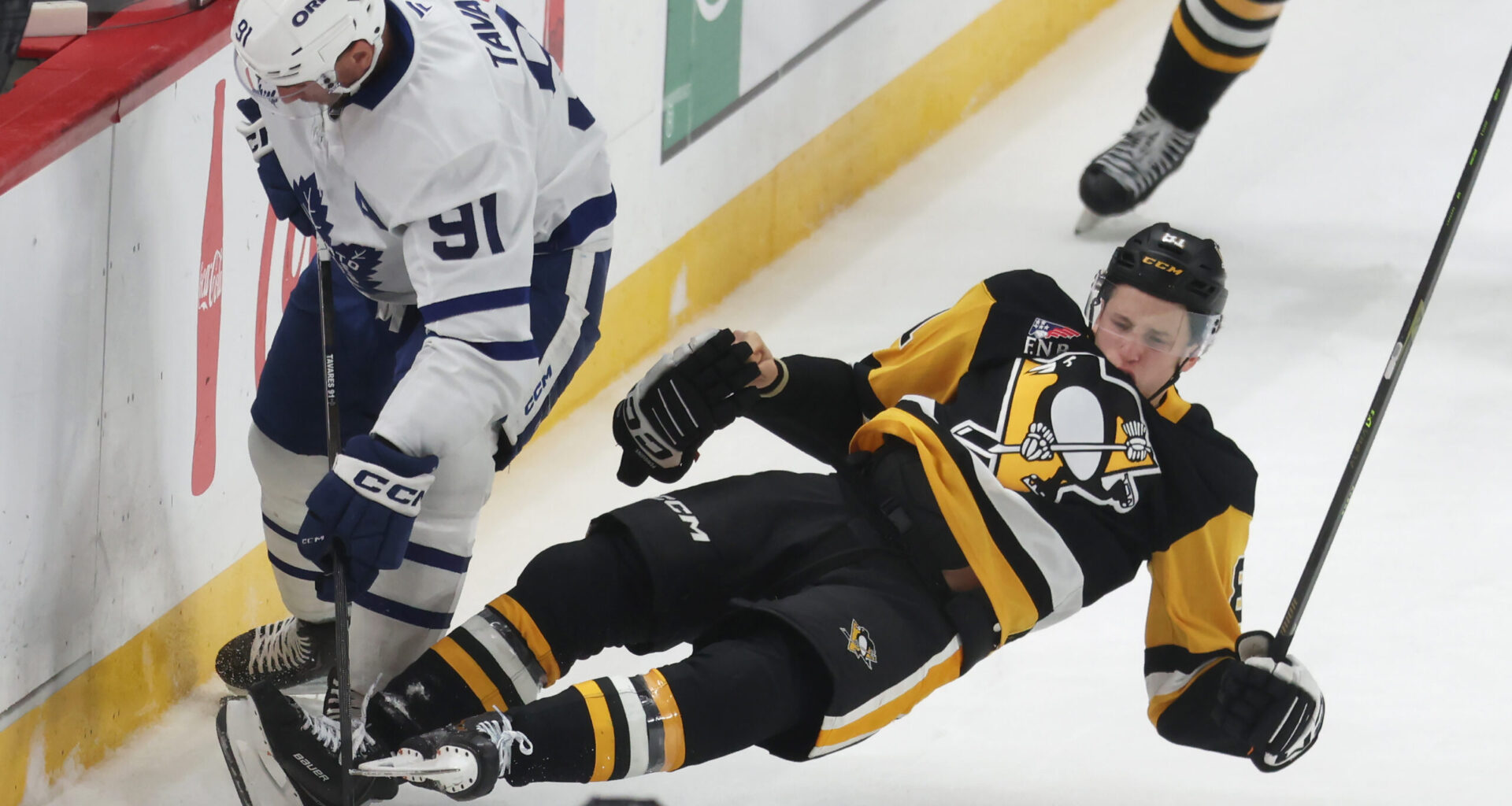
It was another ugly loss. This time, the team was unable to work through the perimeter game with little offensive production against one of the worst defensive teams in the NHL. The Pittsburgh Penguins again suffered shoddy goaltending and poor defensive zone coverage in a brutal 7-2 loss to the Toronto Maple Leafs Saturday.
The residual feelings after the game were not good, and they are lingering. The team can put on a brave face and admit they made too many mistakes, but the cold reality is that the negative trends have been compounding for a few weeks.
And Saturday, it all came to a head. It had the feeling like the Penguins were exposed.
After the game was out of reach in the third period, the Penguins found life, but too little, far too late.
The distressing tone Saturday was too great to ignore. It was not just a bad loss. It was a culmination of issues, great and small. These games have become too common in recent weeks. Despite clawing for enough wins to hang onto a playoff spot, the game has been gaining on the Penguins, who are no longer able to outrun their station.
Sure, the Penguins have a few injuries, but so, too, does everyone else. The Penguins’ Friday victim, the Columbus Blue Jackets, have been playing without their blood-and-guts center, Boone Jenner, and top winger Kirill Marchenko.
Toronto played for a good spell without Auston Matthews. Surely, the Penguins can weather a storm without Rickard Rakell?
The Penguins are struggling to generate offensive despite some solid play up the middle because their weak spots are entirely too weak. The LWs in the lineup in the last two games could be, or have been, waiver wire fodder: Kevin Hayes, Tommy Novak, Danton Heinen, and Joona Koppanen.
To be fair, that’s two salary dumps and two players who began this season in Wilkes-Barre/Scranton.
If there is a reason the Penguins have struggled to stack shifts, it is asking too many players to play above their station, or simply having them in the lineup in the first place.
A couple or few Penguins wingers should get a plate of pressbox nachos. It’s time for general manager Kyle Dubas to recall winger Rutger McGroarty, who had four goals in his first four AHL games beginning last week.
The intention to make him earn his way back to the NHL was a noble one, but the team badly needs another competent offensive presence in the top nine. And a jolt of energy.
Saturday, it should have gone better. The Penguins were not flat or without energy at the start, but Toronto has a way of humbling or embarrassing the Penguins, especially when the eyes of the Canadian nation are watching.
“I think the quality of the chances we gave up was just too good. We had the puck for a good chunk of (the game),” Sidney Crosby said. “When we did have breakdowns, they were big ones, and quality chances. So, we’ve just got to tighten up.”
On Hockey Night in Canada, the Penguins did little to build on their comeback win Friday, instead kicking at their own game the way a toddler would boot a Lego tower and leave the pieces strewn about.
Toronto controlled the Penguins when it mattered. Penguins goalie Arturs Silovs has been pulled early in the second period during consecutive starts, the last being Nov. 21 against Minnesota.
Silovs’s freefall is distressing, but it is hardly the only thing that should concern coach Dan Muse and Dubas.
The team’s brutal November, which included just four wins, is a good starting point, but only a start. They will conclude the month at 4-5-3. The good hockey in losses has been replaced by bad hockey in a few wins.
Pay no attention to the stats Saturday, which showed the Penguins with more scoring chances and, well, more shots than Toronto.
“I thought we had the puck a lot. With the chances, I think we have to create more quality on some of those. There were opportunities there,” Muse said. “Some of our execution–we were making plays into the right area. I didn’t think our execution was there on a number of them. And then the chances we are giving up, they’re just too loud. They’re too big.”
Neither is ideal, but the lack of urgency and necessity in their game, beginning with the Sweden trip, forecasts a very bleak 58 games remaining.
But why? The issues are becoming too obvious to brush past as a blip or momentary dip. They are real, and they begin with the roster.
Where Are the Points?
It’s not the “old” guys letting down the Penguins. Sidney Crosby and Evgeni Malkin have been the Penguins’ best forwards. The problems lie with the remaining cast characters skating upon the same stage.
The cast was surprising and resplendent in Act 1, but Act 2 has been an unmitigated mess.
The Penguins’ defensive breakdowns on Saturday were jarring. They were Friday against Columbus, too. Just as they were against the Minnesota Wild and Seattle Kraken a week ago.
Four wins in 12 games speak loudly. Almost as loudly as the chances given up.
“You look at a game like that, it’s both sides of it. I think the chances are ended up probably being in our favor, but at the end of the day, it’s about the score, and I think our execution can be better,” Muse said. “I think we can still create more quality. I thought there were times there we had the puck in the offensive zone for good stretches, but then when you look back on it, like, what are we creating? We need to create more.”
Exactly. What are they creating?
Where’s the Beef?
If not Crosby or Malkin, where is the offense? The Penguins ‘ top-ranked power play is highly unlikely to convert at 31% all season. The 5v5 offense has been increasingly confined to Crosby’s line.
Anthony Mantha has one assist and no goals in seven games. Kevin Hayes has two points (1-1-2) in nine games since returning from injury. When he’s played well, the Malkin and Crosby lines have benefited, but there he has lacked consistency.
That Hayes has been thrust into such a role of propping up the Penguins’ top six speaks loudly.
Is Justin Brazeau’s injury that unsettling to the roster?
The Penguins’ third line has struggled, too. As Muse noted, the team has not lacked offensive zone time, but the quality of chances resulting from possession is indeed lacking.
Rookies Ben Kindel and Ville Koivunen have not posted numbers as the third line. Kindel hasn’t scored an even-strength point since Nov. 3 against Toronto (he has three power-play points, one goal, and two assists in the last nine games), and Ville Koivunen has merely two assists in 13 games played.
Tommy Novak on the second and third lines has struggled mightly to be impactful.
That’s just the scoresheet.
The play of most of the team has been substandard, too. Sure, the Corsi and Fenwick look good. The expected goals are above water. But the eye tests have been varied from lifeless to energetically disjointed.
The comeback wins have been outnumbered by the blown leads.
The goaltending, mostly Silovs, has suffered and gotten worse.
And as Crosby noted, when the defensive zone coverage breaks down, it breaks down in catastrophic ways.
The sound in the distance might very well be the clock tower striking midnight. The Penguins are becoming a bad team like the carriage turning into a pumpkin. But neither hope nor effort should be lost.
McGroarty should be packing his things, hopefully never to return to Wilkes-Barre. A few players need to be reminded how perilously their NHL careers hung back in September.
From Silovs rapid fall, to the collapse of lines generating real pressure, and the general softness with which the team has played the majority of periods over the past three weeks can’t be excused.
The Penguins’ game has not been good enough, and it cannot continue unless the results are acceptable.
Who or what the Penguins are to be is being decided. Generally, if they want things to change, changes will have to be made.
Tags: Penguins Analysis Penguins Postgame Pittsburgh Penguins toronto maple leafs
Categorized: Penguins Analysis