
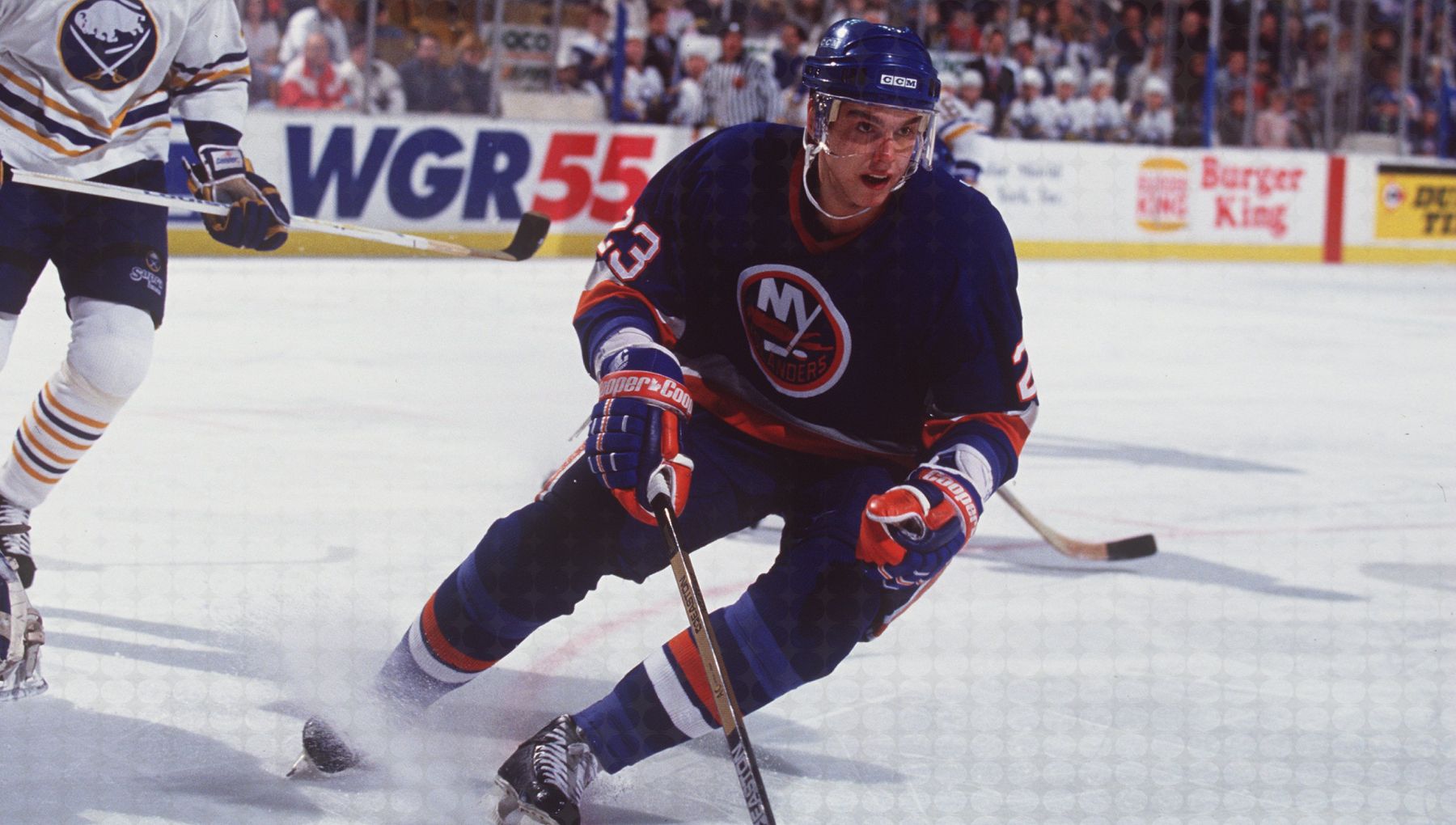

Vladimir Malakhov (Photo courtesy of Brian Bahr/Getty Images)
Vladimir Malakhov is one of the most decorated Russian hockey players. He is a member of the elite Triple Gold Club, joining those who have won the World Championship (1990), the Olympic Games (1992), and the Stanley Cup (2000 with New Jersey). The defenseman played 712 NHL games before retiring in 2006, then spent 11 years away from hockey. In 2017, Malakhov returned to the New York Islanders as a development coach. Over the past two years, he has worked as a free agent scout, focusing on talent evaluation in Russian leagues.
Malakhov was the person who encouraged the Islanders to sign two Russian free agents – Maxim Shabanov in 2025 and Maxim Tsyplakov in 2024.
“To be honest, I didn’t expect him to explode right away,” Malakhov said about Shabanov in an exclusive interview with RG. “I told management last year: give him a chance. You can’t give a guy two or three games and say, ‘He doesn’t fit.’ Adaptation is a serious process, especially when you move with your wife. Suddenly you’re juggling everything – hockey, family, daily life. New country, new mentality, everything different. Your wife may also be facing her own challenges, and you have to play and support your family. Early on, it’s always difficult.”
The 25-year-old winger has played 12 games this season and recorded 6 points (3+3). He suffered an injury in late October and missed several weeks.
“Max is doing well. Credit to him – he’s trying, he’s talking more, settling in. I never expected him to ‘break out’ immediately. He needs time. Management likes him a lot, so I don’t see any problems. Patience is the key,” Malakhov added about the former KHL star.
Malakhov said he watched Shabanov closely for two seasons with Traktor Chelyabinsk. “When they asked me who might translate their game to the NHL, he was one of the names I mentioned.”
A year earlier, Malakhov recommended another Russian free agent, Maxim Tsyplakov. His debut NHL season had its ups and downs. The second year opened on a tougher note: he was scratched for several games by the coach’s decision.
“In his first season, Maxim (Tsyplakov) played fine. I know he was frustrated about the low goal total, but I told him right away: ‘Don’t expect to score as much as you did in Russia.’ I think he played well enough. He understood what the coaches wanted. Sure, he still has habits – like cross-ice passes. I told him to get rid of them immediately. NHL coaches don’t like that. It’s in his system, so it takes time to change. But he’s trying. This season he sat for a few games because he wasn’t fully executing the assignment.”
Malakhov doesn’t want to compare Tsyplakov and Shabanov because he believes they’re very different players.
“Tsyplakov is strong and powerful. Shabanov is smaller, more skilled, but he’s tough too – he doesn’t shy away from battles, he goes first into the corner. Any team values a player like that. I explained what he can do and what he can’t – and the final decision is theirs.”
Schaefer and the Islanders’ Draft Strategy
As a former high-end two-way defenseman, Malakhov shared his opinion about the Islanders’ rising star and first overall pick in 2025, Matthew Schaefer. The 18-year-old defender has already set multiple records, including becoming the youngest defenseman with a two-goal game and the youngest overtime winner.
“The kid is impressive. I watched him a bit, we talked – he came to dinner after the draft. Very open, very grounded. He has a tough story – he lost his mother. He also missed an entire season. And again, we go back to defense.”
Malakhov repeatedly stressed that defensive play is a major issue for young players – especially Russian players.
“That’s probably one of the biggest problems. Guys stop playing when they lose the puck. In the NHL, work ethic means both with the puck and without the puck.”
The Islanders had a unique situation at the latest draft: they won the lottery with only a 3.5% chance and also held two more first-round picks.
“When we got the first pick, I called Trent (Trent Klatt, our head of scouting) and said, ‘We got lucky.’ He said, ‘Finally.’ It almost never happens. Taking three prospects in the first round is fantastic. We drafted them today – in about four years they should help lift the team.”
The Islanders also hoped to draft Zharovsky. “But it didn’t work out – Montreal took him. We’re very happy with Prokhorov. He should have gone in the first round but slipped to the second – thankfully. I was sitting there waiting, and they asked: ‘Do we take him?’ I said, ‘Take him, please.’ We wanted Zharovsky too, but Montreal grabbed him earlier.”
Lamoriello, Darche, and a New Direction for the Islanders
Malakhov joined the Islanders when Lou Lamoriello was still president of hockey operations and general manager. They already knew each other from New Jersey, where Malakhov played parts of two seasons. In spring 2025, the Islanders announced they would not renew Lamoriello’s contract. He was replaced by Mathieu Darche, who had spent the previous six years with Tampa Bay.
“We met during the draft. I don’t talk to him during the season – that’s not my role. And he doesn’t need to talk to me directly, because we have two head scouts. I give them information, and they pass it on. There was no personal communication with Lou either. Everyone does their job,” Malakhov said.
He noted the club feels more open under the new GM. “Darche communicates more with the media, the social media accounts are more active. Management wanted changes: Lou is old-school, secretive, and they wanted someone more open. They hired a younger guy. First year, and the draft went well.”
Malakhov added that he liked the new online draft format – far more convenient for club staff than sitting in the same arena as competitors.
“Maybe the broadcast looks less impressive for viewers, but for us it’s perfect. When you sit in one hall, you hear everyone whispering. Online, you can get up and step out whenever you want, and the camera won’t catch you. Everything moves faster. The first round is always long, but the second goes ‘bam-bam-bam,’ all on the screen. Very comfortable. I think they’re keeping the same format this year. Ideal for work. And no travel is needed.”
Coaching, Montreal Pressure, and Following Russian Players
Malakhov says he enjoys scouting – watching young players develop and analyzing their progress. He did consider coaching but eventually turned it down.
“I was offered a coaching job in Bridgeport (the Islanders’ AHL affiliate). I thought about it, but then realized I wasn’t ready to work 24/7. I also received offers from Russia. I even called the Islanders’ management and said: ‘They’re calling me.’ They asked: ‘Where?’ – ‘In Russia.’ And they said: ‘We didn’t know you wanted that.’ I said: ‘I’m not sure myself.’ And they told me: ‘We can offer you something here as well.’ I was driving and even pulled over – I felt like I had wings.
But then I thought it through. Coaching is very hard. It’s not like a playing career – you show up, play, and leave. It’s constant work, details, and preparation. I’m not ready.”
Malakhov tries to follow the performance of all Russian NHL players, including Montreal’s rising star Ivan Demidov. Montreal is not a foreign place to him – he spent nearly six seasons there. He recalled how he almost ended his career in that city and believes Demidov will face a challenging market.
“In Montreal I started fighting with the media – and you must stay on good terms with them. I simply started refusing interviews. They were writing negative stuff, I was trying to fix things in my game, and I buried myself. I once told my wife: ‘I should retire.’ She said: ‘Are you stupid? Stop reading those idiots.’ I stopped – and everything improved. I slowly began talking to reporters again.
I arrived there without knowing the language. In my second year I was traded to Montreal, and suddenly there was French everywhere. My English wasn’t great yet, and now there was French media too. I pushed myself into a corner… Luckily, they later traded me to the Devils – and everything changed. I thought: ‘Wait, I can play.’ But that stretch was very tough.”