
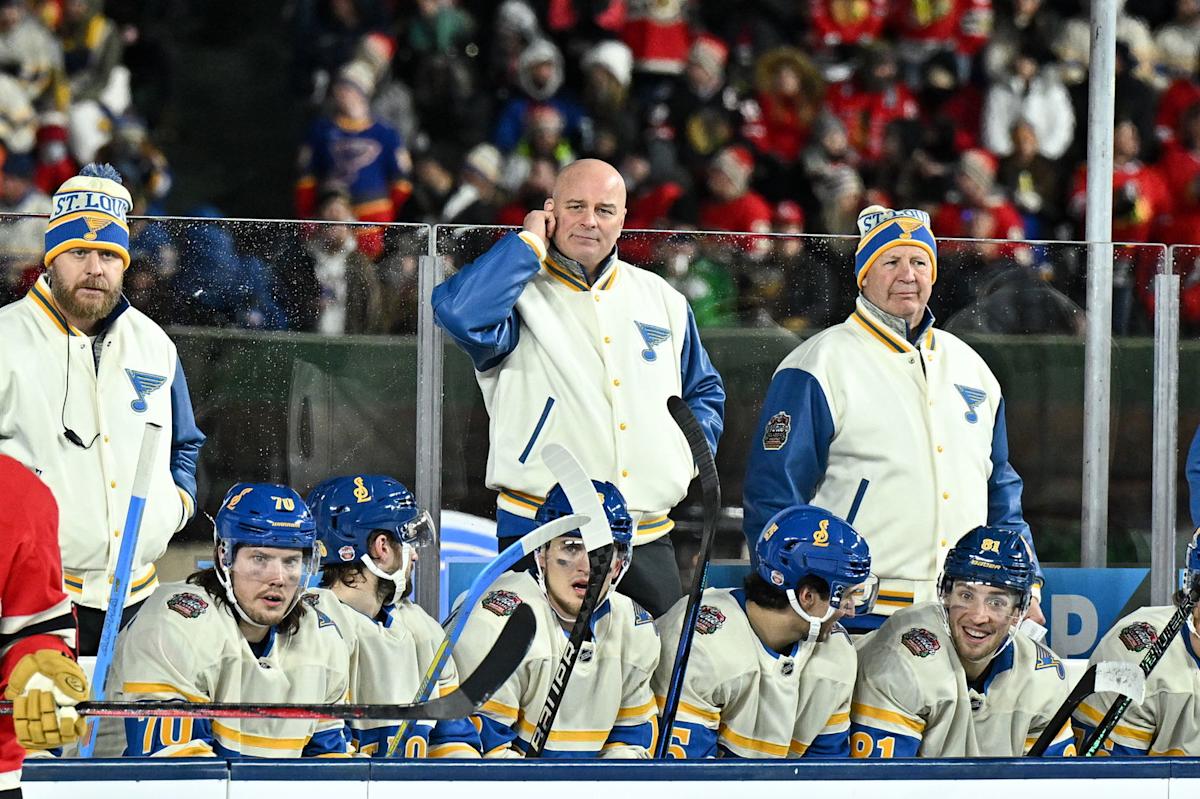
St. Louis Blues coach Jim Montgomery (top, middle), sees a bright future for the franchise moving forward after a painful series loss against the Winnipeg Jets in the Western Conference First Round. (Daniel Bartel-Imagn Images)
ST. LOUIS — As a coach, when things don’t go accordingly, you always wonder what might have been, what you could have done differently.
Players have their feelings on the agony. A coach feels the same but for different reasons. It’s because they ultimately make decisions in the end that can directly lead to victory or defeat.
For St. Louis Blues coach Jim Montgomery, there’s already been reflection, and just like the players, there will be motivation.
Montgomery, who was hired to coach the Blues after Drew Bannister was fired and made his debut Nov. 25, helped the Blues turn their season into a playoff appearance for the first time since, well, he left as an assistant coach three years ago.
Two days after their season ended in a Game 7 double-overtime loss against the Winnipeg Jets, Montgomery, who signed a five-year contract when he took over, spoke about the season as a whole, the lost opportunity against the Jets and where the Blues can go from here after learning from such an agonizing experience:
Opening statement:
Looking at the season as a whole, we improved from last year by about five percent, and in this league, it’s hard to improve by five percent, and that’s what we’re going to need to do again next year and that’s going to be incumbent upon every player, coach and person in the organization to try and get five percent better so we can get five percent better, if not more. How do we go about that? Well, I think we had a culture change, which was significant. The investment by everyone after 4 Nations was significantly improved from where we were. Now, we’ve got to go into this summer and everybody’s got to have a great summer and then we’ve got to come here and have a really good camp so we start on time and we’re not chasing a playoff spot but end one. If you look at the teams that usually start really well, right from first game, you look at Washington and Winnipeg this year, they started great and they were great all year. Finished first in each conference. Those are the things we’ve got to try and do and build upon because we were that for two or three months, and I think the playoffs was a growing opportunity for us. We have to learn to hold onto leads better, we have to learn how to handle big moments where the pressure really gets raised, especially on the road. And those are things where everybody got valuable experience with and I think that’s going to be really important as we move forward as an organization.
Does that ending in Game 7 serve as motivation?
Well, it does sting. It hurts more today than it did two days ago to be honest. But we will use it to grow. I’ll make sure that we’re better in pulled-goalie situations; that’s my job. I’ve got to make sure the plan is better, I’ll study the teams that were the best at it and see what they do that is simular to our D-zone coverage so we can do it easily.
On Tony La Russa saying there’s nothing more that I can do, that coach is probably wrong. When you look back, what’s your regret, or do you have any?
That’s a good question. I think maybe not calling our time out. We had a couple of icings, but I think there was one defection play where I could have called a time out just to go over the plan again. We had gone over it in between periods on TV in the locker room. And their best players were on the ice a significant amount of time so I didn’t want to give them a rest, but probably us going over that plan was probably something that could have helped us, definitely could have helped us. Being more consistent in the playoffs of having (to) create more chaos, especially in Winnipeg, offensively; getting more direct offensively, getting to our forecheck more often on the road. We did it in spurts; we usually did it in the first period, then we kind of got away from it. Those would be the two things I can think of right away.
When you say five percent across the board, can anyone else give more though to improve the overall picture?
No, I think everybody’s got to get better. I think it’s even across the board, whether you’re a defenseman, a forward, a goalie, zamboni driver, head coach, assistant coach. Everybody that’s involved, that’s how the culture grows. It’s how you get better. Everyone has to be invested.
How do you analyze Zack Bolduc in the regular season and then the playoffs?
A really good year. When you look at how he grew as far as his 200-foot game, his competitiveness, he became a thorn in everybody’s side because he could score goals and he got in your face. A lot of growth there, and he’s going to grow from the playoffs.
How impressed were you by Jimmy Snuggerud?
Very impressed with the young man. His hockey sense is off the charts, and I think with a really good summer putting on some lean muscle mass, he’s just going to be better.
When you got here, was it a matter of things were here and you had to pull it out of the team? If so, what do you see that can be pulled out of this team more so moving forward?
I did see the talent right away. I think I said that after the Rangers game the first game I coached, and I think in order for us to pull more out, it’s going to be a commitment off the ice and a commitment in communication. And this is more players pulling each other more into the fight during the summer so that we could start really well when the season starts. And then the other thing is we can be a harder offensive team. I thought we got really good defensively. We protected the real good areas, and I thought we were very efficient defensively, but offensively, I think we can become consistently harder and score more goals because of it.
On hoping to be a better road team, what shifts for a team vs. being home on the road?
I don’t know, it’s a little bit of an anomaly this year. We were a really good road team for the regular season and then we weren’t in the playoffs. It’s a learning opportunity. We’ll become a harder team for 60 minutes on the road because of the experience we’ve gone through.
What do you want to implement moving forward now that you’ll have time with this team after coming in during last season?
I want to tweak some things, look at what some of the best teams are doing that we could maybe copy because it’s a copycat league. There’s some areas of our game that need to get better and we’ll look at those; 5v6 is No. 1. And then I just think everybody coming back and having a training camp together and setting the tone of this is how hard we’re going to work, were going to come and have fun too because we get to play a game for a living, but when it’s your turn to go, whether it’s in training camp, it’s an exhibition game, we’ve got to go and I think that’s something that everybody has embraced that work is fun for us.
Was Dylan Holloway ever going to be an option? Was Robert Thomas limited at the start of the playoffs?
I’ll let Doug Armstrong answer those questions.
Did you push internally to keep this group together at the trade deadline because of your belief they could make a run?
If Army asked me, I don’t know if it was that, to be honest. It’s a long time ago, but I do remember believing with the way we were playing before from 4 Nations until — Parayko got hurt too right before — trade deadline, that we could carry it over because I saw something special and how we were playing for each other and the togetherness, the sacrifice, the selflessness.
On wanting to play harder offensively, is that more system detail in the execution, personnel, what do you think it is?
Well, it’s habits and details. Speed at the blue line, attacking middle ice, having a middle lane drive. You know you’ve got to attack the hard areas. The puck doesn’t have to be there, but bodies got to be there, then the puck can get there. And then the other part was being as committed as we were to the forecheck.
Were any plays at the end of regulation in Game 7 that could have been done differently? Any of them cross your mind?
The biggest takeaway from the 5 v 6 is showing a little more poise. I think we had four icings. I think two of them there’s plays we could have made that probably would have clinched the game. We’ll grow from it.
Do you think the success has put you in a position to play the guys who are ready to make you competitive, whether a veteran player or young guy?
It’s a good question. Before I was here, I don’t know. Doug Armstrong tells me to play the best players, and whether they’re 20 years old or 35 years old, that’s who we play. Snuggerud and Bolduc deserved to play because they’re that good. I think we’re just going to keep doing what we’ve done and we’re just fortunate that we have sprinkled five-year vets, 10-year vets and two-year players. We’re very fortunate with our roster makeup.