
Photos by Greg Venuto, Stadium Journey
Stadium Info FANFARE Score: 4.29
Climate Pledge Arena
334 1st Avenue North
Seattle, WA 98109
Year Opened: 1962 / 2021
Capacity: 17,151
Seattle’s Sustainable Green Jewel
The Space Needle might be the most visited attraction in Seattle, but Climate Pledge Arena is quickly becoming a must-see venue for sports fans and concert devotees.
The arena, now in its fourth year of operation, is the newest National Hockey League building, and this month will become the home to an expansion women’s hockey team in the Professional Women’s Hockey League (PWHL). The Seattle Torrent will host its first home game on November 28.
The goal of the arena is to be the most progressive, responsible, and sustainable in the world. It was named after The Climate Pledge, founded by Amazon and Global Optimism in 2019. The building is powered 100% by on and off-site renewable energy from both the Alaska Airlines Atrium roof and above the 1st Ave N. Garage. 1,300 on-site solar panels are generating 440,000 kWh annually.
Climate Pledge is novel for many reasons, and yet it’s a rebrand of an older facility. The arena located north of downtown Seattle sits in a 74-acre entertainment complex known as the Seattle Center. It was the site of the 1962 World’s Fair, and from 2018 to 2021, the arena underwent a $1.15 billion redevelopment (with no city funds allocated) that preserved the original exterior and roof of the Key Arena.
The venue was declared a Seattle Landmark in 2017 and listed on the Washington Heritage Register as well as the National Register of Historic Places in 2018. The new building has a capacity of 17,151 for ice hockey and 18,300 for basketball (home to the 4-time WNBA champion Seattle Storm).
Throw in some concerts and other events and Climate Pledge is busy as it hosts about 200 dates per year. The City of Seattle and OVG (Oak View Group) have signed a 39-year lease with two, eight-year renewable options for a potential lease of 55 years.
Food & Beverage 5
Climate Pledge offers a wide array of food and beverage choices with an emphasis on seafood.
The food choices include: 1st Avenue Nachos, Ballard Pizza, Bavarian Meats, Big Chicken ($14.75 for the original sandwich with pickles), Bristol Bay Chowder, Casa Escobar, Dumpling House, For the Grazers, Mercer Street Mac & BBQ, Molly D Burgers, Prohosky Prohosky, Sound Pizza, Hempler’s (chicken tenders and fries is $17.25) and Poke Bop. Stadium Journey recommends the Salmon Sandwich on a brioche bun ($16.99) from Bristol Bay.
Beverages include Starbucks (of course), Emerald City Smoothie ($14.99 for fruit supreme or berry berry), 2 Towns Ciderhouse, Bar Northwest, and Coors Light Center Ice, Kraken Rum Bar, Jack Daniel’s Bar, Modelo Bar, and PNW Craft Beer Wall. CPA also features a few vending machines for soft drinks featuring Pepsi products. A 16-oz Aquafina is $7.49. The best deals for beer are a 16-oz Coors Banquet Can for $8.99, and Aslan Tidebreaker West Coast IPA is $9.99.
Four food and beverage stores are equipped with Amazon’s Just Walk Out technology with Amazon One to make the in-arena shopping experience more efficient and cut wait times. The combination of this concept and many different food courts does make the wait for food and beverages bearable in between periods. The bathroom lines are another story.
The goal is to have 75% of food ingredients come from within a 300-mile radius. House wines and craft beer are sourced from Washington or Oregon.
If you choose soft ice cream, Mister Softee is the provider. A souvenir ice cream mask is $13.49, a regular cup is $10.99, and a kids cone is $7.99. Unlike many arenas, Climate Pledge typically offered most food choices on both the first and second levels.
Atmosphere 4
The crowd gets hyped by a DJ who pumps some electrifying tunes during the pre-game warmup. The arena has an organ, but it does not get a tremendous amount of use.
The Kraken fits right in with the lore of a city with a long maritime heritage. This month, the team unveiled a third jersey with the logo crafted in tonal black-on-black stitching, making it nearly invisible, like a predator lying in wait. The Kraken is a mythical giant octopus that lives in Puget Sound and has magic powers. The team has incorporated the octopus into a distinctive ice blue S logo with a single red eye. Keeping with the local theme, the goal horn is the defunct MV Hyak ferry’s whistle, and the goal song is a modified version of the song Lithium from local legend Nirvana, with Let’s Go Kraken added.
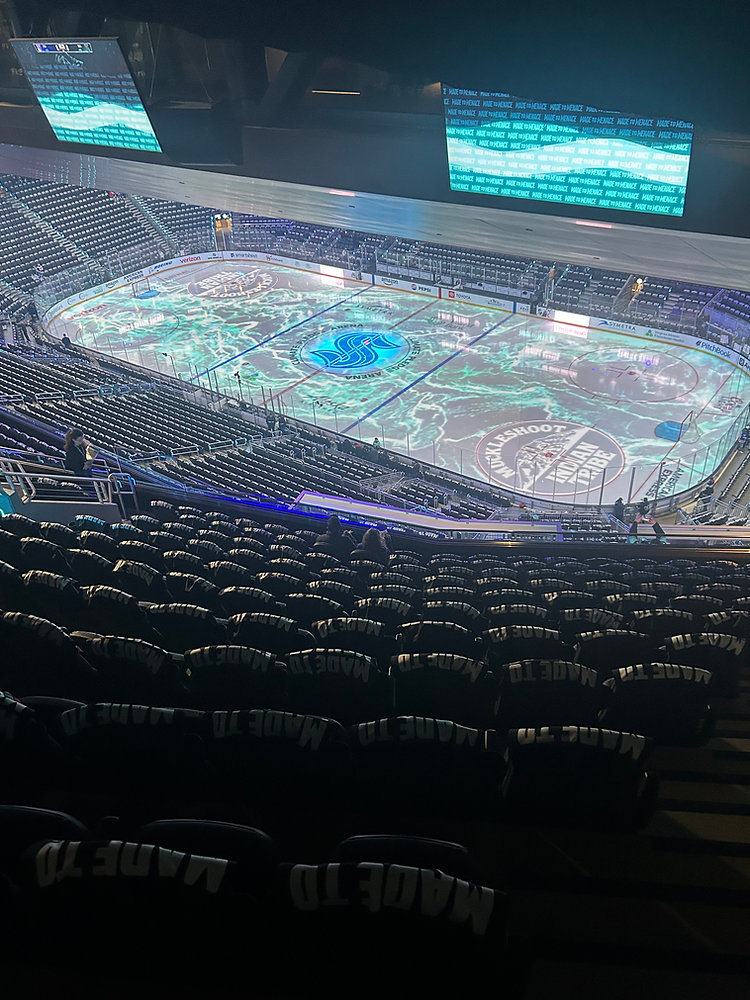
The arena has two six-sided scoreboards, one over each zone and not over the center ice area. The boards, which are higher than most NHL jumbotrons, were designed not to stress the architectural design of the original roof and not to interfere with sightlines. The dual scoreboards are clear and allow most seating areas to see the screens. The only negative is that the boards do not display which players are on ice during play.
Neighborhood 5
CPA is located within the Seattle Center, home of the 1962 Seattle World’s Fair. Its neighbors include the iconic Space Needle, which has a revolving rooftop restaurant, as well as the Chihuly Garden and Glass and the Museum of Pop Culture. The monorail system comes through the museum on its way to its final stop at the Space Needle.
As fans approach the arena on foot, it resembles more of a suburban neighborhood with some greenery in the area. The building looks small from the outside since about half of the seating area is buried underground. The glass windows let in plenty of natural light, and spectators can see some of the seating area and the scoreboard from certain locations outside the building.
There are many places to stay within walking distance of the Climate Pledge Arena, including Hyatt House, Hampton Inn and Suites, Four Points Sheraton, and The Maxwell Hotel. A few places to pregame include The Uptown Hophouse, Agave Cocina & Tequila, and the Queen Anne Beerhall.
Fans 5
The building has been sold out for every home game for the past three seasons. The Krakheads are an enthusiastic bunch, but on this visit, they did seem to lose a bit of steam in the third period.
The ice is illuminated first in sea blue and then changes to bright red as the PA announcer blares “This is Kraken Hockey” and follows it up with “Welcome to the Deep,” and the crowd roars as the Kraken take the ice.
During the anthem sung by Tommie Burton, the fans enthusiastically yell “SEE for SEA” and “RED GLARE” . A celebrity, loyal fan or sports personality leads the surge as fans yell “Let’s Go Kraken” leading into the opening faceoff.
Then the Seattle Kraken mascot, a sea troll named Buoy, takes over and starts banging his drum to lead the fans in the Let’s Go Kraken chant throughout the game. Buoy is inspired by the Freemont Troll sculpture. The Kraken have a group of cheerleaders better known as the Sea Squad who entertain and urge the fans on before the start of each period and during breaks in the action.
The Kraken have only made the playoffs in one of their first four seasons, but that has not dampened enthusiasm. The Lair is the Team Store, which is only open on game days, and was packed on this visit. New coach Lane Lambert will attempt to lead them back to the postseason. Jessica Campbell enters her second season with the Kraken as an assistant coach after becoming the first full-time female assistant coach in NHL history to work behind the bench during the regular season.
The building does not enforce the puck-in-play policy that some NHL venues enforce, not allowing fans to return to seats until there is a stoppage in play. That rule can be good or bad depending upon the beholder, as hockey is conducive to continuous action and often has few whistles. into a new NHL franchise, they also wholeheartedly buy into what the Climate Pledge Arena is trying to do.
Access 4
Climate Pledge is one of the only venues in the country to offer free public transportation to games and other ticketed events. The goal is to have at least 25% of attendees use public transportation.
Fans can also ride bikes and scooters to the facility. There are many protected bike lanes surrounding the arena. Bike Link Bicycle lockers are available in the 1st Ave N Garage on a first-come, first-served basis. Scooters can be parked in one of the designated sidewalk zones.
The Seattle Center Monorail is a 90-second ride between downtown and Seattle Center. From the Seattle Center station, it is just a short walk to Climate Pledge Arena. Parking downtown and taking the Monorail is the fastest option to get to and from the event.
Sound Transit offers an excellent light rail service that runs from the SeaTac Airport to the University of Washington campus. Riders going to a Kraken game would simply exit at the Seattle Center Station and cross the street to the monorail system. The monorail runs directly to the Seattle Center (90-second ride), where it is a leisurely walk over to CPA.
For drivers, there are three main parking garages nearby. They are located on 5th Avenue, Mercer Street, and First Avenue North. Each garage has electric vehicle charging stations. Parking ranges from $25-45, depending upon the lot and location.
The arena has seven access points (one is for press only and one for patrons needing an accessible entry), and the process was easy. Entry 1 is the most used public entry located on the southwest corner of the arena off of the Alaska Airlines Atrium, facing 1st Ave N.
Gates open 90 minutes before the starting time. Reusable (non-glass) water bottles are permitted and must be no larger than 32oz and empty upon entry.
Upon entering the arena, fans are in the 100 level, which is really the mid-level or upper concourse. Walking down leads to the lower level sections 1-26 (lower concourse), and the 200 level is up above. Most of the lower-level seats are subterranean, while the concourse and main south entrance at the Alaska Airlines Atrium are at ground level. The only negative is that the scoreboards cannot be seen from the upper rows of both the upper and lower bowls.
Return on Investment 3
Seattle is an expensive city, and the same can be said for prices at Climate Pledge. The arena ranked as the 7th most expensive according to the Fan Cost Index in 2024. The cost to take a family of four was $528.35 for four tickets, four hot dogs and four sodas, and parking.
Without a doubt, tickets and food are costly. On the secondary ticket market, the prices for a Kraken game can go for less than $100 in the upper level and about $125 and up, but that is for weeknight games. Seattle’s emphasis on farm-to-table food is great, but it does elevate prices. Kraken owner Samantha Holloway did listen to fans and lowered season ticket prices for many seats coming into this season. The team also offers a 25% reduction on food and drinks for full and half-season ticket holders.
Extras 4
Seattle won a Stanley Cup before the inception of the Kraken. In 1917, the Seattle Metropolitans defeated the Montreal Canadians to win the Stanley Cup, and a banner hangs from the rafters to commemorate that Cup. Ironically, Seattle was competing for a second Stanley Cup in 1919, when the series was canceled due to the breakout of the Spanish Flu pandemic.
CPA features wider concourses and the Living Wall, a visual of 25-30 different species of plants native to the Pacific Northwest, which stretches 200 feet long and 14 feet tall. The wall is located next to the Club entrances.
Going green is befitting of the Emerald City, and it seems to be working. From the bathrooms, no fossil fuels to renewable energy, to reducing waste, and is impressive.
The arena features Sue Bird and Lenny Wilkins statues outside the main entrance. Wilkens, who coached Seattle to an NBA title in 1979, was the first person inducted into the Naismith Basketball Hall of Fame three times: Player (1989), Coach (1998), and Olympian (2010). Wilkins recently passed away at age 88. Bird played her entire career with the Seattle Storm and led the team to four WNBA titles. Bird is a five-time Olympic gold medalist.
Final Thoughts
The Climate Pledge Arena features excellent sightlines, a solid sound system, and the combination of new and old works well to make it one of the more unique buildings in the National Hockey League. Its ability to make it sustainable is another huge plus, and it is definitely worthy of a stadium journey.