
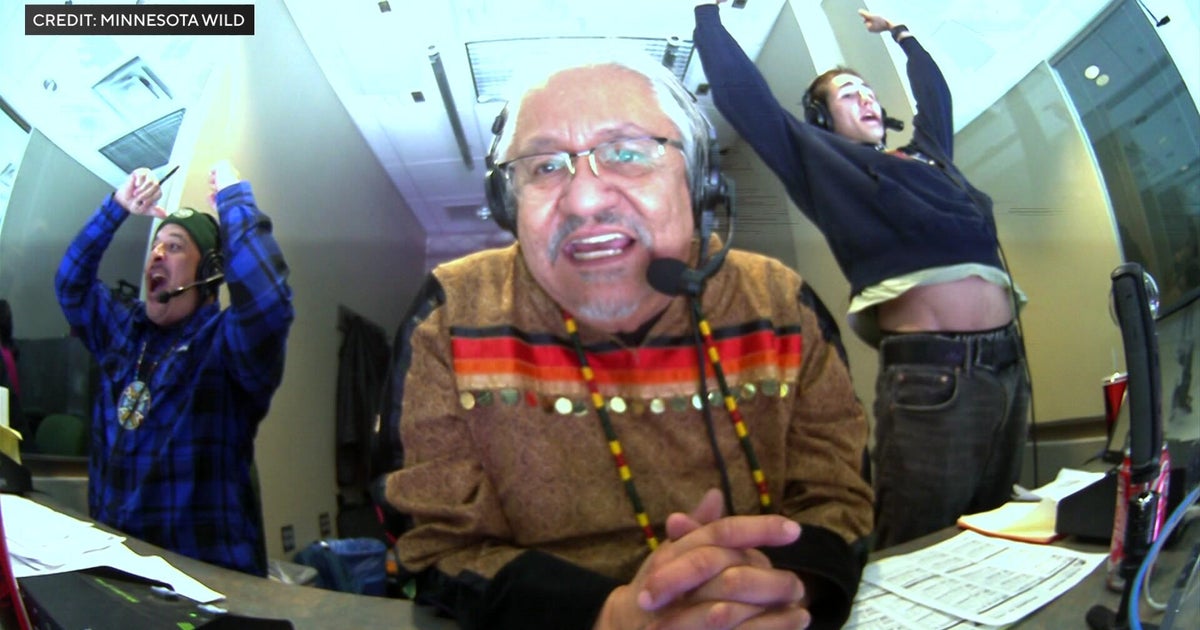
Friday night’s Minnesota Wild game against the Colorado Avalanche sounded different from the opening face off, with the entire broadcast called in Ojibwe as part of Native American Heritage Day.
Ojibwe is an Indigenous language spoken by Anishinaabe people across the Great Lakes region in the U.S. and Canada. For many Native fans, hearing it over an NHL game was a first.
In the booth, three broadcasters shared the call: Maajiigoneyaash Jourdain, a first-language speaker, alongside second-language learners Chato “Ombishkebines” Gonzalez and James “Ginoonde” Buckholtz.
“Oh, it was amazing, not only because of what we’re doing here, but I’ve always wanted to, like, do play-by-play for a hockey game,” Jourdain said. “I grew up playing hockey in the rivers and lakes up and the Minnesota-Ontario border … As a child, you aspire to play in the NHL. I finally made it, but in a different way, with my mouth instead of my skates.”
He said the weight of the moment didn’t fully hit until just before the game started.
“It didn’t dawn on me until I came up the elevator,” he said.
Gonzalez, who has spent years learning and teaching Ojibwe, said the broadcast carried decades of language work with it.
“Yeah, it’s really special for our community to be able to hear our languages used, especially over a public broadcast,” Gonzalez said. “The sense of pride and the sense of accomplishment … how far we’ve come.”
During an intermission, jingle dancers from the Mille Lacs Band of Ojibwe took the ice in another moment of visible culture inside an NHL arena.
“Watching the ladies dance today and listening to them do the commentary, I got really emotional and happy,” said Melissa “Baabiitaw” Boyd, a founding board member of the Midwest Indigenous Immersion Network and a member of the Mille Lacs Band.
Boyd said her work centers on helping people reconnect with Ojibwe language and identity after generations of being told to leave those parts of themselves out of public life.
“I really, truly believe that everybody has a purpose, and so Ojibwe language is that for me and also serving my fellow Anishinaabe people,” she said.
She described Native American Heritage Night as more than a theme game — it’s a signal that Indigenous fans were fully welcome as themselves.
“[It’s] sending this message that you don’t have to leave your identity at the door to participate in mainstream, you know, sports and a major league space,” Boyd said.
Gonzalez said the response to the broadcast stretched well beyond the arena.
“People were excited all over that this was actually happening,” he said.
He also hopes it won’t be a one-time experiment.
“My hope is that this opens the door for other sports,” Gonzalez said. “It’d be an amazing opportunity for us to be able to continue announcing hockey games, but I think it’d be just as exciting to watch the Vikings to watch the Timberwolves.”
For Jourdain, the moment can be summed up in one phrase he shared on the broadcast.
“We say, ‘odamino da,'” he said.
That translates to “let’s play hockey.”