

With an 18-1-6 record, the Avalanche have separated themselves from the rest of the league. The Stars are even finding some space in second place. The Flames and Predators, on the other hand, have sunk to the bottom.
Everyone in between — from third place (Tampa Bay) to 29th (Buffalo) is only separated by just 10 points in the NHL standings.
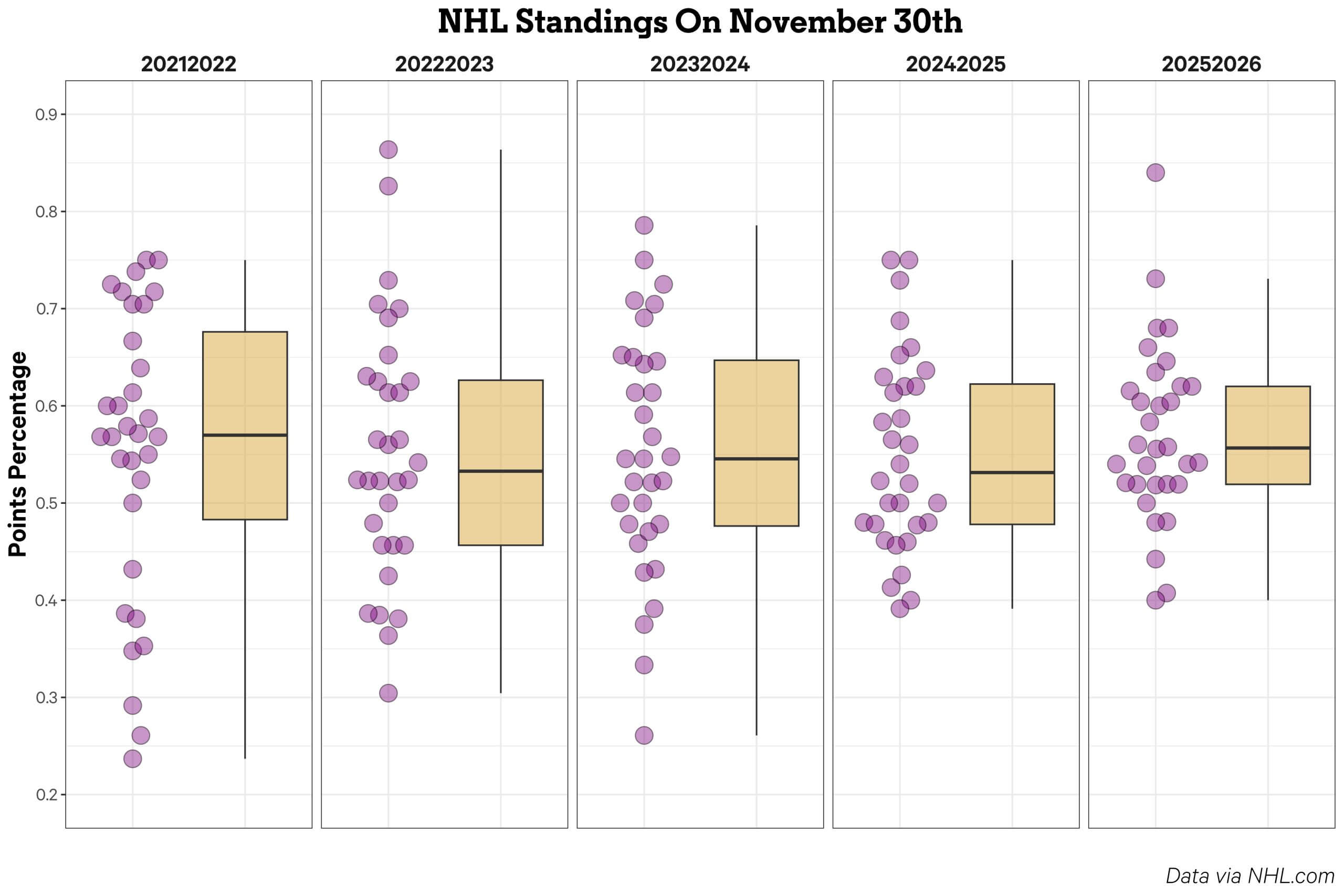
That closeness has gained a lot of attention this season and for good reason — the standings generally aren’t this clustered at the end of November. A larger contingent of contenders and bottom-feeders tends to establish itself at this point, leaving a less crowded field in the middle.
Viz by Prashanth Iyer
This is not to say that there won’t be some separation as the season goes on. Last year’s spread on Nov. 30 was pretty closely knit relative to recent seasons, and it eventually sorted itself out. But this year is extra tight, and a few factors are contributing to this mid-off parity.
It starts with some surprises on both ends of the spectrum. The Ducks have emerged as a real threat in the Pacific. Rebuilding teams like the Sharks and Blackhawks are right in the mix. So are the Kraken in the West. In the East, two retooling teams, the Bruins and Islanders, have been more competitive than expected. On the flip side, the Oilers and Maple Leafs have seriously disappointed over the past two months, along with projected playoff teams like the Panthers, Jets and Rangers.
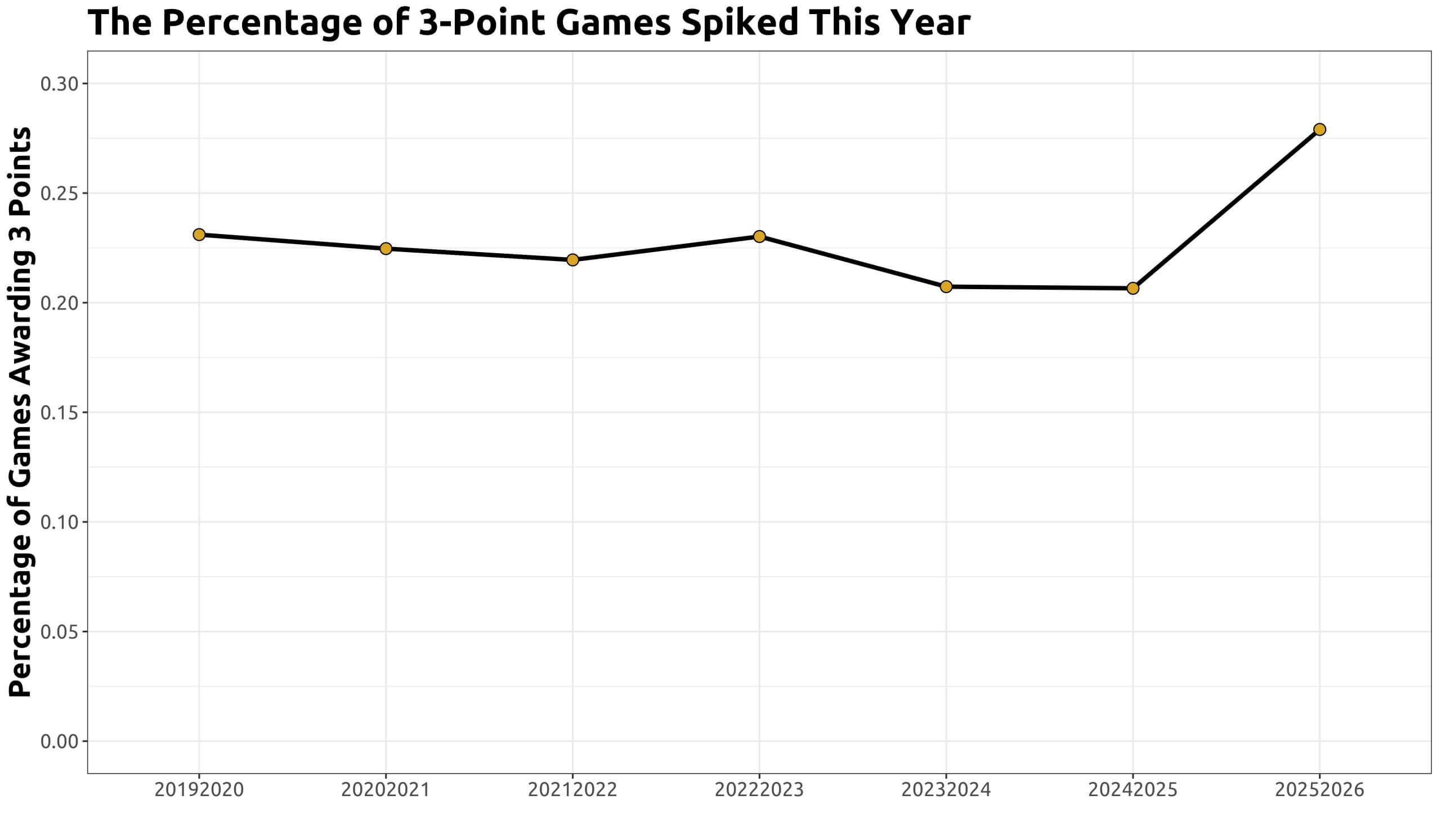
With a more even playing field, there has been a rise in three-point games. Ahead of Monday night’s matchups, 27.9 percent of games have required overtime this season.
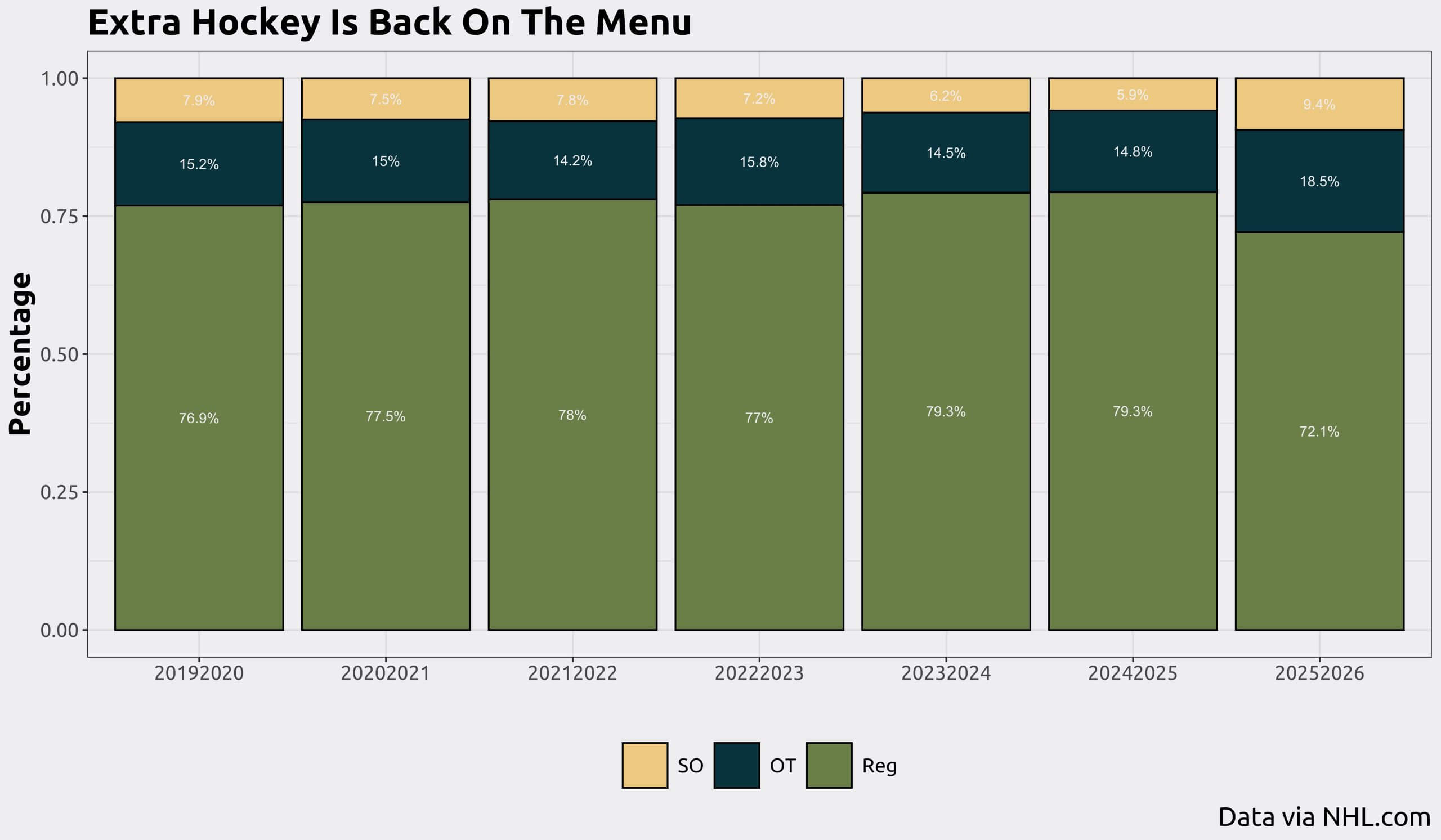
Regulation finishes were actually trending up in recent years, from 76.9 percent in 2019-20 to 79.3 percent in each of the past two seasons. But that has dropped to just 72.1 percent this season (stick taps to Prashanth Iyer for the number-crunching and visuals here).
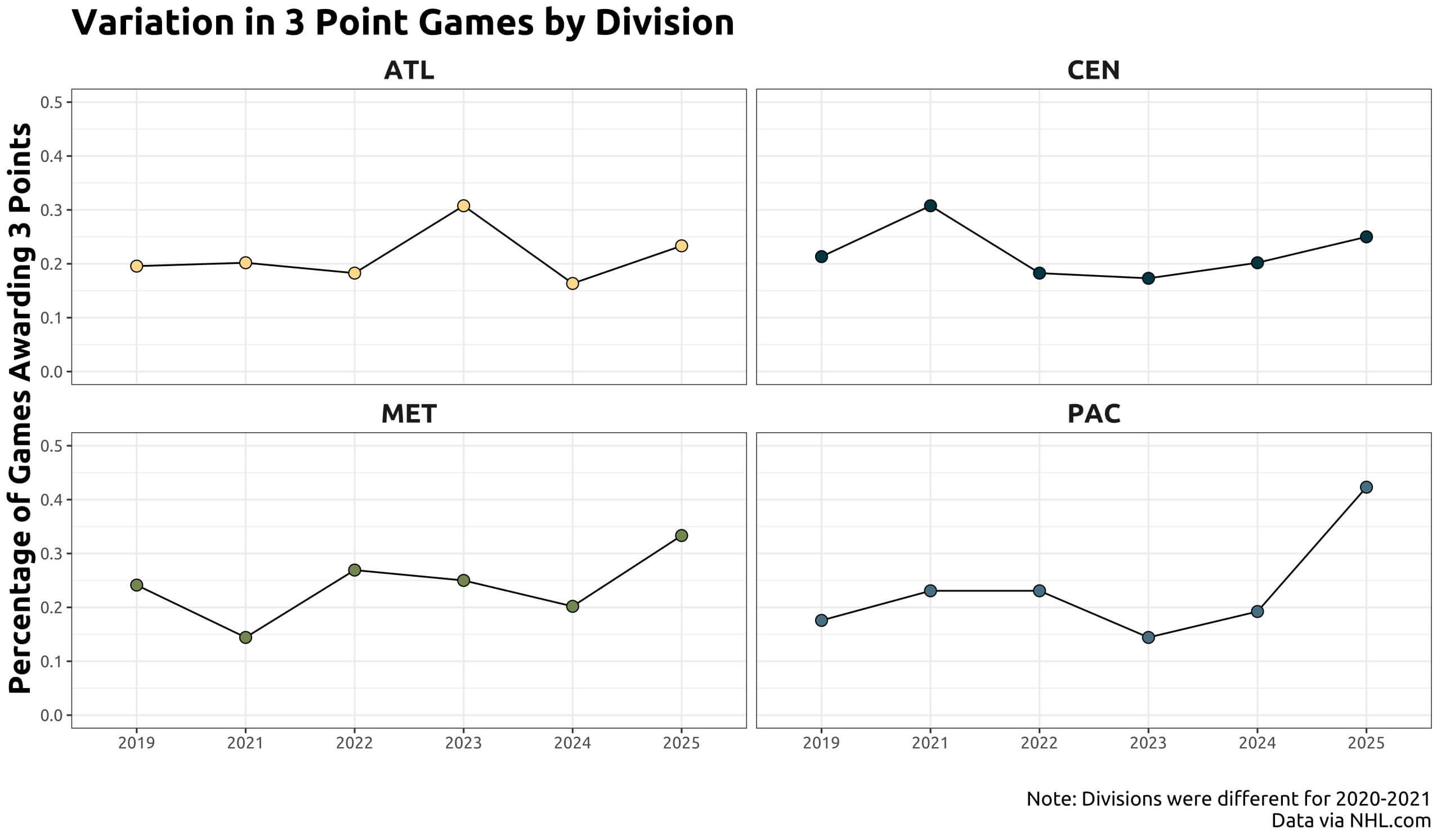
Pacific Division teams are driving the rise in overtime this season, with the Kings leading the charge with 12 appearances in 25 games. The Wild have gone to overtime 11 times already this year, while the Oilers, Kraken, Blue Jackets and Flyers are at 10.
In today’s NHL, there is one clear consequence of extra hockey: More loser points to go around.
A 3-2-1 point system is the way to go
Hockey is a game of inches. The standings, as is, don’t carry that same energy because some level of detail would separate what a regulation win is worth compared to an overtime win.
One answer is just trying to reduce the number of overtime games in the regular season, and there are ways to influence the results. Encouraging officials to strictly call every non-offsetting penalty in the final 10 minutes of regulation would have an impact, considering how efficient power plays are in today’s game. But that would only be a band-aid, not an actual solution.
An actual solution is changing the way games are scored: Three points for a regulation win, two for overtime, and one for an overtime loss.
A 3-2-1 point system wouldn’t have that radical of an impact on the standings — and that’s important here. The idea isn’t to overhaul a system that has worked for years; it’s to tweak it to better reflect which teams win games in a traditional, 60-game setting before the (beautiful) chaos that is three-on-three hockey and the shootout. And this year’s emphasis on overtime is the perfect time to bring this discussion back to the forefront.
At the end of November, with a 3-2-1 system, the Lightning, Bruins and Canadiens would still lead the Atlantic. The Capitals, who have 14 regulation wins, compared to the Hurricanes’ 11 and Devils’ 10, would slide into first place in the Metropolitan. With only eight regulation wins this year, the Senators would move further out of the wild-card picture.

The top three of the Central Division standings would remain intact. In the Pacific, despite eight loser points (that currently make up 27 percent of their 30 points), the Golden Knights’ 10 regulation wins would move them into first in the Pacific. The wild-card picture would change the most, with Winnipeg knocking Seattle out of playoff standing. The Jets are one of two teams without a loser point (they’re two for two in overtime this season; the Bruins are the other team with six OT wins so far). Edmonton, on the other hand, would sink due to having only six regulation wins this season.
While the standings would still be closer than usual in this format compared to seasons past, there would be a more reasonable 16 points separating third place from 29th. And that’s before considering how strategies might change to push for that third point — instead of teams playing on their heels in the final moments because two points are still guaranteed for a win. That would add a fun element to every game, especially as playoff races heat up down the stretch.
Yaroslav Askarov is the Sharks’ best penalty killer
There’s a saying that a goalie is a team’s best penalty killer. That has been especially true in San Jose over the last month.
Despite leading the league with 96 short-handed minutes in November, the Sharks only allowed four power-play goals against. That shakes out to a 92.6 percent PK, which ranked second to the Kings’ 93.3 percent.

That is particularly impressive for a team that was outright putrid when shorthanded in October. San Jose operated at 63.9 percent (third-worst last month, ahead of only Ottawa and Minnesota) with 13 goals against. The team bled scoring chances at a rate of 11.6 xG against per 60, and the goaltending was average relative to its workload. When accounting for minutes played, that shakes out to 12.5 goals against per 60.
Fast forward to November, and the Sharks’ goals against have dropped to just 2.49 per 60. San Jose isn’t the only team to turn its PK woes around; the difference is that it hasn’t been a team-wide effort fueling it, like the Wild, whose defense has stepped up over the last few weeks. The Sharks are still giving up 9.71 xG per 60, which is the eighth-worst over the last month. Yaroslav Askarov has been the difference, with just two goals against in November. In 10 games (and 71 minutes) of short-handed action, he has saved 11 goals above expected to give his team a chance against opposing power plays.
Meier-Hischier-Bratt are helping carry the Devils
There were breakdowns in the Devils’ game before the Jack Hughes injury. The Brett Pesce injury was the first major pressure point that impacted New Jersey’s defensive game.
Then came some two-way struggles from Nico Hischier, who is counted on to shoulder some of the toughest minutes in the league. Red flags started to emerge in late October, when the Devils began their California swing. In the seven games between the start of that road trip in San Jose and Hughes’ last appearance on Nov. 12, the Devils were outscored 6-2 at five-on-five with Hischier on the ice.
So not only was the team losing its biggest star at that point, but their ace 2C was playing far below expectations. Add in the depth concerns behind Hischier, considering how little center Dawson Mercer has played over the last couple of seasons, and New Jersey’s season really could have gone off the rails.
Suffice to say, it hasn’t been pretty for the Devils in November below the surface. The power play isn’t converting on its chances, the penalty kill is leaky, and the team’s five-on-five game has lacked. The process may not be perfect, but an 8-5-1 record has kept this team afloat. And the Hischier line has been pivotal in that.
This line has been pretty reflective of the team as a whole: The process isn’t what it needs to be, but it’s getting by for now by outscoring opponents 6-4 at five-on-five since Hughes’ injury. Without that top-line trio of Hischier, Timo Meier, and Jesper Bratt on the ice, the team has been outscored 15-9. A top-heavy approach can only get a team so far, so the Devils should be looking for reinforcements — even after Hughes and Pesce eventually return.
Mats Zuccarello’s impact
It’s impossible to talk about the Wild’s turnaround without leading with goaltending. Between Jesper Wallstedt and Filip Gustavsson, Minnesota rocked a league-high 0.944 save percentage in November. Gustavsson went eight for eight with quality starts, while Wallstedt was five for six. That has unquestionably been the biggest needle mover behind the team’s jump from 13th in the West to third.
That turnaround also coincided with Mats Zuccarello’s return on Nov. 7. He missed the start of the year after core muscle surgery, but since making his season debut, the team has gone 9-0-2 in 11 games.
His return resets a depth chart that was somewhat out of sorts without him in the top six, giving Minnesota a deeper approach. And, most importantly, it adds a playmaker, whose little plays tend to add up, back into the fold.
Take this shift against Colorado on Friday, for example. Zuccarello was able to read the play, extend his stick to pick the puck, and slip it to Kirill Kaprizov for the entry when three Avs skaters were focused on him.

While Kaprizov wasn’t able to generate a shot directly off that sequence, he did create a chance off another Zuccarello pass seconds later.

The fact that Zuccarello is scoring at a career-high pace at five-on-five, with 3.01 points per 60, contributes to that. It’s not the most sustainable start, with the Wild’s two-way play in that time in mind, or his team-high 12.9 on-ice shooting percentage. But it’s an encouraging start for a 38-year-old who had to shake off offseason and injury-recovery rust.
The Canadiens’ inconsistent goaltending
At least when Sam Montembeault was struggling in October, the Canadiens had Jakub Dobeš to lean on. He earned a 0.930 save percentage and saved 9.63 goals above expected in six appearances to open the season, while his partner — and the Canadiens’ rock in net last year — slipped to the bottom of the league.
Now, these two are trending in opposite directions again.
Dobeš has come back down to earth over the last month. Two absolutely brutal starts against the Stars and Avalanche tanked his numbers, after he allowed a combined 5.77 goals above expected in two games. But maybe the bigger red flag is that he didn’t bounce back well enough after either outing; he earned only one quality start in six starts in November.
Montembeault, at least, gave the Canadiens a chance in five of seven starts last month — and was especially impressive against Vegas last Friday. While that win should give him confidence, he still has a lot of work to do to rebound to last year’s difference-making levels after such a shaky start. With Dobeš struggling, the pressure is on for him to prove that he can be The Guy again.
November Stars

Nathan MacKinnon is a force. Not only did he lead the league in scoring in November with 11 goals and 26 points, but Colorado also dominated his five-on-five minutes with a 21-3 (!) edge in scoring. He is, once again, making an early case for the Hart Trophy.
In Dallas, Jason Robertson’s star-powered play this month should be enough to make Team USA. He has been popping off on the scoresheet with 23 points and providing a much-needed even-strength spark on the Stars’ second line.
Jeremy Swayman and Jakub Chychrun both earned a look this month, but the third star belongs to Brandon Hagel, whose pesky all-around game has helped fuel the Lightning through some key absences. Despite shouldering matchup minutes, Hagel still generated a ton of scoring chances, earned a 59 percent xG rate, and helped Tampa Bay outscore opponents 16-4 at five-on-five.
Data via Evolving-Hockey, HockeyViz, HockeyStatCards, All Three Zones, Natural Stat Trick, and Prashanth Iyer. This story relies on shot-based metrics; here is a primer on these numbers.