
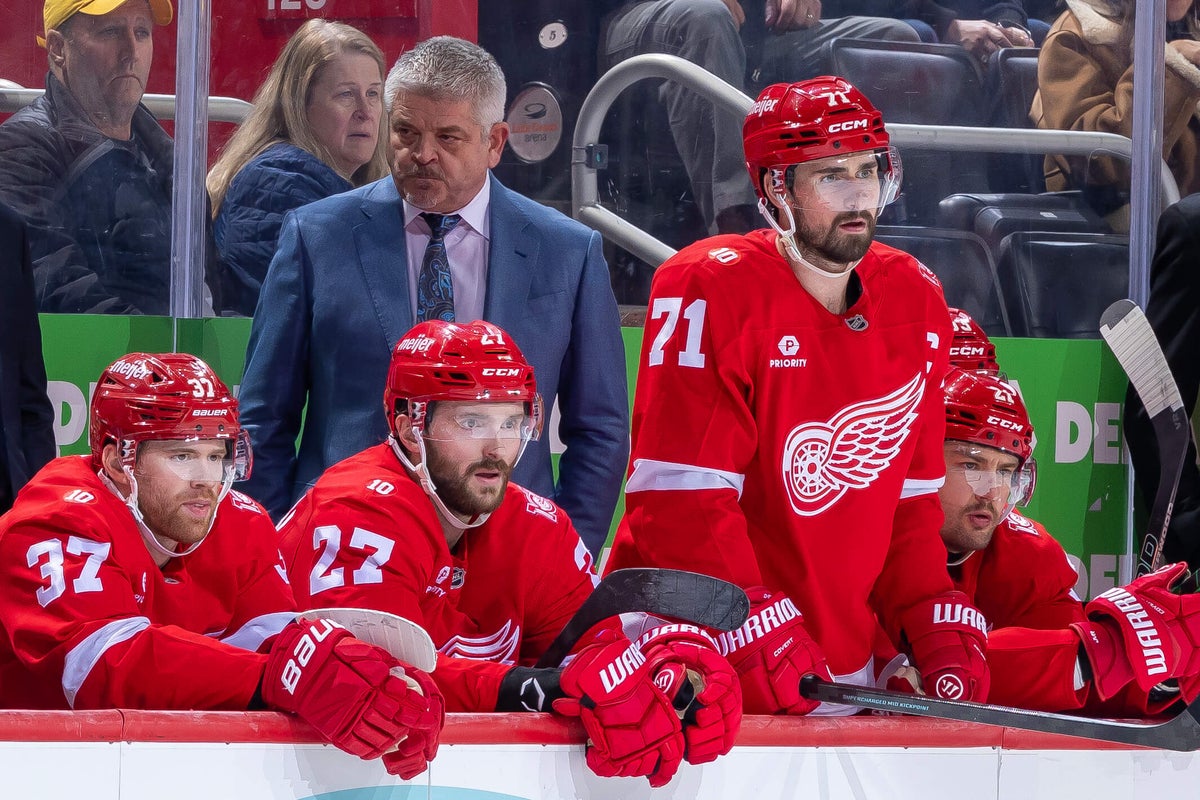
Not much is breaking the Detroit Red Wings’ way of late.
Yes, Detroit battled back Saturday night to earn a much-needed point in Boston. They did so by twice overcoming third-period deficits, a sign that the players remain invested and engaged. But when they eventually fell in a shootout to the Bruins, the Red Wings’ losing streak stretched to four games and kept them mired in the muck of an Eastern Conference that is as tight as any year in recent memory.
The Red Wings have time, of course. The 26 games they’ve played represent less than a third of the NHL season, and they’re still within one game of a playoff spot — and one good week from a very different kind of narrative.
But this deep into the season, their issues are becoming clear. The Red Wings are prone to defensive mistakes, mostly mental ones. Despite a big offseason trade to acquire John Gibson, Detroit also isn’t getting the kind of goaltending that readily overcomes such miscues. They also have one of the lowest five-on-five scoring rates in the league, and have a tendency to get pushed around a bit too often.
It’s a healthy list of problems for a team with playoff aspirations.
And in fairness, some of them may clear up with time. Patrick Kane has been as snakebit as it gets of late. Forward Marco Kasper — with just three goals and no assists through 26 games — figures to snap out of his sophomore slump at some point. Young defenseman Albert Johansson has previously demonstrated far more stability than he’s shown this season. And rookie Axel Sandin-Pellikka should only improve with more time, too. If those things correct, maybe that will make life easier on Gibson, too.
But in what has always felt like a crucial year for the Red Wings, it’s fair to ask if simply letting things play out is really Detroit’s best course of action — and what the alternatives might be.
As the year goes on, the Red Wings should have options via call-ups from AHL Grand Rapids, which has been staggeringly hot to begin the year. Top goaltending prospect Sebastian Cossa is sporting a .942 save percentage in nine games for the Griffins, who lead the league. Rookie forward Michael Brandsegg-Nygård has 11 points in 13 games since being sent down after beginning the year in Detroit, and he can bring some of the heaviness the Red Wings lack.
In the short-term, though, getting younger rarely leads to more stability. The Red Wings already have three rookies on the roster, as well as four second- or third-year players, and that fact is hard to separate from their inconsistency and tendency toward mistakes.
So if Detroit does want to take a stab at improving its roster, it may require looking outside the organization, via a trade.
Now, it is, admittedly, a bit early on the calendar to be talking trades. Most of the action in the NHL is spurred by impending deadlines, and the trade deadline isn’t until March 6. The specter of the Olympics could plausibly prompt some action before that break, but even that’s not until February.
And most notably, the remarkable parity in the Eastern Conference could have a real impact on the near-term market. If nearly everyone is still alive, it’s hard to convince a team to start selling.
Having said all that, there are a small handful of markets where that picture is at least coming into view.
The most notable is in Vancouver, where the Canucks are off to a rocky start in an important year. The Athletic’s Thomas Drance recently reported that Vancouver is preparing to steer its roster in a younger direction.
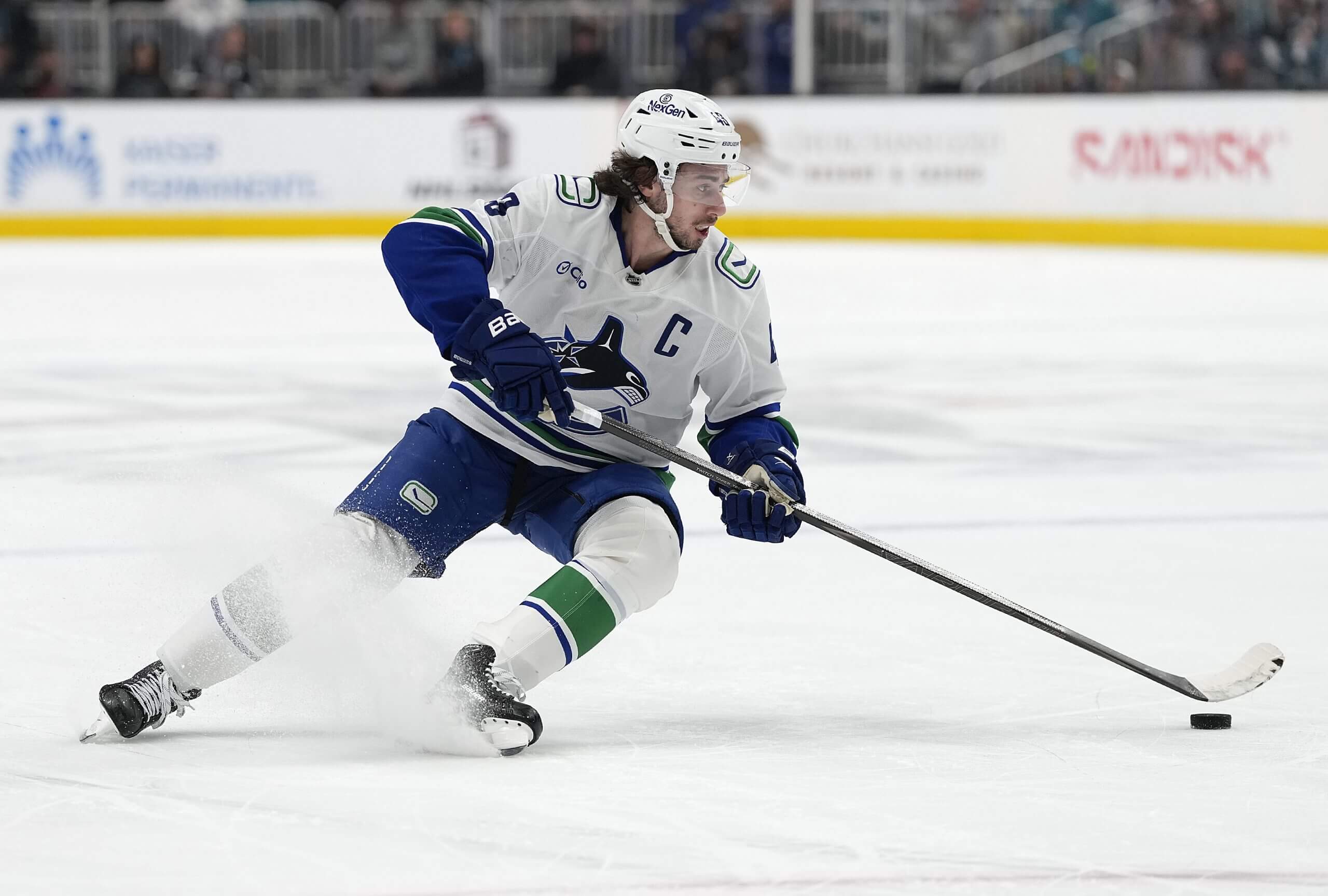
If he becomes available, Vancouver Canucks defenseman Quinn Hughes would be the kind of immediate-impact player the Detroit Red Wings need. (Thearon W. Henderson / Getty Images)
Certainly, the big name to watch with the Canucks is Quinn Hughes — the Norris Trophy winner who can become a free agent in 2027. And if Hughes indeed comes available, the Red Wings should absolutely get involved in those talks. Hughes would be the kind of immediate-impact player Detroit needs, and he could transform the look of their blue line with his dynamic skating. He also has local ties — one reason to believe the Red Wings may be able to extend him if they acquired him — and Detroit is one of a small group of teams with the caliber of farm system to make a tempting offer to Vancouver.
That being said, serious Hughes talk may be a bit further off yet, as the more imminent names Drance highlighted were pending unrestricted free agents Evander Kane, Teddy Blueger and Kiefer Sherwood. And while none of those names are as splashy as Hughes, Sherwood is nonetheless intriguing as the NHL’s reigning hits leader (with 462 last season), who is second in the category this season while also chipping in 12 goals in his first 26 games.
Drance wrote that the Canucks would want “at least a second-round pick” to consider moving him, and the Red Wings could afford that — whether it’s an actual second-round pick, or an equivalent prospect. The hang-up, however, is that general manager Steve Yzerman has yet to show an inclination to pay that kind of price for a pending UFA.
Across Canada, meanwhile, the Toronto Maple Leafs have won two of their past three games but remain a team that could be in line for midseason moves after a thoroughly uninspiring start. The Athletic’s Joshua Kloke noted that the Maple Leafs recently scratched forward Dakota Joshua, a metro-Detroit native who has similarly shown an ability to blend snarl and physicality with passable secondary scoring — all boxes the Red Wings still need to check. He also has two years remaining on his contract after this season at $3.25 million annually.
Sherwood and Joshua would come with questions. Joshua’s underlying metrics are solid, particularly defensively, but he has struggled to produce this season. Meanwhile, Sherwood has been the opposite: good goal scoring but discouraging defensive metrics.
Environment surely plays a role, particularly in Sherwood’s case with the Canucks being the league’s worst defensive outfit by expected goals. But they’re nonetheless factors to consider for a Detroit team that needs more than a new face getting the same results.
Part of the issue with the current prospective trade market, at least as of today: few obvious needle-moving candidates on defense.
The Red Wings have an obvious need for help on their third pair, which has been a consistent source of avoidable mistakes this season. Detroit replaced Justin Holl (currently in Grand Rapids) with Travis Hamonic and has seen no clear improvement. Another offseason signing, Jacob Bernard-Docker, hasn’t been burned as frequently on the scoresheet, but he doesn’t appear to have earned much trust from the coaching staff, either.
Perhaps more will emerge as the season progresses, and teams start to fall behind the peloton. Hughes would of course be the dream target, the one true potential game-changer, who would fit in perfectly with Detroit’s core. St. Louis could be another place to look if things go south, whether it’s aiming high for Colton Parayko or a shorter-term bridge option such as Justin Faulk.
And of course, all of this assumes a willingness on the part of Yzerman to push in chips to improve his team before his team improves itself. That would be a departure from past years, and for that reason, the improvement may need to precede any reinforcements.
Right now, though, it’s almost a moot point: In a league where virtually everyone is still alive, finding a spark via trade would require navigating a market that is even more narrow than usual.