
Two legends in the making, 10 years apart, winning the Hart and Art Ross trophies as teenagers. That’s what it looked like for Sidney Crosby and Connor McDavid.
A pair of young defensemen, going from elite to the unquestionable best of their generation before alternating Norris trophies. That’s what it looked like for Cale Makar and Quinn Hughes.
Linemates in their early-20s, becoming point-per-game players in tandem and leading their last-place franchise back into the postseason. That’s what it looked like for Nathan MacKinnon and Mikko Rantanen.
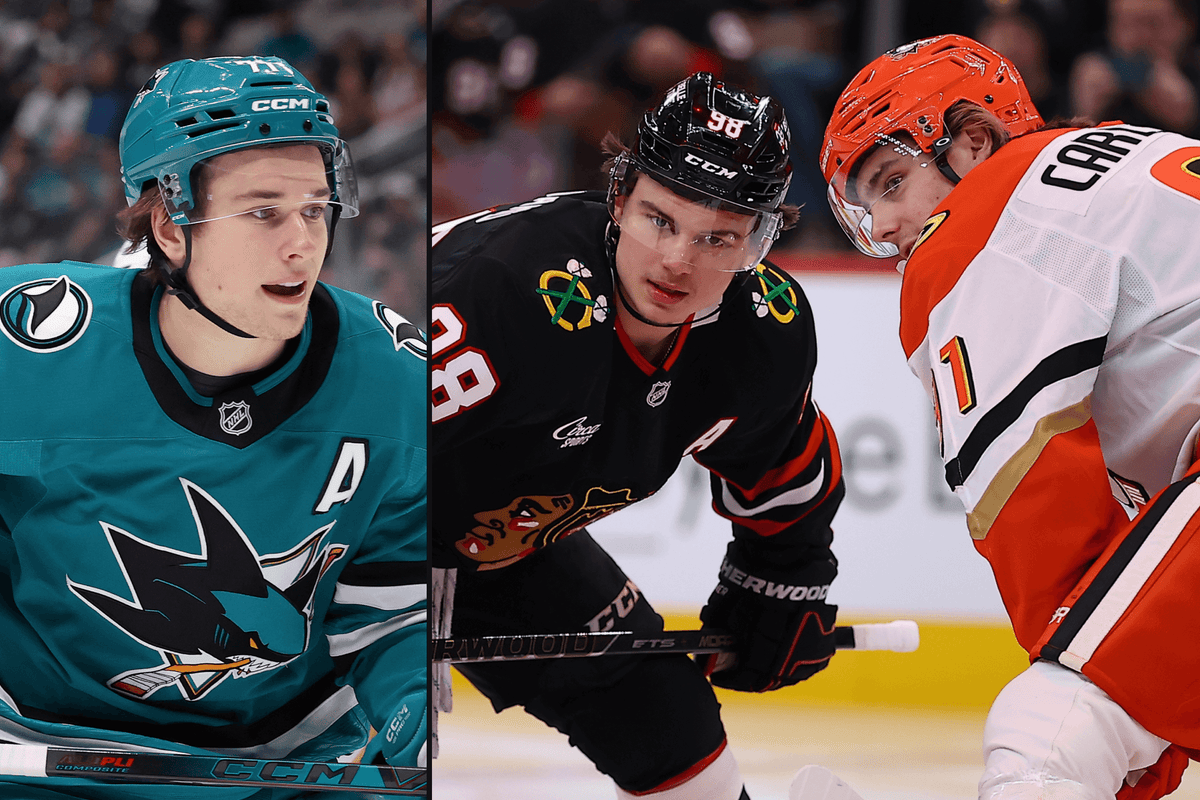
And now, three young centers, staking simultaneous claims to be treated not just as the next wave of superstars, but as an in-the-moment force. Connor Bedard, Macklin Celebrini and Leo Carlsson, through at least their first 25 games of the 2025-26 season, are each among the NHL’s top five in points. All three are bringing their franchises back to relevance after years in the wilderness.
All three are doing what Crosby, McDavid and all the rest did before them, going from good to special, turning potential into reality along the way. All three are making the leap.
What is “the leap”?
A player becoming one of the league’s elite doesn’t happen overnight, but it can sometimes feel that way. One season they’re good, the next season they’re something else entirely. The move toward the franchise level can be a massive one — less escalator, more elevator, with a player seemingly skipping the typical intermediate steps.
When that happens, one development coach said, it’s often the logical endpoint of elite talent merging with physical development and NHL experience.
“All of it clicks at the same time,” the coach said. “And then, all of a sudden, you feel like you can do whatever you want on the ice. And now, you feel like you’re the same player you were at whatever level you came from.
“And that’s a big-time game changer for those players, because now, if they don’t have a good shift or don’t have a good game, or whatever, we’re not wondering whether they’re going to find it again. They know they have it.”
That was true for Crosby and McDavid, Makar and Hughes, MacKinnon and Rantanen. It looks true for Bedard, Carlsson and Celebrini, too. But it was also true for the large majority of the league’s current franchise class.
There were 29 skaters in Tiers 1 and 2 in this year’s Player Tiers, many of whom took a major step to reach that level; a gradual climb was usually the exception to the rule. On average, their point pace jumped by 24 points in their leap year, with all but five going up by 10 or more points. By Net Rating, a measure of a player’s impact on a team’s goal differential, the average leap feels even more substantial: 10.3 goals. It’s the difference between being an ordinary first liner and one of the best 25 players in the world.
Bedard, Carlsson and Celebrini are on track to make that jump this season, playing at a Net Rating pace north of plus-15. That’s typically franchise player territory and a major jump from where they were in 2024-25.
The leap usually happens early, too. The average age of each franchise player’s leap year: 22.2, with half being 21 or younger. There are exceptions to the rule, such as Sam Reinhart and William Nylander, but the game’s best usually figure out that they’re the game’s best early.

When it comes to crowning the best players in the world, there’s a tendency to be overtly cautious as they build up the appropriate track record. And in the case of Bedard, Carlsson and Celebrini, we’re talking about just 25 games this season of elite hockey. Their current paces are probably not an accurate reflection of where they’ll finish the season and it’s likely they slow down to some extent. Those 25 games, though, serve as a signal of their respective capabilities.
With budding superstars, it may make more sense to throw caution to the wind. When franchise players arrive, it usually happens fast and they’re usually here to stay.
Going through each franchise player’s leap year and the one that preceded it, we looked at each player through every 25-game stretch he played that season. Only nine percent of those stretches fell below the previous year’s baseline, while almost 80 percent were at least five goals better. Essentially, the new heights had staying power.
There were some players who dipped as the season progressed and some players who got better, but on average, what happened in the first 25 games generally sustained for the rest.
It’s not just a hot start, it’s a new level. Bedard, Carlsson and Celebrini have arrived.
How Bedard, Celebrini, Carlsson are taking the next step
Bedard, Celebrini and Carlsson have each significantly amped up their production. All three are averaging more than four all-situations points per 60 (Celebrini at 4.36, Bedard and Carlsson both at 4.17). There, Bedard has taken the “smallest” season-over-season jump, at 72 percent.
They’ve also made major improvements at five-on-five, as well. With them on the ice, their teams are decisively outscoring the opposition (Anaheim at 22-15, Chicago at 25-20, San Jose at 25-16).
While the similarities are clear, according to a coach and scout who were both part of our Player Tiers panel, each player has been pushed primarily by growth in different spots.
Celebrini, the coach said, was always the smartest bet to skyrocket, owing to an already-full offensive toolbox, a Crosby-esque obsession with competition and an earned confidence in his skills, with and without the puck. Celebrini can do nearly anything, the coach said, and he knows it.
“(Celebrini) is truly one of the rare players — and I’m saying of the elite players — where he’s equally good at pretty much everything offensively,” the coach said. “That’s what allows him to access whatever is needed. Even for some of the very best players, there’s one thing they like more than everything else, or there’s one thing that they’re always in search of offensively, more than anything else. And at times, they go to that when they shouldn’t, and that window to make the play they could’ve made disappears.”
That’s not the case with Celebrini. The best comparison might come from a different sport: The golfer who can hit every club in his bag.
“Not only does (Celebrini) not have holes, he doesn’t have any one thing it feels like he’s over-leveraging. It never really feels like he’s boxed in,” the coach said.
Bedard, coming off a relatively underwhelming second NHL season, had a bit more room for improvement. That’s evident in his skating; he now ranks in the 92nd percentile or better in 18-20 mph bursts, 20-22 mph bursts and 22-plus mph bursts. In the latter two categories, he’s already topped his totals from 2024-25. Physical maturation and improvement, especially for players in their teens or early 20s, count for plenty.
What might be bigger for Bedard, though, is a better understanding of the mental side of the game. He’s got more than two seasons’ worth of NHL games under his belt at this point, the coach said, and it’s easy to see.
“I think a lot of people might say something along the lines of ‘He’s simplified his game.’ I don’t think that’s true,” the coach said. “I think he’s a creative, dynamic offensive mind who’s figured out what’s worked and, more importantly, some stuff that won’t work.
“For elite players that are dominating at their previous level, it’s hard to accept, ‘Hey, you’ve got holes now.’ It took him two years to say, ‘OK, I get it now, and I’m willing to change stuff and adjust my approach.’ For players that are that good, what they need to understand is there are certain things they have to do consistently that will enable them to use their unique ability.”
The scout put it more succinctly: “He went to the well with the s— that worked in juniors. Subsequently, the reason why he’s so much better this year is that he’s learned different dimensions to play the game and different ways to solve problems.”
Carlsson’s jump, the scout said, seems to be driven more by confidence.
“The tough thing with young players who are talented is the first couple years, they don’t know what to expect. They know they’ve got talent, but they’re not confident … They know what they need to do, and now they’re able to execute it. And that builds momentum.
“(Carlsson) knows that he’s got the talent. It doesn’t matter who’s facing him or who he’s going up against — his skill set and his confidence in his ability is off the charts. And he’s trying s—. Last year, he knew what to do. He just didn’t have the confidence in pulling it off.”
That confidence looks fully fleshed out this season, but there was also some evidence of it growing to close last season. In Carlsson’s final 25 games, he scored at a 69-point pace — a prelude to this year’s leap.
That hint toward something special was also evident for Bedard and Celebrini and while each player’s growth differed, the end goal was the same: Turning those dominant flashes into consistent greatness. It’s those types of players who can change the game in more ways than one.
What it means for the rest of the league
It’s no coincidence that the three also-ran franchises that Bedard, Carlsson and Celebrini lead have suddenly surged to relevancy to start the season. Their personal leap forward is a rising tide for their respective teams, one that has the Blackhawks, Ducks and Sharks set to make substantial jumps in the standings.
Maybe the Blackhawks and Sharks don’t hit 85-plus points. Maybe the Ducks don’t win the Pacific Division. But the fact that those three teams are capable of even reaching those heights this season would’ve seemed almost unfathomable given where the teams were one year ago.
It’s not only a testament to the individual growth of their best players, but also to the power of even having a player at that level. It’s hard for a team to be that bad with a player that good. The efforts of Bedard, Carlsson and Celebrini have put the early league standings into a state of chaos as the trio are individually willing their teams to victory.
Their emergence has upset the established order in a way we haven’t seen in a while. For the last five or so years, the league has mostly been stagnant at the top for both teams and players. We know McDavid and Leon Draisaitl will be the most lethal 1-2 forward punch league, with no close runner-up. We know MacKinnon and Makar will compete for hardware. We know Nikita Kucherov will pile up points, and Auston Matthews will fill the net, and Aleksander Barkov will provide two-way domination.
There have been surprises, sure, but the contending class for teams has mostly stayed constant and so too has the franchise class for players. With all three in the top five in points this season despite playing within difficult contexts, Bedard, Carlsson and Celebrini are changing the league’s power structure.
In the six years we’ve catalogued where the NHL’s best players stand via the Player Tiers, only four players under 22 have made an appearance in Tier 1 or 2. Makar, Miro Heiskanen and Elias Pettersson were there in 2020-21 and 2021-22 and Jack Hughes made the cut in 2023-24. That’s it, with none over the last two seasons. Bedard, Carlsson and Celebrini are making a very strong case to change that next season, signaling the NHL’s next wave of superstar talent is here — and not to be ignored. And that doesn’t even include the potentially generational Matthew Schaefer, a rookie so uniquely good out of the gate that it’s terrifying to imagine what his leap would look like.
In a world where being patient to get things right is the convention, Bedard, Carlsson and Celebrini have been so undeniably dominant this season that it may be more prudent to be aggressively assertive in where they stand in the NHL’s hierarchy.
“There are other young guys who are ‘maybes,’” a scout said. “Leo Carlsson, Macklin Celebrini, Connor Bedard — they’re ‘for sures.'”
Like McDavid and Crosby, MacKinnon and Rantanen, and Makar and Hughes before them, Bedard, Carlsson and Celebrini are proving they belong with the league’s best.