
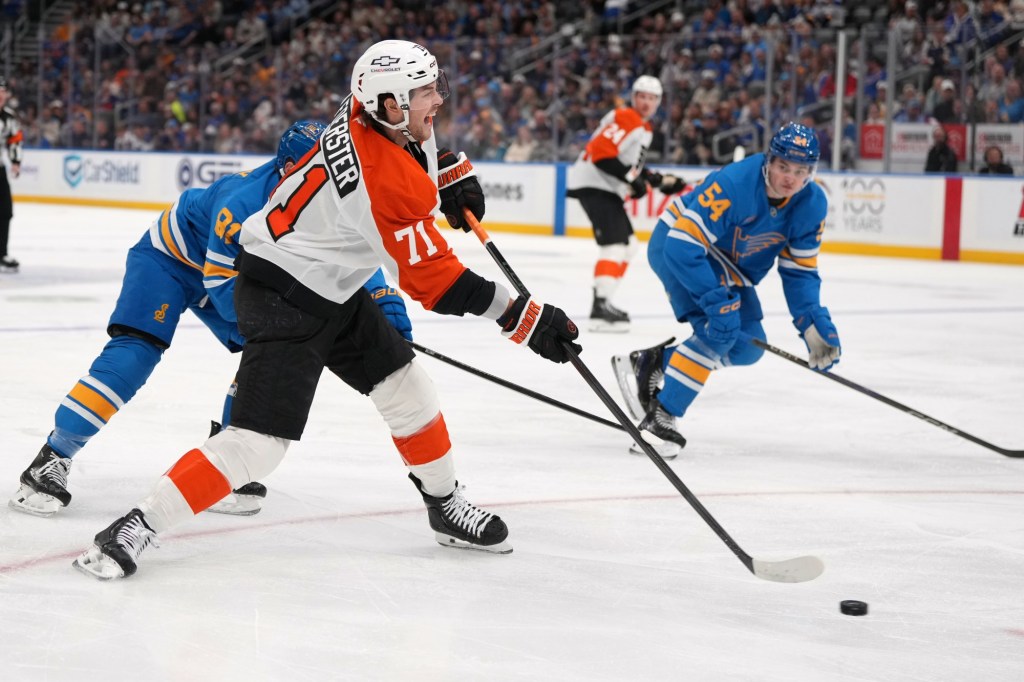
PHILADELPHIA — No one player can replace a leading performer such as Tyson Foerster, so it has to be a group effort.
With Foerster gone for at least a couple months due to an upper-body injury suffered in Monday night’s loss to Pittsburgh, the Flyers are hoping other players can take up the slack both on offense and defense.
Rookie Nikita Grebenkin was expected to play on a line with Noah Cates and Bobby Brink as a fill-in for Foerster in Wednesday night’s game against Buffalo. Maybe he can raise his game and help the effort.
What does coach Rick Tocchet hope to get from the young Russian?
“Just good decisions,” Tocchet said after the morning skate at Xfinity Mobile Arena. “Sometimes when he gets the puck he doesn’t move his feet. For him, I just want him to play mind-free. But he’s got to skate, hold onto pucks.”
Grebenkin played in Russia last year. The Flyers understand there’s a bit of a transition period.
“It doesn’t happen overnight,” Tocchet said. “In practice, there’s day-to-day stuff that we see. The solution is to let him play and see if he makes mistakes. There’s a process to it. Do I feel like he’s ready? Yeah. It’s the way you practice, the way you take in information.”
The coach said one thing Grebenkin has to work on is two-on-one situations, especially in practice. Sometimes he tends to slow down when he attempts to pass the puck.
“Against Pittsburgh he had all day to go in and fire the puck,” Tocchet said. “But he waited and tried to make a pass and their guy picked it off. Today we talked about it (in morning drills) and his two-on-ones were outstanding.
“Hopefully he can apply that in a real game. To be an NHL player, you have to take that information.”
“A ton of skill,” Cates said of Grebenkin. “He’s been working at his game. Getting a lot of good looks so I know he’s excited to play. He brings that energy, just have to work with him and get some chemistry. He can do a lot of good things on the ice, just have to help him out.”
In addition to Grebenkin, Tocchet said there are other players who will have to contribute while Foerster is out.
“I don’t think it’s just one guy, I think can everybody give themselves five percent better,” Tocchet said. “You know you add all those up and it helps. We have a few guys who can play 5, 10 percent better.”
Foerster is a big piece of the power play and a penalty killer. So the Flyers will lose more than just a team-leading 10 goals.
Tocchet said this is a time when team leadership has to step to the forefront.
“It’s a dressing room thing,” he said. “It’s ‘next man up.’ It’s not making excuses when the coaches leave the room. More like ‘hey, we got this.’ We really rely on a chunk of leaders to really do the messaging, that we can still be a good hockey team. The ‘poor is me’ stuff can’t linger in the room.”
The Flyers began Wednesday night in the final playoff spot in the Eastern Conference standings with games in hand on several teams.
• • •
Defenseman Rasmus Ristolainen, still on the mend from offseason surgery on a torn triceps, has began skating and could be back in a few weeks if all goes well with his rehab.
“We’re not quite there in the contact stuff,” Tocchet said. “I’m not sure when the contact stuff is coming but it’s coming.”
Tocchet closed by saying Ristolainen’s return “will be less than a month.”
• • •
The Flyers’ power play started off hot this season but has cooled considerably. Going into the Buffalo game, the Flyers were just three for their last 27 power plays and had dropped from 14th in the NHL to 20th. Losing Foerster won’t help matters.
Tocchet said the power play has been giving up too many two-on-ones with the man advantage. A player like Trevor Zegras is important on the first unit but can also be a defensive liability.
“We have to get middle shots,” Tocchet said. “We need to start hammering the puck, also get more down-low plays. Hopefully Trevor and Mich (Matvei Michkov) can show some motion for us, handle the puck and then start hammering the puck from that side of the ice. Get more shots from the prime areas.”