
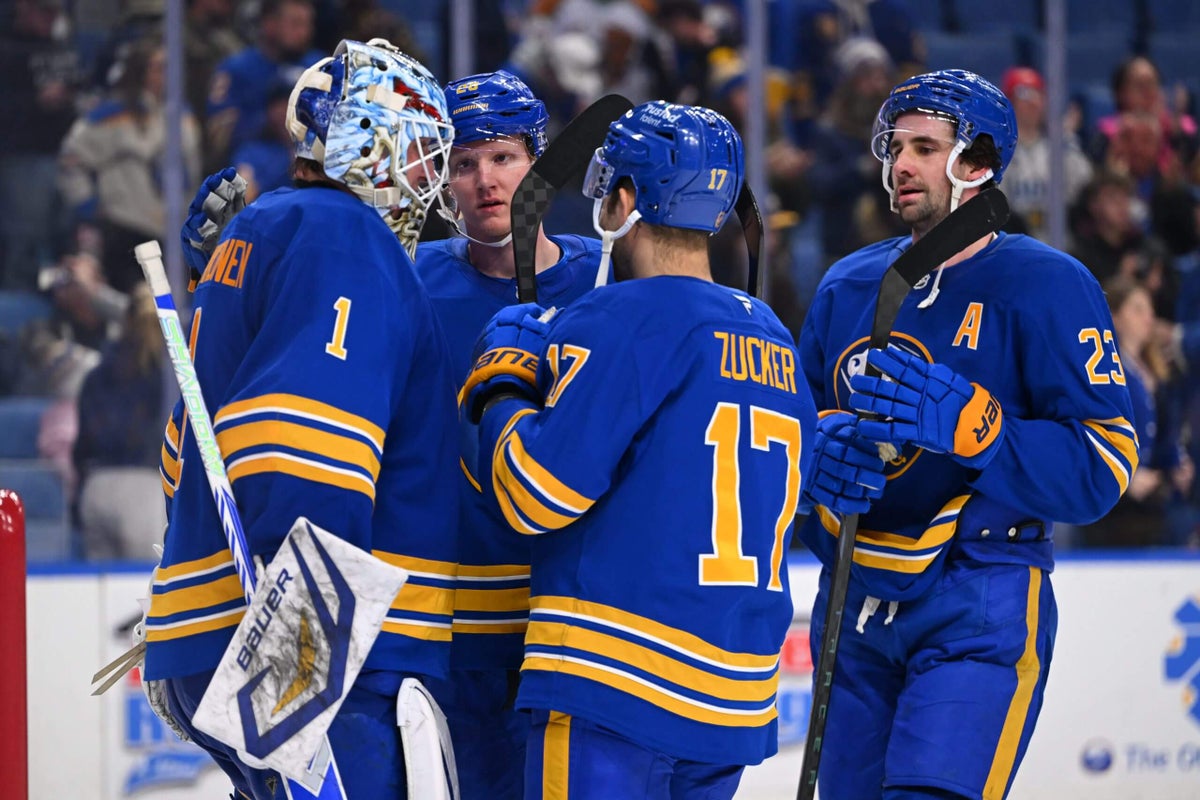
It’s not easy believing in the Buffalo Sabres.
The franchise has missed the playoffs for 14 straight seasons and looks very likely to make that 15 with a 70 percent chance of missing this year going into Wednesday’s game against the Flyers. A 5-2 loss likely pushes that closer to 75 percent.
But there’s a reason it’s not zero (or all that close to it) despite falling to last in the Eastern Conference by points percentage. Over the last 10 games, the Sabres have started to flash genuine reasons for optimism. In a tight East, the Sabres aren’t finished yet.
Ten games is not a long time. But for the Sabres, it’s notable because it marks when Rasmus Dahlin returned to the lineup — his heart and mind hopefully clearer with his fiancée recovering well in Sweden. In the 10 games the Sabres have played since his return, they are 6-4-0 and Dahlin’s dominance has been at the forefront of that. He has eight points in those 10 games and 62 percent of expected goals, good for an average Game Score of 1.28.
Dahlin’s return has been a rising tide for the Sabres, who have been one of the league’s best five-on-five teams by expected goals percentage over that stretch, clicking at 56.3 percent. It may be a small sample, but that’s a notably high mark for this franchise. The last time the Sabres had a 10-game stretch that strong was at the start during the 2010-11 season — the last time the Sabres made the playoffs.
It’s not just Dahlin’s return, though; it’s the team finally getting healthy. The Sabres have been without four of their starting top six options for various stretches this season and three of them — Jason Zucker, Zach Benson and Josh Norris — made their returns over the past 10 games. In that time, Zucker has eight points in seven games, Benson leads the team with 64 percent of expected goals and Norris came back strong with four points in two games.
With everyone back, the vision for a successful Sabres season starts to take place. The main premise for the Sabres taking a step this season was that depth would be their biggest advantage thanks to key additions and budding youth. The team’s top nine, as currently constructed, haven’t spent a lot of time together to draw any meaningful conclusions, but have dominated together in that limited time. That’s not nothing.
The Sabres aren’t at full strength yet with both Jiri Kulich and Michael Kesselring still out, but right now they’re the closest they’ve been all season. And they’re starting to get the results to show for it. If they can figure out their goaltending conundrum, the Sabres have the potential to add even more spice to an already chaotic Eastern Conference playoff race.
It’s easy to count the Sabres out early, especially after a brutal loss to the Flyers. But even within that game there were flashes of what this team can do at full power. And the last 10 games have been a glimpse that this year could actually be different.
16 Stats1. The Byram and Timmins experience
While I have an unfortunate amount of undeserved belief in the Sabres, the team getting in its own way doesn’t help. Sending Isak Rosen (seven points in 10 games) down felt odd, but even more troubling is the team pairing their two worst defensive defenders in a top-four role.
While they’ve been a little better of late during Buffalo’s recent surge, Bowen Byram and Conor Timmins have played 173 minutes together at five-on-five, earning a 46.5 percent xG with a high number of goals against. Considering their sometimes-erratic playstyles, I’m inclined to believe that’s not all bad luck.
That pair might be a necessary evil once Kesselring returns to play with Owen Power, but it should probably be in a more sheltered capacity.
2. Spence thriving in top-four minutes
When it comes to defensemen crushing sheltered minutes, you don’t know what you have until you actually give them a chance. Sure, there are a lot of fake good defensemen who can’t be trusted in a bigger role, but there are also exceptions who look like they can make the jump into the top four.
The Kings look like the best current example of that. Last season, Jordan Spence looked like a player deserving of that chance — and the Kings infamously refused to give him one, going so far as to play him only 2:55 in a playoff game. Spence was then traded to Ottawa in the offseason. Cody Ceci is working out great, by the way.
To Los Angeles’ credit, the Senators weren’t exactly willing to give Spence that chance either. He was healthy scratched early and often and suited up in some of the most sheltered minutes in October when he did play. But an injury to Thomas Chabot forced the team’s hand and Spence has taken advantage with a jump into the top four. Since Chabot’s injury, Spence has been getting secondary matchups and is doing well in them with 64 percent of expected goals while outscoring opponents 9-5.
I don’t know for sure if Spence can be an everyday top-four option, especially in the playoffs, due to his size. But he did look like the rare sheltered star who legitimately deserved a shot. So far, the Sens have been well rewarded for it.

Jordan Spence seized his opportunity in Ottawa’s top four after Thomas Chabot’s injury. (Chris Tanouye / Freestyle Photography / Getty Images)
3. Red Wings’ third pair getting obliterated
Everyone knew defensive depth was going to be a problem for the Detroit Red Wings this season and that certainly manifested with an absolutely disastrous November for the team’s third pair.
The top four, featuring some combination of Moritz Seider, Simon Edvinsson, Ben Chiarot and Axel Sandin-Pellikka, won their minutes 21-15 with at least two of those defenders on the ice together. Seider was up 3-0 babysitting the third-pair options while Edvinsson was at 0-0.
The rest of the time featured some unholy combinations featuring Chiarot or Sandin-Pellikka without another top four defenseman, where they were outscored 8-1. Or they featured two of Albert Johansson, Travis Hamonic or Jacob Bernard-Docker who were outscored 11-1. Yes, that’s a 19-2 score-line for the other guys in minutes without one of Seider or Edvinsson, or an intact second pair.
In case it wasn’t obvious before, the Red Wings desperately need multiple non-replacement-level defensemen to patch some major holes. The current projected Net Rating of their bottom four is minus-31. The league average is minus-13.
4. Kasper’s sophomore slump
One reason to be optimistic about the Red Wings going into this season was Marco Kasper coming off a strong rookie season. He looked like the team’s 2C of the future. Instead, he’s having a sophomore slump for the ages: Kasper is pointless in 16 straight games and has just three in 27 games this season.
5. Brandon Hagel, five-on-five superstar
I never resist the urge to gas up Hagel, who seems to be cementing himself as one of the game’s most impactful players — specifically at five-on-five.
Over the last two seasons, there are only two forwards who rank in the top 15 in five-on-five points-per-60, goals percentage and expected goals percentage. Nathan MacKinnon is one of them. Hagel is the other.
6. Avalanche fun facts
First Avalanche fun fact: They have just three regular players with a below-average Net Rating this year: Parker Kelly, Gavin Brindley and Zakhar Bardakov. So … just the fourth line. That’s an obscene level of dominance across the board.
Second Avalanche fun fact: Colorado is getting just .500 goaltending during three-on-three overtime, where the team is 1-3, and .444 goaltending during the shootout, where the team is 0-3. If not for that, the Avalanche might be sitting on an absurd 22-1-3 record right now.
7. Makar away from MacKinnon and Nelson
There are some folks out there who like to discredit Cale Makar as a Nathan MacKinnon merchant using with-or-without-you (WOWY) data, a blunt tool that is often overly reductive and missing key context.
With Makar, it’s that he’s not only Colorado’s offensive focal point from the back end, but also the defensive focal with Devon Toews. That’s an important thing to consider when Makar is out there with Brock Nelson, Colorado’s main shutdown center this season. If those are heavy matchup minutes slanted toward defensive-zone starts, it’s a bit more acceptable if the duo’s xG together isn’t as great — especially if they’re still outscoring opponents 6-2 in those minutes.
That leaves Makar with 60.3 percent of expected goals with MacKinnon, 47.2 percent with Nelson and 59.7 percent with the bottom six. In other words: big whoop.
8. Utah’s power-play struggles
One key contributor to Utah stumbling down the standings after a red-hot start? An ice-cold power play. Since Nov. 1, the Mammoth are just 2-for-38 with the man advantage. With the sixth-worst expected goals rate, they’re not exactly deserving of more either. Utah needs to figure this out; there’s too much talent not to.
9. Savoie struggling on the top line
Just because a player gets to play with Connor McDavid doesn’t mean tough minutes aren’t still tough when it comes to defense. Rookie Matt Savoie is a good example of that. He’s clearly just not there yet.
Savoie has played 115 five-on-five minutes with McDavid this season and they have not gone great. Together, the pair have been on for 4.9 xGA/60 and 4.6 GA/60.
10. Andersson stock watch
I’m not the biggest Rasmus Andersson fan, but it’s hard to deny he’s been playing some really good hockey lately. Over his past 10 games, he’s scored 12 points, 10 of which were primary, and has won his minutes with 51.1 percent of expected goals despite playing a shutdown role. On a poor team short on talent, that’s a noteworthy jump. For the year, he now ranks 34th among defensemen in Net Rating.
That’s a nice bounce-back for a player who looked below average last season, but that lack of year-to-year consistency does make Andersson difficult to trust considering how much he’s going to cost in a trade. When he’s on his game, he can be a real difference-maker — he just needs to show it more.
11. Danault not delivering offensively
It’s not really Phillip Danault’s job to be a scorer, but one key point to being a “two-way” player is going both ways. In each of his past four seasons with the Kings, Danault has scored at a 44-point pace or better. This year, he has just four points in 26 games — all assists. His xG plummeting to 46.3 percent with some rough defensive numbers isn’t ideal either.

Beckett Sennecke could be making a case for Calder contention after a fantastic November. (Harry How / Getty Images)
12. Sennecke’s hot November
One of the biggest omissions from the first edition of Awards Watch this season was Beckett Sennecke for the Calder. This early in the season, I wanted to mention some of the glaring snubs and why, but with Sennecke, I didn’t go far enough because I was only looking at his full-season numbers.
Since Nov. 1, Sennecke has really come on strong, scoring 15 points in 16 games while also being one of Anaheim’s strongest five-on-five players. With Sennecke on the ice, the Ducks have a 55 percent xG and are up 15-6 on the scoresheet.
Sennecke’s defensive game, the main reason he didn’t make the cut, has also improved. His xGA/60 in November was 2.8, down from 4.51 in October. I have no doubt he’ll be firmly in the top 10 among rookies in the next edition.
13. Chychrun getting a historic level of chances
Since 2007-08, there have been four seasons where a defenseman has personally fired 20 expected goals at the net: Cale Makar and Zach Werenski last season, Brent Burns in 2015-16 and Dustin Byfuglien in 2013-14. Werenski at 21.1 was the highest.
This year, Jakob Chychrun is already at 8.3 in 27 games. That’s a 25.2 xG pace.
14. Washington’s new shutdown center?
I was looking through quality of competition data for the month of November to see if there were any changes at the top. One name immediately leaped off the page: Justin Sourdif.
Some will remember the Capitals curiously trading a second-round pick in June for Sourdif, a 23-year-old whose AHL numbers weren’t exactly noteworthy for his age. Clearly, Washington knew he had game and Sourdif is starting to flaunt it.
Since mid-November, Sourdif has been playing on a line with Tom Wilson and Aliaksei Protas. In that time, that line has played some of the league’s toughest minutes, trailing only Joel Eriksson Ek’s line and Sebastian Aho’s line league-wide. Despite that, the line has a 70 percent xG rate together and has outscored opponents 8-2. Sourdif isn’t much of a scorer, but five of his six points this season have come during that 11-game stretch.
If he’s the real deal, that’s a helluva find for the Capitals.
15. Wilson’s ascent to the elite class
Not to make this edition all about the Capitals, but they’ve been such an interesting team over the last two seasons in setting the standard for re-tooling. Tom Wilson is at the center of that as an unlikely story of a player reaching his full power in his early 30s. Wilson’s last two seasons have placed him firmly in the Team Canada conversation not by virtue of being the boogeyman, but by genuine merit.
Last season, Wilson broke out with a plus-12 Net Rating, a result of a career-high 65 points while playing extremely well in shutdown minutes. This season, he’s taken it a step further with 30 points in 27 games and even stronger five-on-five impacts in the same difficult role. Wilson’s Net Rating for this season already sits at plus-6.7 — a top-10 mark. Put those two seasons together and only nine Canadian forwards have been more valuable.
16. Nemec’s questionable defensive game
When it comes to defensemen, it’s easy to be fooled by points. Simon Nemec has been on a tear this season with 15 points in 26 games, a 47-point pace that suggests he’s arrived. But below the surface, there’s still a lot of trouble with his game — especially defensively.
With Nemec on the ice, the Devils give up a team-high 3.24 xGA/60 despite Nemec playing mostly sheltered minutes. Even his recent stint playing over 20 minutes per night hasn’t seen a material jump in minute difficulty (he’s fifth among the team’s defensemen in offensive quality of competition) and in that time, his xGA/60 is still sitting at a team-worst 3.36.
It’s nice that Nemec has unlocked his offensive game and his scoring does matter, enough to earn a solid plus-1.4 Offensive Rating. But his play without the puck also matters, and in his case, it seems to matter a whole lot more. Nemec is currently sporting a minus-3.5 Defensive Rating this season, the third-worst mark in the league ahead of only Alex Romanov and Logan Mailloux. That’s after finishing last year at minus-4.5 in just 27 games, a pace only matched by Jack Johnson.
Nemec is still young and it’s possible he figures things out. But the list of elite defensemen who ever looked this poor defensively is extremely short.
17. PWHL Model sneak peek
A little bonus: Last week, I started working on a soon-to-be-unveiled PWHL player model, a necessity amidst rapid expansion changing rosters and the Olympics on the horizon.
The best player? Marie-Philip Poulin. Like the Crosby or McDavid test in the NHL, that’s a good sign the model works. Stick tap to @HockeySkytte on Twitter and his tremendous website for the data.
