
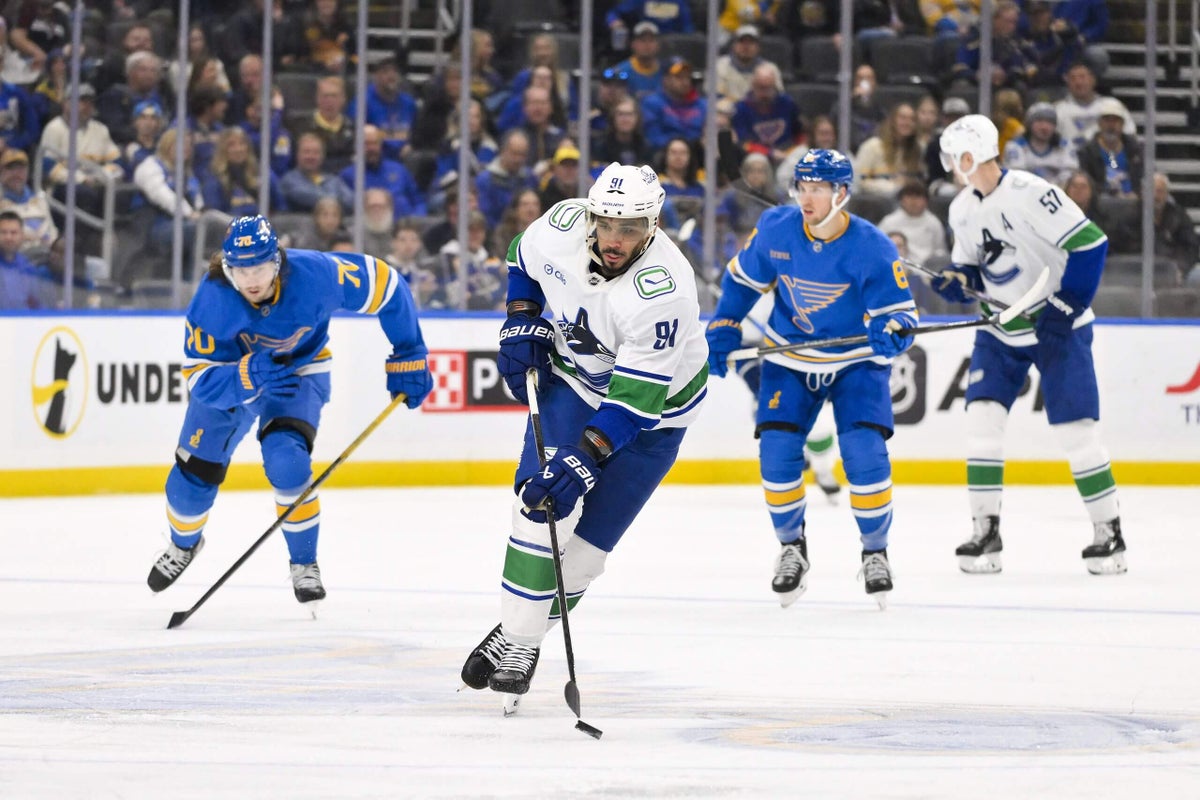
In the Western Conference, time is ticking for the back-to-back Stanley Cup finalists in Edmonton and last year’s Presidents’ Trophy winners in Winnipeg. There are problems in Vancouver that J.T. Miller’s departure hasn’t fixed, while young teams and next-generation contenders alike find themselves outside of the playoffs.
Which of these underachieving Western Conference teams could legitimately miss the playoffs? Who’s a good bet to make a strong push back into a playoff spot by season’s end?
Today we’re examining these teams purely by this season’s performance in actual games, not preseason expectations. Let’s break out the panic meter to analyze how concerned these organizations should be about their chances of making the postseason: 1 meaning not worried, 10 meaning full panic mode about their playoff hopes.
Winnipeg Jets
Record: 13-12-1
What’s gone wrong: Winnipeg started its season by winning nine of its first 12 games, but signs of struggle were clear. The Jets’ elite goaltending and top-tier power play were hiding even-strength woes.
Last season’s wave-over-wave attack, with a deep forward group chaining handoff shifts together? Gone. Last season’s forecheck — so quick and effective that the Jets’ D could gap tightly, creating neutral-zone turnovers? Let’s not belabour the format. The Jets’ five-on-five game was once a strength and now their opponents break the puck out with ease, carve through the neutral zone at will and outchance Winnipeg on a consistent basis.
And did we mention Connor Hellebuyck had arthroscopic knee surgery?
Hellebuyck is not Winnipeg’s only injury concern, with Adam Lowry, Dylan Samberg and Cole Perfetti all off their form after missing substantial periods of time to injury. Jonathan Toews may have a higher level available to him, but he’s moving slowly enough to be ineffective despite past heights. Combine those problems with Nikolaj Ehlers’ departure to the Carolina Hurricanes, and a team whose top-nine forward group outscored opponents by 33 goals last season has turned into a one-line team. Mark Scheifele, Kyle Connor and Gabriel Vilardi are scoring — as is Norris Trophy candidate Josh Morrissey — and that’s about it.
Winnipeg held a players-only meeting after Monday’s 5-1 loss to Buffalo, with Lowry instigating a much-needed call-to-arms for a team that’s falling well short of its standards.
Outlook: The Jets are only two points out of a playoff spot, with games in hand on most teams ahead of them. They are the oldest and slowest team in the NHL, but they also have more to give — and a playoff spot remains within their reach, despite the doom and gloom.
Hellebuyck will be healthy again — the knee injury that required the scope is being characterized as minor — and the Jets will have half a season to work with when he returns. Winnipeg’s ability to fix its five-on-five game depends partly on the speed at which Lowry reclaims his two-way excellence, if Toews’ production increases (or his minutes decrease), and whether the Jets’ defence corps stays healthy for any stretch of time. Presently, they look disconnected, with large gaps between forwards a step behind on the forecheck and defencemen backing off and giving up zone entries for free.
Scott Arniel might try breaking up the top line in an effort to create more scoring throughout the lineup. It’s the only one that’s scoring, but we haven’t seen the Jets try other options. Otherwise Winnipeg will rely on incremental improvements and the hope that Hellebuyck’s return is enough to cover off the team’s weaknesses.
Playoffs are within reach, but the Jets are a game-breaker or two away from being a legitimate threat.
Missing the playoffs panic meter: 6/10
Edmonton Oilers
Record: 11-11-5
What’s gone wrong: For the third year in a row, the Oilers have stumbled out of the gate through the one-third mark of the regular season.
Edmonton has given up 3.48 goals per game, ranking 29th in the NHL. There’s been a ferocious debate about whether goaltending or team defense is to blame for these woes. The truth is both have been problematic.
Goaltending-wise, Edmonton’s team save percentage is .879 this year, which is the worst mark in the NHL. Stuart Skinner is too inconsistent to be a reliable starter, and Calvin Pickard has been one of the league’s worst backups, winning just two of his seven starts.
However, it’d be a mistake to solely pin the ballooning goals against rate on lackluster goaltending. When you watch the Oilers play, you see a group that routinely looks like a defensive mess. This team is prone to brutal turnovers and bad pinches, and their first forward back defensively has been lackadaisical with slot and net-front coverage. Since Nov. 5, their five-on-five expected goals against rate ranks bottom-five in the NHL. Overall, the Oilers’ five-on-five analytics are mediocre, which is concerning because their underlying metrics were still elite during the previous two years’ slow starts.
Edmonton’s defensemen, in particular, have been the worst versions of themselves. Brett Kulak, who’s usually been a steady rock on the Oilers’ blue line, has been outscored 24-12 during his five-on-five shifts. Darnell Nurse has been a liability at times. Jake Walman, who was an excellent pickup for the Oilers last season, has made far more defensive errors than usual. Mattias Ekholm’s decline is becoming noticeable, and Evan Bouchard has had his fair share of lapses as well.
Outlook: Despite all their problems, the Oilers are still only four points back of the Los Angeles Kings for third place in the Pacific Division and only one point back of a wild-card spot. In other words, they haven’t dug themselves a massive hole because the standings are so compressed. Moreover, it’s the Seattle Kraken and San Jose Sharks who are ahead of them in playoff spots by points percentage; both teams could easily fall off, especially given their weak underlying numbers.
Edmonton has a history of going on a heater every year in the second half. Zach Hyman should also be more of a difference-maker down the stretch once he has more than eight games under his belt to shake off the injury rust.
With all this in mind, we’re not too worried yet about the Oilers missing the playoffs. It’s hard to bet against their offense with Connor McDavid, Leon Draisaitl, Hyman and Ryan Nugent-Hopkins, especially with Jack Roslovic (18 points in 23 games) emerging as a terrific fit. The Oilers have enough flaws with their blue line, team defense and goaltending that their status as a Stanley Cup contender is in massive jeopardy, but we’re still reasonably confident they’ll at least qualify for the postseason.
Missing the playoffs panic meter: 5/10
Utah Mammoth
Record: 13-12-3
What’s gone wrong: After a dream start to the season, Utah has come crashing back down, winning just four of its last 15 games. The Mammoth have one of the worst records in the NHL during that stretch.
Goaltending has emerged as a glaring issue. Utah has comfortably outshot and outchanced teams during this miserable run, but their goalies are carrying a woeful .862 save percentage at five-on-five over the last month, which is ahead of only the Oilers and Montreal Canadiens. Karel Vejmelka’s play has slipped significantly after a strong 2024-25 campaign, where he ranked 12th among netminders in goals saved above expected. Backup Vitek Vanecek has been even worse, winning just two of his eight games with even worse goaltending metrics.
Utah’s power play ranks dead last in the NHL, despite the high-end skill this roster has. The Mammoth’s five-on-five offensive metrics are above average, but by the eye test, it seems like it’s been a challenge for them to translate their speed and skill into Grade-A scoring chances on the inside. In a recent loss to the Vegas Golden Knights, for example, the Mammoth created many controlled entries with speed. The problem was getting consistently restricted to the perimeter after gaining the zone. Vegas did a masterful job of gapping up on Utah’s puck carriers and denying passing lanes, which meant many of their speedy, promising entries fizzled or led to low-danger shots. And once their rush offense was shut down, the Mammoth didn’t have a Plan B to create scoring chances off either the forecheck or cycle.

Nick Schmaltz has just four points on the top line in his past 14 games. (Rob Gray / Imagn Images)
Outlook: On paper, there’s still a lot to like about Utah.
This roster doesn’t have a superstar, but the top-six group still boasts a lot of exciting pieces in Logan Cooley, Dylan Guenther, Clayton Keller, Nick Schmaltz and JJ Peterka. We believe it’s only a matter before more of those players break out after a sluggish November.
Utah’s even-strength play is still on a solid foundation. The Mammoth’s 53.4 percent shot attempt share is fourth-best in the NHL behind only Carolina, Washington, and Colorado. They surrender five-on-five shots against at the lowest rate of any team in the league.
To punch a ticket into the playoffs, the Mammoth likely either need Vejmelka to bounce back or their league-worst power-play to become a weapon again. The odds of one of those departments stabilizing seem decent — Vejmelka was rock-solid last year and Utah’s power play finished 10th in 2024-25. However, neither one is a slam dunk.
This should be a playoff-caliber team, but there are still some question marks, and if their struggles continue, the coaching staff needs to be examined more closely as well.
Missing the playoffs panic meter: 6/10
St. Louis Blues
Record: 9-11-7
What’s gone wrong: It would be easy to start and end with Jordan Binnington posting the worst save percentage of his career. The 2019 Stanley Cup champion and 2025 4 Nations Face-Off gold medalist has given up three or more goals in 10 of his 18 games thus far and was pulled early after two quick goals against the Anaheim Ducks on Monday night.
That would be too simple, given Joel Hofer hasn’t been good either.
It might still be true.
The Blues are theoretically a solid defensive team — they’re in the top half of teams in terms of preventing shots and scoring chances — but they’ve given up the fourth-most goals in the league. Look at any public data site or study the heat maps at Hockey Viz; St. Louis gives up fewer scoring chances from prime real estate than average teams do, even on its 26th-ranked penalty kill. The Blues appear to control flow of play but, as Jeremy Rutherford writes, some of the breakdowns have been much worse than is conveyed by analytics. It’s not only the goalies who are struggling.
St. Louis is hurting at the other end of the rink, too. The Blues are one of only seven teams without a 10-goal scorer so far this season (Jordan Kyrou leads with eight). Robert Thomas is the team’s points leader with four goals and 13 assists. These aren’t impressive totals for team leaders, nor are the Blues getting scoring from elsewhere in the lineup. Pavel Buchnevich has 11 points in 27 games in the first year of his six-year, $8 million AAV contract, while taking the fewest shots per game since he was a 21-year-old rookie. Dylan Holloway is on pace for 39 points after breaking out for 63 points in 77 games last season. And speaking of 21-year-old rookies, Jimmy Snuggerud started hot but cooled off and is now out for at least six weeks following wrist surgery.
Outlook: It’s hard to find the Blues’ route to upgrading their 30th-ranked offense. They’re scoring just 2.56 goals per game while generating the 24th-most per minute at five-on-five and the 25th-most shots per minute on the power play. Even knowing the Blues’ top forwards have more to give, it’s not as though they’ve been a bounce or a post away from a ton of goals.
It’s easier to believe the Blues can clean up the severity of their defensive breakdowns. All of Colton Parayko, Cam Fowler, Justin Faulk and Philip Broberg were good for them last season. Parayko and Broberg are winning their minutes 14-9 so far this season, while Faulk and Fowler have been badly outshot and outscored 10-2 despite good zone time numbers. The fact that they’re winning in shot attempts but losing in shots on goal implies a lack of blocked shots — that is, a large number of rush chances or defensive breakdowns that take defenders out of shooting lanes.
It doesn’t look like enough to make a playoff push — not without a star turn by the forwards or a dramatic improvement in goaltending.
Missing the playoffs panic meter: 9/10
Vancouver Canucks
Record: 10-14-3
What’s gone wrong: Where do we even begin? The Canucks have picked up just three regulation wins in their last 21 games. They haven’t won back-to-back games since their first road trip in mid-October.
The Canucks’ centre depth behind Elias Pettersson is disastrous following Filip Chytil’s injury, with David Kämpf currently serving as the club’s second-line center. Vancouver is currently icing the worst group of bottom-nine centers in the league.
Vancouver’s defensive structure has completely collapsed since Rick Tocchet’s departure. The Canucks have adopted a different, higher-pressure defensive zone scheme under Adam Foote, which has completely backfired. They aggressively overcommit to puck carriers in the defensive zone, leading to countless coverage breakdowns in the slot and net-front areas and egregious backdoor tap-in goals. Combine that with the Canucks’ 30th-ranked penalty kill, and you begin to understand why they surrender more goals against than any other team in the NHL.
Thatcher Demko was papering over some of these glaring defensive issues early on, but he’s gone down with an injury. Marcus Pettersson and Tyler Myers have disappointed on the back end.
The Canucks don’t have enough offensive game-breakers besides Quinn Hughes, even with Elias Pettersson rounding into form.
Outlook: This team is probably closer to the Gavin McKenna sweepstakes than it is to a playoff spot.
The Canucks have controlled 43.9 percent of expected goals at five-on-five this season, according to Evolving-Hockey. There are 15 instances (excluding teams that made a midseason coaching change) since the 2021-22 season in which an NHL team has owned a five-on-five expected goal share below 46 percent through the first week of December. Thirteen of those teams finished in the bottom 10 at the end of the season. Nine of those 15 teams finished bottom five.
Injuries have, of course, been part of the story behind the club’s disastrous start. However, across the league, many teams have been ravaged by injuries. The Tampa Bay Lightning, for example, went 11-4-0 in November despite Victor Hedman, Brayden Point, Ryan McDonagh, Erik Cernak and Anthony Cirelli missing games with injury in that span.
Demko and Chytil are the only injured players whose returns could move the needle for this team. The problem is whether they can stay healthy; Demko has been injured five separate times in his last 37 appearances and Chytil has suffered several concussions in his career.
Barring a miracle, there doesn’t appear to be a realistic path to a playoff spot, which has to be worrying considering the uncertainty around Quinn Hughes’ future.
Missing the playoffs panic meter: 10/10