
PHILADELPHIA — An early-December victory over the NHL’s sorriest franchise for the past dozen years and running isn’t cause for too much celebration in and of itself.
The Philadelphia Flyers beat the Buffalo Sabres 5-2 on Wednesday night at Xfinity Mobile Arena, scoring three goals in a 59-second stretch in the first period and essentially cruising from there. Buffalo did not play well.
What makes the Flyers’ performance more notable is that they maintained what has become an encouraging trend: halting losing streaks in their early stages before they can potentially snowball. Nearly one-third into the season, the Flyers have lost back-to-back games in regulation just once, on Nov. 1 and 2. There hasn’t been a single three-game stretch this season in which the Flyers haven’t banked at least 2 points.
The result is a 15-8-3 record, including a 6-2-0 mark in their last eight, and a team that continues to hang near the top of the standings.
The Flyers were coming off arguably their worst performance of the season, a 5-1 drubbing Monday at home at the hands of the rival Pittsburgh Penguins. No one was strong, from the goaltender on out.
Nothing about the game that night bled into Wednesday, though.
“It’s usually the sign of a good hockey team, right?” Nick Seeler asked rhetorically. “I think it’s a good sign that we have that mentality of ‘Hey, we didn’t play good as a group last game, and we need to get back to it.’”
“That’s a really good sign that you know you’re maturing,” Noah Cates said, “and taking that next step.”
Recognizing, like everyone else who watched, that the Flyers were drained Monday after their fifth game in eight days, coach Rick Tocchet gave them Tuesday off to recover. Their renewed energy and focus were evident from the outset against the Sabres.
Yes, they fell behind anyway when Cam York’s delay-of-game minor led to Jason Zucker’s power-play goal at 4:08. But after another ill-advised penalty, this one by Matvei Michkov for interference, Rodrigo Abols’ hustle on the penalty kill resulted in Tage Thompson having to hook Abols to prevent him from getting a scoring chance from in tight.
The Flyers seized control shortly after that. Travis Konecny evened things up on the power play at 8:26, Trevor Zegras scored a power-play goal of his own at 9:04 on a fortunate bounce after a failed challenge for goalie interference on the Konecny goal, and Bobby Brink made it 3-1 at 9:25, easily flipping home the rebound of a Cates shot.

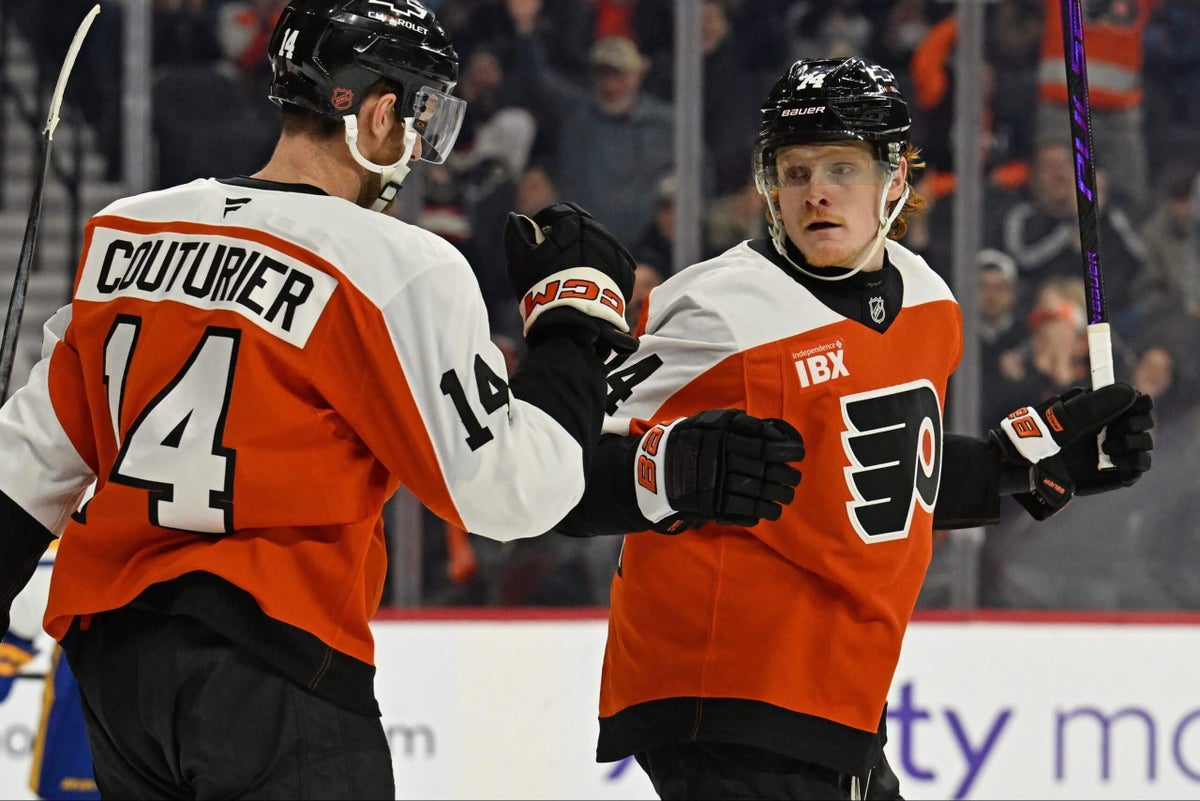
Travis Konecny scored the first of three goals within a minute of play during the first period. (Eric Hartline / Imagn Images)
Cates upped the lead to 4-1 at 1:45 of the second period, getting to the front of the net and jamming through a Brink feed. Although the Sabres threatened to work their way back into it after that, outshooting the Flyers 14-1 just after Cates scored and drawing back to within 4-2 on a Bowen Byram marker at 11:48, Owen Tippett restored the three-goal cushion less than a minute later by tipping in his own rebound after Michkov’s strong work below the goal line.
Those kinds of responses, too, are the sign of a young team that’s seemingly growing up.
“We don’t really panic in this room,” Tippett said. “Obviously, the feeling in the room after (the Pittsburgh game) was we needed to be better tonight. I think guys took the message after last game and came ready to play today. It does show a sign of maturity that we can bounce back like that and have a complete one today.”
Said Konecny: “I think that’s just showing our maturity, as we’re growing.”
That will need to continue, particularly now. The Flyers were playing their first game since the news they would be without Tyson Foerster until at least the Olympic break with a shoulder injury. That meant three entirely new scoring lines, including Nikita Grebenkin getting promoted to the third line with Cates and Brink.
Cates and Brink instantly reestablished their chemistry after Brink was taken off that line about two weeks ago. But they also got a boost from Grebenkin, who earned a secondary assist on Brink’s goal by forcing a turnover at the Flyers’ offensive blue line and pushing the puck down low to begin the scoring sequence.
“I thought he had some jump,” Tocchet said of the rookie winger.
Michkov — two minor penalties aside — also continues to look stronger as the days and weeks go by. He created Tippett’s goal by getting inside position and bodying off Mattias Samuelsson before slipping a backhand to his open linemate for his second assist of the night. Michkov now has 7 points (four goals, three assists) in his last seven games, and with Foerster out, he’ll likely be leaned upon even more at even strength and on the power play, where he returned to the top unit.
Earlier this week, Tocchet touched on Michkov’s improving strength.
“He’s using his body, his positioning, way better than he did three weeks ago,” the coach said. “He’s starting to get his legs.”
It wasn’t all good news. York left in the second period, apparently after getting hit “up high,” Tocchet said. The defenseman was part of a scrum after Rasmus Dahlin’s boarding major, when the Buffalo captain ran Zegras into the wall from behind in the second period. Zegras was slow to get up from the hit but stayed in the game.
But none of that deterred the Flyers, either. It was a vital win not only because they quickly moved past the unsightly Pittsburgh loss but also because their next game isn’t until Sunday, when they host the otherworldly Colorado Avalanche.
“You want to bounce back the best you can after something like (the Pittsburgh game) happens,” Tippett said. “Tonight was a big step, and I think we were ready to go right from the start.”