
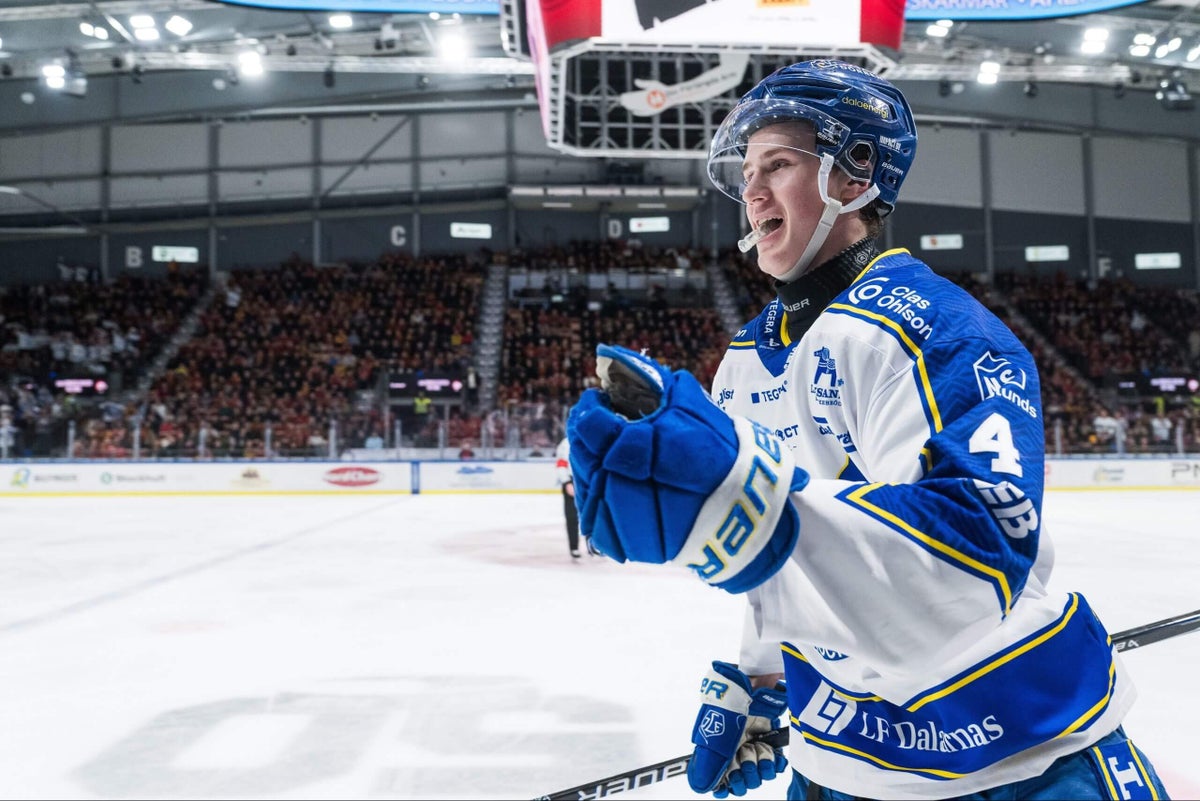
Niklas Persson laughs in disbelief, recalling when he knew Tinus Luc Koblar’s rookie season in the Swedish Hockey League was going to be different.
“The first game he played,” the Leksands IF assistant coach said.
Persson stood on the Leksands bench, blinking in shock as Koblar, the Toronto Maple Leafs’ second-round pick in the 2025 NHL Draft, intercepted an opposition pass in his own zone. Just 18 years old, Koblar darted fearlessly through the neutral zone with his lanky frame and head up. In front of Koblar was veteran Skellefteå AIK defender Arvid Lundberg, “one of the best defensive defencemen in the league,” according to Persson.
With another blink of the eye, Koblar shifted the puck from his backhand to his forehand, freezing Lundberg and giving himself a lane to the net in the offensive zone. Before another encroaching defenceman could get close, Koblar fired the puck into the top corner.
Skellefteå goalie Strauss Mann, recently an AHL netminder, threw his head from side to side, also in disbelief that a teenager had scored a goal with that kind of moxie.
“It’s just such a hard thing to perform on the ice,” Persson said. “Making that move in his first game, that was a ‘wow’ moment for me.”
Tinus Luc Koblar gör sitt första SHL-mål och @leksands_if leder med 5–1 efter den första perioden!🔥 pic.twitter.com/J3thg0cqI9
— SHL.se (@SHLse) September 25, 2025
Through the first half of Koblar’s rookie SHL season, Persson and others around him have not stopped expressing shock at how well the centre has met and exceeded expectations.
“I had no idea how good Tinus was,” Leksands coach Johan Hedberg told The Athletic in October. “If he keeps going like he’s been going, he’s going to be our best player by the end of the year.”
Teenagers aren’t supposed to be playing as well in the SHL as Koblar has. Fellow 2025 second-round pick Theo Stockselius is playing the majority of his season in Sweden’s junior league.
Among 18-year-olds, the Norwegian-born Koblar is sixth in SHL scoring with five points in 21 games. His blend of playmaking and physicality makes him a rare player.
“(Koblar) has taken the chance to play well and he’s made it easy for us to play him,” Persson said.
The Leksands coaching staff insists it never intended for Koblar to become so vital to the senior team this season.
Originally, the plan was to give Leksands’ veterans a chance to keep their spots and turn to young players later in the season, after they dominated the Under-20 level. It’s also a lot to ask of 18-year-olds to log minutes against players sometimes double their age, many of whom are fighting to stay in the league and earn paycheques to support their families.
Persson and others knew Koblar had talent after reviewing his Under-20 games on video. They saw a strong and agile skater, but talent is only part of the equation.
“We hoped for our young players to have great development during the offseason and preseason, but you know how it is with young kids like that. You never know who’s going to take a step during the season,” Persson said of Koblar’s quick jump to the Leksands senior team.
Koblar began the season on the team’s fourth line. His ice time hovered around 10 minutes during his first three games.
After three games, Persson and the rest of the coaching staff saw a player who never appeared fazed by playing against men. They saw pro habits from a teenager in a way they rarely do. Even though Koblar is skilled with the puck, he has focused on setting his teammates up as well.
“The first thing I thought about was how well he scanned the ice all the time. His head is always on a swivel; he knows exactly where both his teammates and his opponents are,” Persson said. “He always seemed to have a plan for where he would go with the puck.”
Koblar has become one of the better young forwards in Sweden at creating scoring chances with his skating and playmaking.
Still, early on, Koblar made the mistakes other young players make, sure. Through those first three games, though, the number of errors plummeted.
Those 10 minutes of average ice time through the first three games quickly jumped to 16:13 in his fourth. Since then, Koblar has not played less than 12:11 in a game.
“Everything needs to be done more, at, like, 10 percent more,” Koblar said of playing men’s hockey. “Every player is really good, it’s a lot faster, you need to be a lot more (precise) and with your physicality, you need to be a lot more stronger on the puck,” he said.
Persson insists a more accurate representation of Koblar’s future usage is in his last two games, where he logged more than 17 minutes. Koblar is now a bona fide middle-six centre. His power-play time, thanks to his vision, has increased. So have his defensive zone starts, making Koblar a more well-rounded player in a short time.
In the second half of the season, few at Leksands would be surprised if Koblar becomes their top-line centre.
“He plays a grown man’s game. He’s smart on the ice, he reads the games well, he skates well and he plays physical. That’s a couple of things that made it easy for us to play him,” Persson said.
Koblar credits his “mentality” for his SHL success.
“I just wanted to stay there. So I tried to early on, take a spot and show what I’m good at, compete at every practice, and that was that,” Koblar said.
What’s also been crucial for Koblar’s adaptation is that he’s thrived with the physical side of the game.
Koblar never shies away from using his 6-foot-3 frame in the ugly areas of the ice. With a few more years of experience, the Leafs may have a pest on their hands.
“When he plays his best game, he plays just on the line: He finishes checks, he’s really strong and has a great balance like that. He needs to keep it on that level, too. If he takes one or two steps over that line, he loses a couple of things in his game. There have been a couple of games that he’s been pissed off and he starts chasing things, and that’s not good for him,” Persson said. “You just need to be on that line, play that dirty hockey sometimes and win those battles because he has great control over the puck. When opponents start hitting him and start chasing him around, he loves that and that just makes him better.”

Tinus Luc Koblar is not yet signed to an entry-level contract by the Leafs. (R.J. Johnston / Toronto Star via Getty Images)
Koblar said he’s been visited in Sweden by Tomas Pacina, who works in the Leafs’ player development department. They’ve focused on how Koblar can build strength and better protect himself.
Full of confidence, Koblar will now head to Slovenia, where he was raised, to play for Norway in the second division of the World Juniors. He’s expected to play an integral role on a team that hopes to win the tournament and earn promotion to the top division.
The pressure that comes with being a heavily depended-on player doesn’t faze Koblar in the slightest.
“I’ve grown up playing in that kind of role, so I’m pretty used to it,” Koblar said. “It’s always fun to have eyes on you.”
Koblar is also well aware of the scrutiny he’ll face should he make it to Toronto.
“I like the attention that I get,” Koblar said, bluntly.
Winning the tournament as a dominant player, combined with his start to the season, could only benefit Koblar’s possible future in North America.
“Maybe next year or the year after,” Koblar said of when he would like to begin his professional career in North America.
He has not yet signed an entry-level contract with the Leafs, but if Koblar keeps playing the way he has to start his first SHL season, it might not be long before he does
It’s a jump he might be ready for sooner than anticipated.
“Everything needs to be perfect,” Koblar said, “for you to manage to reach the NHL.”