
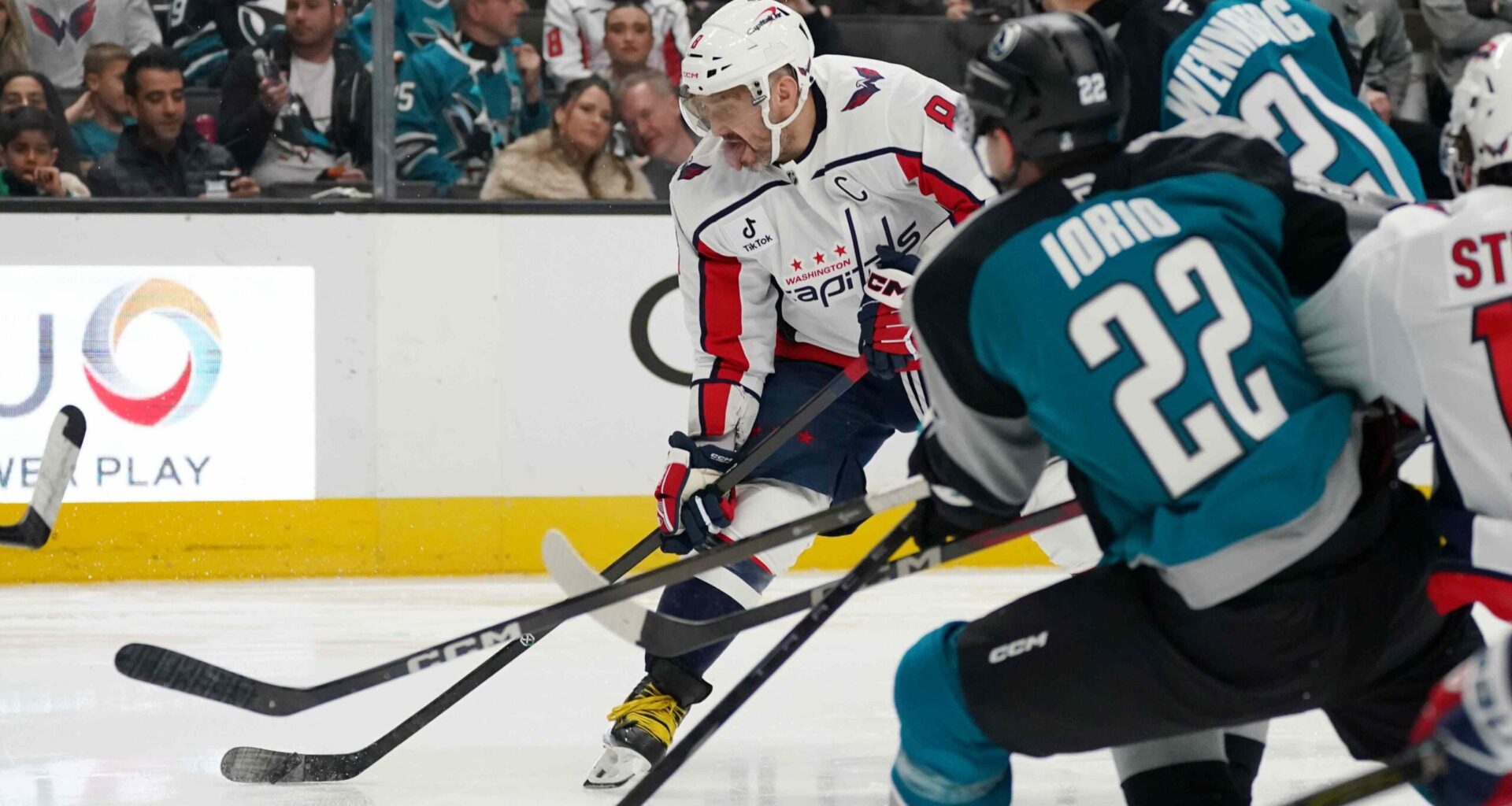
Alexander Ovechkin was on hat trick watch. Twice in the night, history was made for goals scored in the NHL. But the cost of it all was a game that the San Jose Sharks will learn from and remember for the rest of the season.
A lesson disguised as a setback.
First period
The puck was on the ice at 7:13, and the game started with chaos. Tom Wilson got a shot on goal off the bat, but Yaroslav Askarov was able to save it in a fancy fashion.
Five minutes in, the Sharks were holding their own in the Caps zone, with good playmaking courtesy of William Eklund and Adam Gaudette. After Anthony Beauvillier got a breakaway, a hooking penalty was called on him. San Jose was on their, and the first power play of the game
John Klingberg was displaying some great energy. He initially drew the penalty and was a backbone for the first half of the PP. For the second half, the Sharks weren’t able to produce. After the advantage ended, Collin Graf delivered a beautiful pass to Barclay Goodrow, but Charlie Lindgren was able to stop it. It’s clear that this team has gotten very connected.
Alexander Ovechin opened the scoring at a steep angle halfway through the frame. What else would you expect?
The physicality picked up shortly after, with a lot of hits in the corner. This was followed up by another Washington goal by Sonny Milano. But San Jose challenged the goal, and it stood. Smith took the Penalty for the Sharks.
Ryan Leonard kept it going with another Capitals goal with six minutes left.
Things were getting heated, and the Sharks’ frustration was felt throughout the SAP Center. Beauvillier took some more time in the box for tripping, putting the Sharks on the power play with four minutes left.
San Jose has the structure and the playmaking ability; they were just trying to force it. Aliaksei Protos got the breakaway, passed it nonchalantly behind him to Brandon Duhame, and that was the Capitals’ fourth goal. 4-0.
The Sharks fought for the remainder of the period, but weren’t able to change anything.
Second period
In the first minute, Mario Ferraro was in the penalty box for roughing. The Capitals were on their second power play. Who else to seal that deal than Ovechkin, with his second of the game.
The Sharks were looking shell-shocked. The length of the period was just a lot of back and forth and lot of the Capitals keeping steady while the Sharks were playing whiplashed. However, it is important to note that Ferraro, Goodrow, and Toffoli were stepping up as the players who were showing out.
In the final three minutes, the most obvious struggle was that San Jose was not shooting the puck enough. With two minutes left, Washington was outshooting the Sharks 24-17.
With a minute left, Dylan Strome added to the frustration with a snipe to the top right corner, which went in.
The period ended on that note.
Third period
It was two minutes in. Ryan Leonard saw it. He took it. He made it. His seventh of the season.
After three minutes, the Sharks got another power play opportunity because of a call on Nic Dowd for holding. This power play went the same as the others, the only difference being some good, genuine chances.
The game went on, and at 8:24, Milano hit the box for tripping.
This power play was not like the others, or, it was until Pavol Regenda got the Sharks on the board
Ovechkin went to the box for the Capitals after they tried to challenge the goal, and the Sharks were on their fifth power play.
After that ended the same way, the fight was still on. But the game died down as the Sharks still played stunned.
Postgame
Head coach Ryan Warsofsky was blunt following his team’s 7–1 loss, emphasizing that the issues went far deeper than a single bad night.
“There’s more of a concern how we don’t compete consistently,” he said, stressing that the responsibility is shared throughout the organization. “It’s up to coaches and us as a group to figure that out. Do it more consistently,” he said.
Warsofsky described how one mistake ignited a sequence the Sharks couldn’t recover from. “It just snowballs out of control, really. We turn one over, and it goes on the power play, and it goes in the back of our net, and next thing you know, the momentum shifts dramatically.” He added.
He framed the blowout as a necessary reality check for a young team that may have started to feel too comfortable after small stretches of progress.
“This is more of a reality check… we get comfortable having a little bit of success, and we think sometimes it’s going to be a little bit easier for us. And this is a tough league, and when you play some really good teams, they compete, shift in and shift out.”
Warsofsky didn’t hide his frustration with the team’s play without the puck, either. “Our defense was terrible,” he said, summing up a night where breakdowns and lost battles repeatedly turned into quality chances against.