
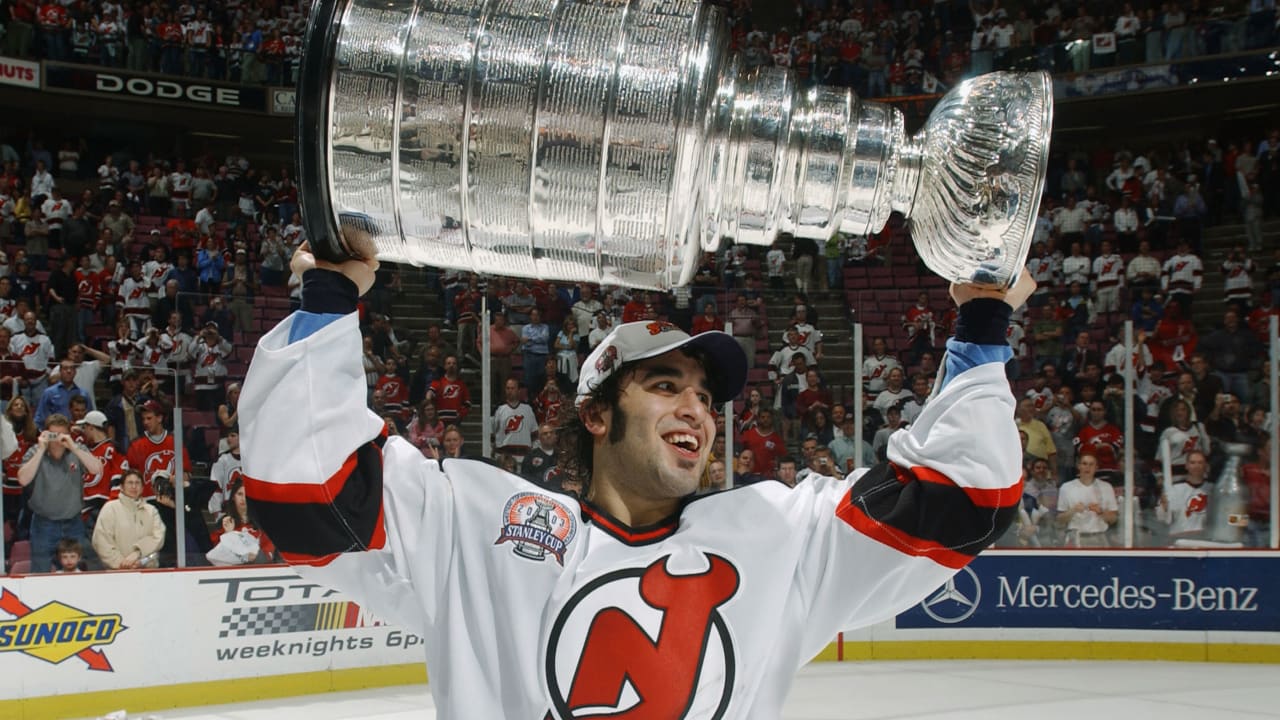
Brian Gionta, a 2019 inductee into the U.S. Hockey Hall of Fame, met Gomez at that U16 selects camp in 1996 and benefitted from Gomez’s passing skills at several stops throughout their careers with USA Hockey, New Jersey and Montreal. Playing on a line with Gomez and Patrik Elias, Gionta scored 48 goals in 2005-06 to set the Devils’ single-season record.
“Classic ‘Gomer’ was him coming through the neutral zone, head up and just kind of shimmy shaking and then distributing it out from there,” Gionta said. “That’s what he was the best at, and I think he was ahead of that generation now where you see it happen more often. I wanted to get to the spots to score goals and so it was basically for me, ‘How do I match his speed to get the puck where I want it?’
“I was always just trying to find spots for him to find me. That’s why it worked. He was a passer, and I wanted to be the shooter.”
During an era when New Jersey was known for its defense, Gomez was a key cog in an underrated offense that was second in the NHL in goals in 1999-2000 (251) and led the League in 2000-01 (295). Alexander Mogilny was sixth in the NHL with 43 goals playing on Gomez’s line in 2000-01, and Elias tied for fourth with 38 goals playing with Gomez in 2003-04, when Gomez tied for the League lead with a career-high 56 assists.
Gionta was sixth in the League in goals in 2005-06, when in addition to having 51 assists, Gomez set career highs with 33 goals and 84 points.
“I think a goal-scorer would enjoy with a player like Scotty because he would hang onto the puck, and then all you had to do was get in the right spot and he’d find a way to get you the puck,” Lamoriello said. “He was a passer; he wasn’t a shooter. But he could draw players towards him and create holes and opportunities, and he did that very well.”
Gomez also brought a swagger — and some light-hearted humor — to a team filled with future Hockey Hall of Famers such as Mogilny (inducted this year), goalie Martin Brodeur, and defensemen Scott Stevens and Scott Niedermayer. Gomez’s confidence was evident during his first interaction with Lamoriello, about six months before the Devils drafted him.
While at training camp for the 1998 World Junior Championship in Hackensack, New Jersey, Gomez and the rest of the U.S. team attended a Devils game against the Rangers in nearby East Rutherford. Some of the players were invited into Lamoriello’s office to see his 1995 Stanley Cup ring.
Entering the office before Lamoriello arrived, Gomez and his teammates couldn’t help noticing the white marker boards displaying the Devils’ organizational depth chart, including a list of their top prospects.
“Someone said, ‘Hey, I’ll give you 20 bucks if you put your name on there,’” Gomez said. “I was like, ‘All right.’ So, I go up and put Gomez on the list. Then, Lou comes in and talks to us and at the end, he goes, ‘Does anyone have any more questions?’ I go, ‘Yeah, I do.’ And I turned and I go, ‘Why is my name so low on this list? I’m better than all these guys.’”
Gomez acknowledged, “I never would have done that,” if he’d known Lamoriello’s stern reputation and noted that USA Hockey officials in the room were not pleased.
“They were all waiting for Lou to do something,” Gomez said. “And Lou was like, ‘There’s something different about that kid.’”
“That’s a true story, absolutely,” Lamoriello said. “But you looked at it as somebody comfortable in his skin and certainly confident, which is what he had. He was confident in what he did. He believed in his abilities. Just every once in a while you had to have a nice talk.”
Gomez views it now as, “kind of like destiny,” that he ended up with the Devils and includes Lamoriello on a long list of his biggest influence, along with former teammates such as Brodeur, Stevens, Niedermayer, Gionta, Ken Daneyko, Bobby Holik, Randy McKay, Jim McKenzie, Turner Stevenson and Jay Pandofo, who is now coach at Boston University who Gomez said was “like an older brother.”
Going back further, Gomez credits his coaches in Alaska, Scott McLeod and Rob Larkey, his high school English teacher Lou Chandler, former Surrey coach Rick Lanz, and, of course, his parents, Carlos and Dalia. Growing up in a diverse community in Anchorage, Gomez considered himself, as a Mexican-Colombian American, part of the “melting pot” in Alaska.
“It was never like, ‘I’m a Mexican hockey player.’ You were Alaskan,” he said. “And it was funny because when I made the U.S. select-16 team, I’ll never forget I was in the locker room and it was like, ‘I’m the only brown guy in here.’”
It wasn’t until Gomez was repeatedly questioned about his heritage when he reached the NHL, though, that he began to understand he could be a role model for other Latino players. He remembers his father telling him, “Just go with it,” so when reporters would ask about being a Mexican-Colombian from Alaska, he’d joke, “They dropped me off at the border with a pair of skates and two bottles of tequila and magic happened.”
The number of bottles in the joke varied, but, ultimately, Gomez realized he could make the most impact with his play.
“It was part of the gig, but the thing with hockey was it didn’t matter,” said Gomez, who is in his first season as coach of Chicago of the United States Hockey League. “It was if you could play. And I’ve still got it today. Yeah, I grew up in Alaska. There was ice.
“It’s not an easy sport, but that was always my saying: ‘It doesn’t matter, the race. If a kid sees in whatever sport, if that kid can make it, that’s the result.’”