
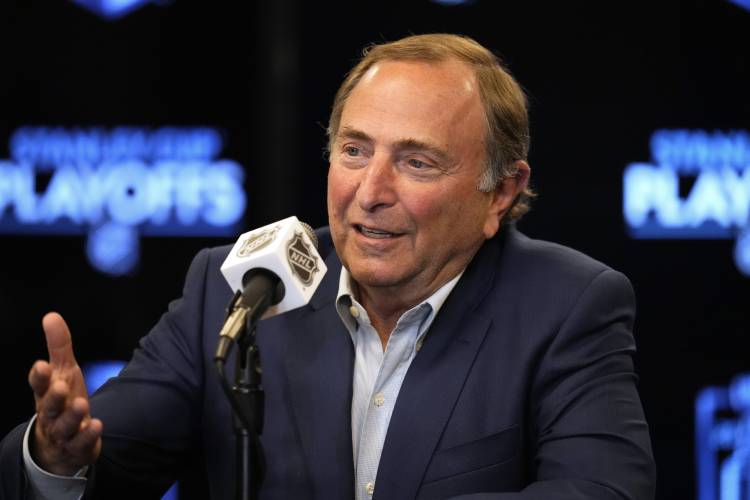
AMHERST — NHL Commissioner Gary Bettman engaged in a 90-minute discussion at UMass’ Integrated Learning Center on Tuesday night, expounding on a variety of topics in a conversation with former NHL executive Brian Burke, including the commissioner’s early days on the job and advice on how to make it in the sports industry.
The talk was part of UMass’ Mark H. McCormack Department of Sport Management executive-in-residence program, and attracted a couple hundred or so attendees
Will Norton, director of the McCormack Center introduced both guests, then Bettman began the keynote talk with a brief overview of his career before the NHL, which began as an undergraduate at Cornell during the 1970s with the desire to study law, to his position with the NBA that lasted for 12 years.
In 1993, Bettman became the NHL’s commissioner and revealed what went into his decision to leave his job as general counsel for the NBA while working for his mentor and former commissioner, David Stern.
“The NHL was in need of somebody to take over and try and modernize and the owners liked what the NBA was doing, which is, I guess, one of the reasons they came knocking on the door,” Bettman said. “David repeatedly said ‘you don’t have to do this. You can stay here with me forever, maybe at some point you could even succeed me.’ But I was given an opportunity to do my own thing, to be the person who had to make the final decisions and I didn’t think that it was an opportunity that I could miss.
“I had passion for hockey going to Cornell,” Bettman added.
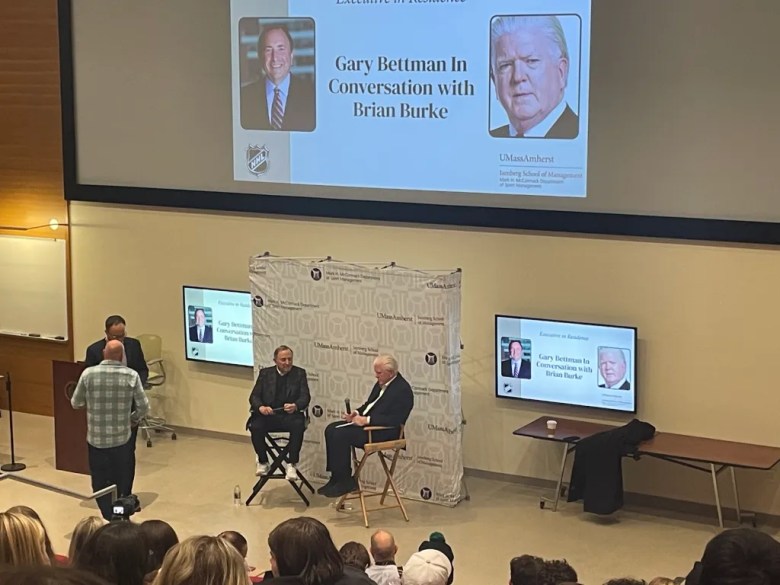 NHL Commissioner Gary Bettman, seated left, and former NHL executive, Brian Burke, seated right, prepare to discuss their careers as part of the Mark H. McCormack Department executive-in-residence program at UMass on Tuesday night. RYAN AMES/Gazette
Bettman then delved into the notorious 2004-05 lockout the wiped out the entire NHL season, with the primary point of contention between the owners and the players union being the owners’ insistence on implementing a salary cap.
“I made all the preparations necessary to lose a season if we had to,” Bettman said. “This time I went to the [players’] union and I said, ‘we have to have a salary cap and we’re not going to play unless we get one.’ Salary cap coupled with revenue sharing, where that way, all clubs could be in a position to compete.”
A deal wasn’t reached until the summer of 2005 and the league returned to action the following fall after the union eventually acquiesced to the owners’ demands. The NHL, in turn, had new infrastructure that included a salary floor (i.e. a league-wide minimum every team had to spend to ice a roster), that Bettman felt changed the game for the better.
“What happened in the late 90s and early 2000s, before we took the year off as I euphemistically call the year-long lockout, season cancellation, is the game wasn’t very good,” Bettman said. “The reason the game wasn’t very good, it was because we had a disparity in what teams were spending and what they could afford to spend on payrolls that was unsustainable. We had teams with $90 million payrolls … and then we had teams with $20 million payrolls.
“I would talk to the coaches of the $20 million teams and go, ‘how do you compete against the $90 million team that has lines skating with five future Hall-of-Famers?’ The response was, ‘we clutch, we grab, we hook, we hold,’ and, in effect, was a euphemism for ‘neutralizing the skill that we don’t have. We do that for 50 minutes and generally unsuccessfully, we try to steal the game in the last 10 minutes.’ It made for boring hockey, no lead changes,” Bettman said.
After, Bettman hit on the league’s expansion since his tenure. The NHL has grown from 24 teams in 1993, to 32 following the Seattle Kraken’s formation in 2021 and Bettman outlined what he looks for when deciding on potential new franchises.
“The most important thing for any franchise in any sport is ownership,” Bettman said. “The second is market, it’s got to be a good market. When we decided to go to Las Vegas, it was, at the time, the largest U.S. city that didn’t have one of the four major sports.
“The third, there needs to be an arena,” Bettman continued. “We had problems from day one in Arizona because we didn’t have a suitable arena. And fourth, will it make the league stronger?”
Later on, Bettman discussed how the NHL maneuvered through the COVID-19 pandemic in 2020. Burke complimented Bettman, saying it was the commissioner’s “finest moment,” because all the players were paid 100% of their contracts, despite the shorter-than-normal, 56-game schedule in 2021-22.
The conversation was capped off highlighting the NHL’s philanthropic efforts, plus some words of wisdom from Bettman.
“You have to have a passion for what you’re doing,” Bettman said. “You can’t be successful if every day you wake up and you dread going to work. It should be something that’s meaningful to you and that you’re excited to do.”
Bettman and Burke then spent the final 35 minutes answering questions submitted to the McCormack Department’s various social media platforms and engaged with UMass hockey’s head coach, Greg Carvel, who was in attendance, on how college hockey is dealing with the new landscape of college athletics.
McCormack department chair Dr. Matt Katz concluded the event by presenting Bettman with a ceremonial plaque, honoring the commissioner’s visit to campus.