
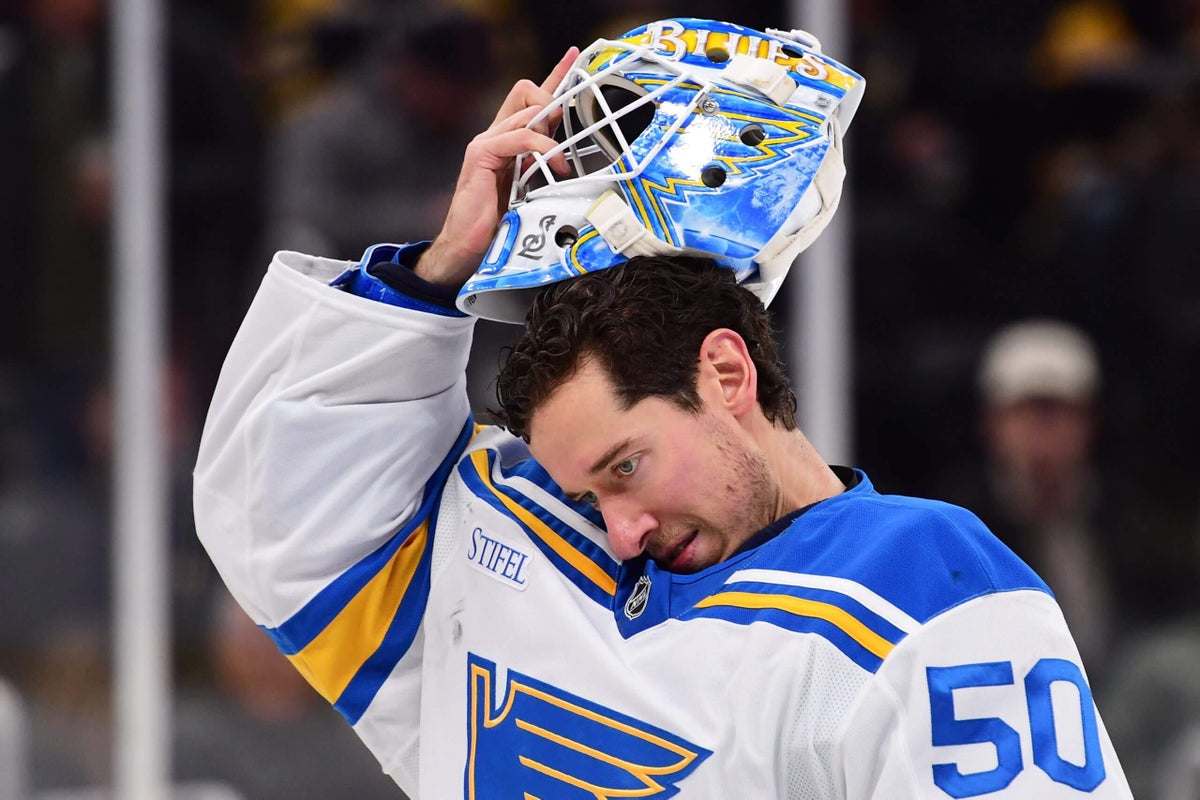
By now, if you’re wanting more from the St. Louis Blues, you’re probably asking for too much.
Before that can happen, they have to want it, and that’s obviously not the situation because if there’s one category the Blues lead the NHL in this season, it’s their coach talking about a lack of effort.
“It’s an effort thing,” Jim Montgomery was forced to say again after a 5-2 loss to his former club, the Boston Bruins, Thursday night.
Asked if he’s surprised to still be talking about that this deep into the season, he replied: “Yes.”
Not that the Blues’ two-game winning streak over the Ottawa Senators and Utah Mammoth had anybody’s heart pumping, but that, too, is now long forgotten. Since winning those back-to-back games for just the second time this season, they’ve been buried in back-to-back losses to the Anaheim Ducks and the Bruins.
They fell to 9-12-7 for 25 points and a .446 points percentage, which is fourth-worst in the NHL. They are the only team in the entire league without a double-digit win total.
Next up is Ottawa on Saturday and the Montreal Canadiens on Sunday, which, interestingly, are two teams whose games Blues’ management staff have been in attendance for recently. That likely has little to do with prepping for those opponents and more with identifying potential trades.
The Athletic’s trade board last month listed three Blues players among the top 25 candidates: captain Brayden Schenn at No. 6, Justin Faulk at No. 8 and Jordan Kyrou at No. 20. And as the losses pile up, that speculation will only grow.
The NHL’s holiday trade freeze this season will run from Dec. 20-27, so there are just 15 days before that goes into effect. But it’s no certainty that clubs will be ready to make deals with the Blues before then, and, in fact, there’s no guarantee that anything may happen until the league’s trade deadline March 6.
There’s a lot of hockey left before those two days — nine games until the holiday freeze and 34 games until the trade deadline. Other than the occasional spark, will the rest of it even be watchable?
There’s no real shame in losing to Anaheim and Boston, who are No. 1 in the Western Conference’s Pacific Division and No. 2 in the Eastern Conference’s Atlantic Division, respectively.
It’s that they only managed just three goals combined against two backup goaltenders in the Ducks’ Ville Husso (.821 save percentage going into the game) and the Bruins’ Joonas Korpisalo (.880 save percentage). Husso and Korpisalo, however, combined to make 58 of 61 saves (.951 save percentage) against the Blues.
They have scored two goals or fewer in nine of their last 10 games, and with the losses to Husso and Korpisalo, the team is just 3-5-2 against backup goalies this season.
“We need to be hungrier offensively, and that means sacrificing,” Montgomery said earlier this week. “You’ve got to have two guys inside the dots offensively. This league, if you don’t score off the rush, it’s built off of screens, tips, rebounds, primarily.
“Everybody wants to score the goal; no one wants to be the person screening it. But we need more people’s faces looking like Jake Neighbours’ face, and Oskar Sundqvist’s face.”
That’s not the case, of course, and a closer look is even more alarming.
In their last 10 games, covering 30 regulation periods, they have scored no goals in 15 of those periods and one goal in 12 of them — so 27 of 30 periods they have had one goal or less. As far as shot attempts, they’ve had fewer than 10 in 21 of those 30 periods.
“It’s obviously frustrating,” Blues forward Jake Neighbours said. “We’re getting chances and obviously not doing a great job of finishing them right now. That’s something we can improve upon. When we do get our looks, we’ve got to bear down and finish on them. It’s easier said than done, but that’s what needs to be done.”
Through 28 games, the Blues’ leading scorer is Jordan Kyrou with just eight goals. After netting 36 goals last season, and 30-plus in each of the last three seasons, he’s on pace for just 23. His shot attempts per game are down from 2.9 in 2024-25 to 2.57 this season, and his shooting percentage is down from 15.1 to 12.1.
“Overall on the season, I would say that Jordan has not gotten to the same amount of areas — scoring areas — as he did last year,” Montgomery said. “Some of that is team-related, some of that is personal-individual related.”
Dylan Holloway has seven, while Robert Thomas and Pavel Buchnevich are still stuck on four. Defenseman Justin Faulk (6 goals) and rookie Jimmy Snuggerud (5) have more and Nick Bjugstad (4) is tied.
It speaks volumes when your lineup loses two players to injury — Alexey Toropchenko (leg burns from off-ice incident) and Nathan Walker (upper-body injury) — and the resulting impact on the fourth line has caused more concern about the team’s five-on-five offense than the top lines.
“We have a lot of gifted offensive players that haven’t found the back of the net as often as they’re used to and sometimes you don’t have the same poise,” Montgomery said.
The coach compared the Blues’ current production to that prior to the 4 Nations Face-off last February, and said it’s not too dissimilar.
This season, they’re averaging 2.54 goals per game and allowing 3.50 per game. A year ago, they were averaging 2.7 goals per game and allowing 3.05 per game before going on an incredible run, averaging a league-best 3.81 goals per game and allowing 2.31 per game.
“I would say it’s a surprise that we’re not scoring more than we have,” Montgomery said. “I think you start the year off and everybody has goals and objectives, and everybody is in an incredible mindset. Then when things don’t go your way, there’s a transition into losing confidence, and when you lose confidence, you wonder what you’re not doing. That’s where us as coaches come in.”
Several players said they weren’t comfortable offensively because of the frequency of goals they were giving up, so the defense needed to be fixed first.
Montgomery acknowledged that the defensive system has been overhauled recently from a zone system to more man-to-man, which he used when he coached the Dallas Stars. It allows the Blues to be more aggressive, engaging in more physical contact.
It also lets the goalies see more pucks, which was important because of the struggles they were having. It’s easier to box out when you’re playing man-to-man than zone and second-chance rebounds aren’t as prevalent because there aren’t as many uncovered sticks.
“The results have been positive compared to the way it was before,” Montgomery said this week.
That was beginning to look true, as the Blues put the clamps on Ottawa and scored a few late goals in the third period of their 4-3 win over the Senators, and then blanked Utah 1-0.
But now, they’re back to having their effort questioned.
“It starts from within — from everybody,” Montgomery said.
The coach may be asking for too much from this team.