
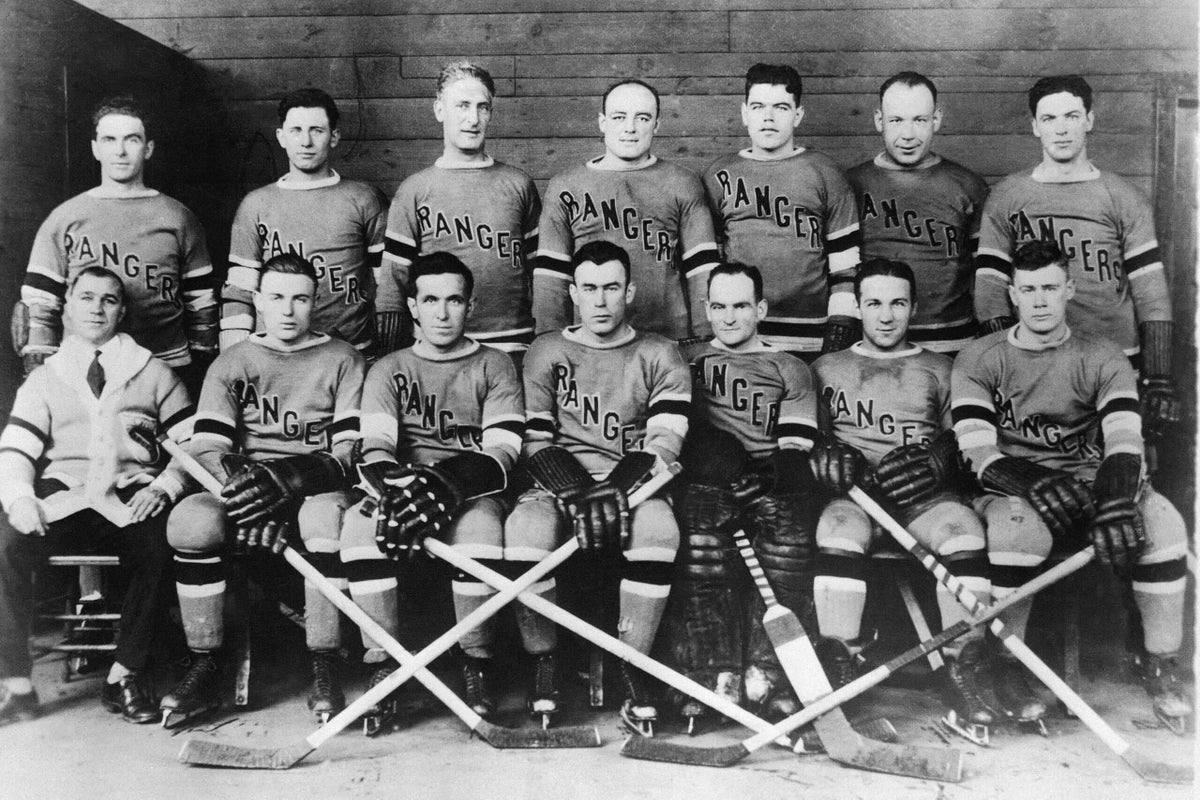
Editor’s note: This is the first in a four-part season-long series looking back at the New York Rangers’ four Stanley Cup wins as the team celebrates its centennial season.
For present-day fans of the New York Rangers, who have seen only one championship in the last 85 years, it may be hard to fathom that the original Blueshirts captured a Stanley Cup only two seasons into their existence.
A heap of the credit belongs to Conn Smythe, who went on to become the principal owner of the Toronto Maple Leafs and have one of the NHL’s most coveted trophies named after him. Before Smythe helped guide the Leafs to eight titles over 30 years, however, the Rangers’ first team president, Colonel John S. Hammond, hired him to assemble a roster for the new franchise in 1926.
Paid $10,000, Smythe hit the road to recruit players. One of his top priorities was visiting the Cook brothers, Bill and Bun, at their Saskatchewan farm. Getting them on board gave him a pair of scoring wingers to propel the Rangers’ top line, with Bill suggesting Ottawa native Frank Boucher, who would need to be purchased from the Boston Bruins, as a fine choice to be their center.
In his 1973 book entitled “When The Rangers Were Young,” Boucher recalled Smythe as “a cocky, stocky, abrasive little man” and remembered their first exchange:
“What do you weigh?” were his first words.
“Around a hundred and thirty-five or so,” I said.
“I paid fifteen thousand dollars for you,” Smythe grunted. “Bill Cook must be crazy.”
As it turned out, Cook was prophetic.
One hundred years later, that trio remains one of the greatest lines in franchise history. The three players led the Rangers to a 25-13-6 record and first-place finish in the American Division in their inaugural season, with Bill Cook winning the league’s scoring title with 33 goals. They’re credited with inventing the drop pass, which Boucher claimed was conceived over beer in the Cook brothers’ New York apartment.
Smythe also signed Ching Johnson, who became the Rangers’ rugged leader on defense, and his partner, Taffy Abel, among others, to set the foundation for a team ready to contend right away. He didn’t last long enough to see the fruits of his labor, though. A dispute over Babe Dye, a Toronto St. Patricks forward whom Smythe had declined a trade offer for, led to Hammond replacing him with new manager Lester Patrick at the onset of the 1926-27 season.
That promising first season ended in the semifinals with a loss to the Bruins, followed by a 1927-28 regular season that was not quite as successful for the Rangers. They went 19-16-9 to finish second to Boston while enduring what Boucher called “the strangest month in Ranger history” that February. They were shut out in four consecutive games at one point and went 341 minutes, 42 seconds without scoring, prompting captain Bill Cook to enforce a no-drinking policy until the slump ceased.
The Rangers finished the roller-coaster month with four straight shutout victories of their own, with the Bread Line, as Boucher and the Cook brothers came to be known, leading the charge. Boucher finished as the division leader with 23 goals that year while being awarded the Lady Byng Trophy. Bill Cook was voted as the NHL’s best right wing, finishing with 18 goals and six assists, while Bun added 14 goals and 14 assists.
New York also benefited from the addition of goalie Lorne Chabot, who posted a 1.74 goals against average and 11 shutouts while playing in all 44 games that season. As the team’s only netminder, Chabot played a key role in helping the Rangers upset the Bruins in the 1928 semifinal round.
On the Canadian side of the bracket, the Montreal Maroons pulled off an upset of their own by defeating the crosstown Canadiens. That set up a Stanley Cup Final in which every game in the best-of-five series would be played at the Montreal Forum because Madison Square Garden, then located on Eighth Avenue between 49th and 50th streets, had booked the circus for the month of April.
The Canadian Division was considered superior — the only American team to win the title at that point was the 1916-17 Seattle Metropolitans — and the Maroons reinforced their position as favorites with a 2-0 victory in Game 1. Game 2 would produce a story that still lives in hockey lore.
With the game scoreless in the second period, Chabot was struck in the left eye by a backhand from Maroons forward Nelson Stewart. The Rangers, who carried only 13 players and had no backup goalie, were suddenly in a tough spot. The referee ordered both teams to the dressing rooms as Patrick, Maroons coach Eddie Gerard and league president Frank Calder debated how to proceed.
The Rangers spotted Ottawa Senators goalie Alex Connell in the crowd and asked for permission to use him, but the Maroons “balked” at the idea, as the New York Daily News reported at the time. Boucher recalled Smythe, who was also in attendance, entering the visiting dressing room and bellowing, “Hang the nets on me and I’ll go in there.” As the chaotic scene played out, Boucher and Bill Cook came up with a plan: They pulled Patrick aside and suggested that their 44-year-old coach step in.
Patrick was an excellent defenseman in his day, but he hadn’t played professionally in three years. His goaltending experience was limited to what equated to beer-league settings. With few other feasible options, however, Patrick agreed, calling over Rangers trainer Harry Westerby to request Chabot’s gear and “a dry set of underwear,” as Boucher recalled. Then, he asked Pittsburgh Pirates coach Odie Cleghorn, who was also there to watch the game, to take over for him on New York’s bench.
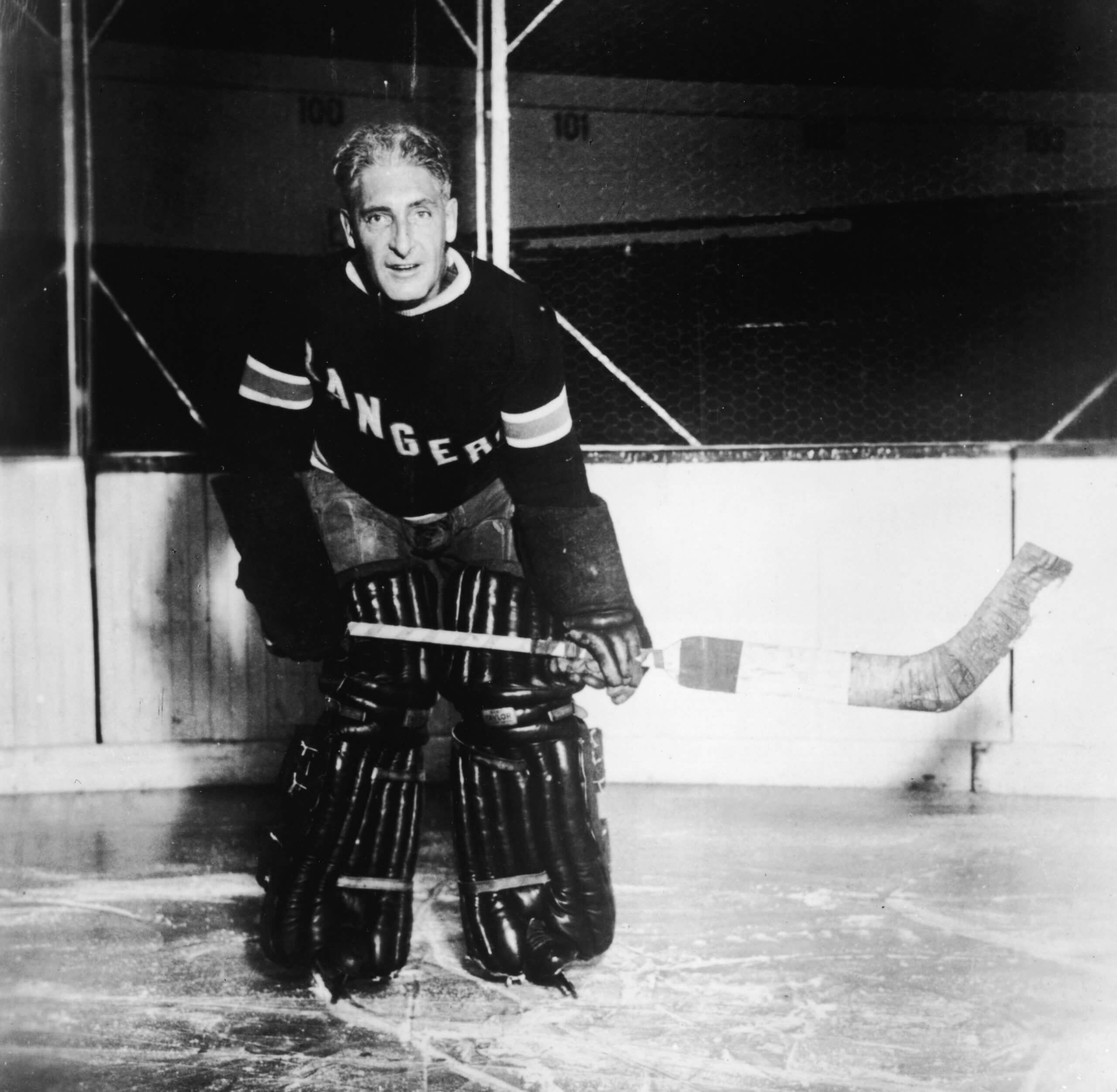
Lester Patrick poses on the ice while wearing goalie gear in 1940. While coaching the Rangers during the 1928 Stanley Cup Final against the Montreal Maroons, Patrick, then 44, was forced to step in as goaltender after Lorne Chabot was injured. (Getty Images)
The game resumed after a 25-minute delay, with the Rangers committing to “a strong back-checking game,” as the Daily News wrote. Despite Patrick’s cries to “Let them shoot!” he didn’t face a shot in his first five minutes in goal. (Cleghorn responded, “For God’s sake, don’t let them shoot!” as Boucher remembered.)
Bill Cook gave New York a stunning 1-0 lead 30 seconds into the third period, but Stewart would tie the score on a long shot that went between Patrick’s legs with less than six minutes remaining. That sent Game 2 to overtime, where Boucher would tie the series at one game apiece with one of his four game-winning goals in that year’s playoffs.
The New York Times described the atmosphere in Montreal as “more like a riot than a game,” the result of bitter Canadiens fans who attended the game to root against the rival Maroons.
“Scenes were witnessed in the Forum, as the teams battled into overtime, that had never taken place before, even in this hockey-mad community,” the Times reported. “It was a shouting, wild, hysterical crowd.”
While Patrick’s captivating story caused an uproar and grabbed headlines, an unlikely hero emerged in the aftermath. After meetings preceding Game 3 between Patrick, Calder and Montreal management, the Rangers were permitted to sign Joe Miller, who had spent that season as the goalie for the last-place New York Americans.
Known as “Red Light Miller” for all the goals the Americans allowed, he would win two of the series’ final three games to help the Rangers seize the Cup. New York lost Game 3, but Miller shut out the Maroons in Game 4 and stuck it out in Game 5 despite taking a stick between the eyes in the first period.
Boucher would score both goals in the clinching 2-1 victory, with each coming off his own faceoff wins. The first, which the Times described as “one of the prettiest pieces of work ever seen in hockey,” came after slapping the puck forward along the boards, then racing ahead and slipping it between defenseman Red Dutton’s legs to create his own breakaway. Boucher would score four of the Rangers’ five goals in the series and finish with 10 points (seven goals and three assists) in nine playoff games. No other player on any playoff team posted more than Bill Cook’s five points.
The Rangers returned to New York with the Cup — “The first time the much-battered and inscribed cup has crossed the border in the East,” wrote the Times — and were celebrated with a dinner at City Hall hosted by Mayor Jimmy Walker. From there, many returned to their Canadian homes, the Times reported, where Boucher would spend the offseason “roughing it and building up after the wear and tear of the season” while the Cook brothers “turned their attention to wheat-growing.”