
LOS ANGELES — When news broke in early July 2022 that Chicago Blackhawks general manager Kyle Davidson had traded Alex DeBrincat — all of 24 years old and already an elite goal scorer in the NHL — to the Ottawa Senators for draft picks, I was walking from my hotel to the Bell Centre in Montreal for that evening’s draft. I was so stunned by the trade, and so disgusted with what it signified — that Davidson was going into full tank mode — that I sat down on the steps of the church I was walking by, pulled out my laptop and immediately banged out 1,222 words of righteous indignation. I couldn’t even wait five more minutes to get into the arena.
Over the next week, as Davidson dealt away Kirby Dach to pick some undersized center named Frank Nazar, let Dylan Strome walk for nothing, took on Petr Mrázek’s bad contract to reach for some high school project named Sam Rinzel, and made move after move that made the Blackhawks demonstrably worse, all in a blatant long-shot attempt to win the right to draft Connor Bedard in the lottery, I repeatedly tore into Davidson.
I called it “gross.” I called it “contemptible.” I called it “a crappy way of doing business,” given the fact that ticket prices weren’t likely to drop along with the Blackhawks’ standing. It was the most aggressive teardown in modern NHL history, a naked attempt to put together the worst team possible. The Blackhawks pushed Patrick Kane out the door and never offered Jonathan Toews another contract. It was the tank to end all tanks. No one was more critical of this rebuild than I was.
And you know what? It was gross. It was contemptible. It was crappy.
It was also clearly prudent. Smart. The correct path to take.
The Blackhawks did get Bedard. Nazar turned out to be a burgeoning star. Rinzel is an NHL regular with a high ceiling. Davidson has made 11 first-round picks in the last four years, something that’s never been done before. And he and his scouting staff have hit on nearly all of them so far, with two more first-rounders to come this summer. The Blackhawks are in a playoff spot years ahead of schedule, Bedard is everything he was made out to be and then some, and there are so many high-end prospects still on the way.
Davidson did it. And he did it faster than anyone had the right to expect.
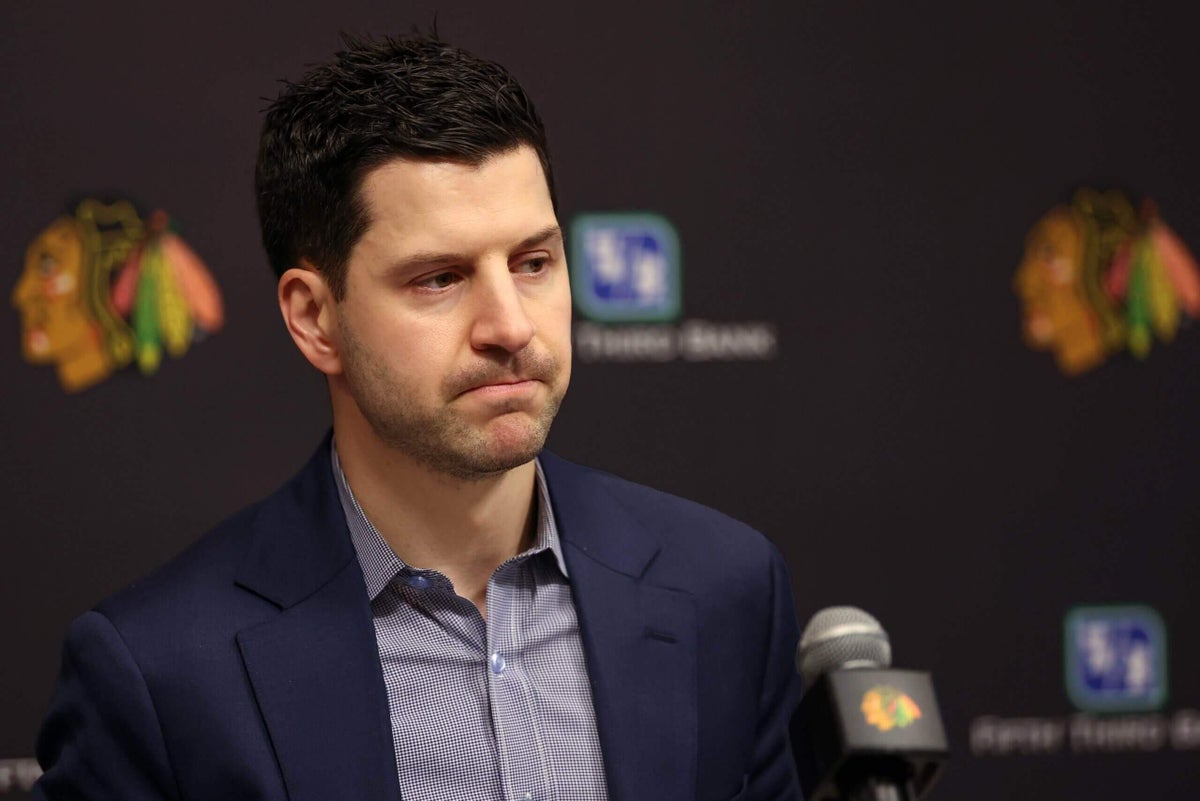
So as we sat in his box high above the ice at Crypto.com Arena on Thursday night, before the Blackhawks’ 2-1 victory over the Los Angeles Kings, I opened our conversation by flat-out offering Davidson the chance to say, “I told you so.”
“Not yet,” Davidson said with a laugh.
“It’s not about that at all,” he continued. “We’re having a nice start, but I don’t think we’ve accomplished anything close to what we want to, right? There’s a lot of work left to do, a lot of development that needs to occur still (before we can) say that we’ve accomplished something. But I really like where we’re at. And I really like where we’ve come from. There was a lot of pain that went into that, but the progress has been very tangible.”
One of the biggest arguments against tanking is that no team in the cap era has truly built a championship team strictly through high draft picks, by completely gutting a franchise. The Buffalo Sabres haven’t made the playoffs in 14 years. The Detroit Red Wings seem to have hit their ceiling just outside the Eastern Conference playoff picture. The Arizona Coyotes never made much headway. And the Blackhawks — like the Anaheim Ducks and San Jose Sharks — still have a long way to go to break that trend.
But it’s also clear now that it’s the only way you can build a contender anymore. The soaring salary cap has all but killed free agency, as major stars aren’t making it to unrestricted status anymore. Connor McDavid re-signed with the Edmonton Oilers, Kirill Kaprizov re-signed with the Minnesota Wild, Jack Eichel re-signed with the Vegas Golden Knights and Adrian Kempe re-signed with the Kings. There might not be a viable top-line player available this summer, certainly not one in his prime. Even the kinds of savvy trades that landed Davidson the likes of Jason Dickinson and Ilya Mikheyev — both cap dumps for the Vancouver Canucks — are less likely to happen these days. You can’t weaponize cap space when everyone has cap space.
“The flat cap (post-COVID) was definitely something that was advantageous to where we were at that period,” Davidson said. “We did take advantage of that.”
We’ve all spent the past few years wondering who this generation’s Marián Hossa would be, who this generation’s Brian Campbell would be — the free agents who serve as statements of intent that the Blackhawks are now ready to compete, the high-end veterans who would catalyze and expedite the rebuild.
The answer is: There won’t be one. The new NHL doesn’t really allow for that.
In hindsight, Davidson’s rebuild looks all the more prescient because of the soaring cap. Was that on purpose? Did he anticipate the end of free agency as we know it? Not exactly. But he never counted on it, either.
“My thought was always build from within,” he said. “That was always the belief. Everyone calls back to the Hossa signing, or (Campbell). Which I get. But there were rules and a system in place at the time. Marián Hossa wouldn’t be coming as a $5 million player under today’s structure; he’d be coming in much higher. Under the current system, that team doesn’t get to keep Duncan Keith on a 13-year deal. It’s a different build, a different model. So (free agency) wasn’t anything I was banking on.”
That’s not to say he’s ruled it out. But if any big names are coming in — and that’s a big if — it’s more likely to happen via trade than free agency. When you have as many top prospects as the Blackhawks do, eventually some of them become assets to trade away.
That won’t happen this season, though. Davidson is clear that the Blackhawks’ surprising competitiveness won’t knock him off the path he’s been walking for more than three years. He did, however, say he’d be perfectly happy to keep pending UFAs such as Dickinson, Mikheyev and Connor Murphy at the trade deadline if the Blackhawks are still in it. After all, how many fourth-rounders in 2029 does one GM need?
After years of accumulating draft picks, Davidson isn’t shifting into win-now mode, but he is entering win-soon mode. Winning now is a bonus.
“Trading some of these young players for a rental doesn’t feel like it would be in the cards,” Davidson said. “But if someone’s there with term and that fits, then why not? You’re always exploring that, no matter the time of year. If you can plug a hole in your roster for a long time, we’ll always look at that.”
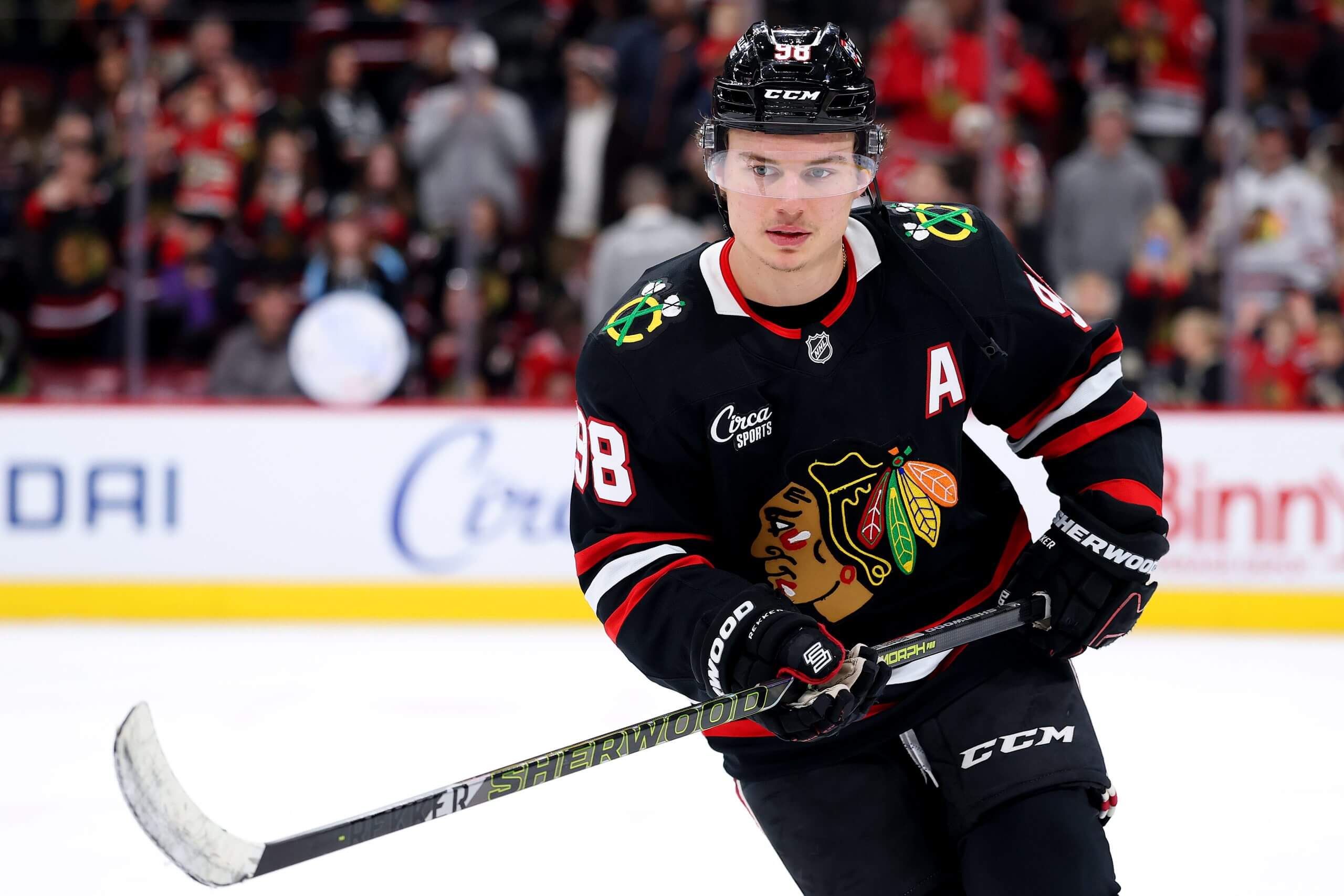
Connor Bedard is everything he was made out to be and then some for the Blackhawks. (Michael Reaves / Getty Images)
It’s remarkable how fast everything has changed. The Blackhawks were atrocious last season, Bedard was perceived as merely very good, not necessarily great, and that promised future felt so far away. A third of the way into this season, though, the Blackhawks players openly talk about the playoff race. This team gave the mighty Colorado Avalanche one of their toughest games of the season in a 1-0 loss. The Blackhawks have hung with Vegas, beaten the Tampa Bay Lightning, beaten the Toronto Maple Leafs, whipped Ottawa, and have been in every game but one or two.
And they’re just getting started. Oliver Moore, Artyom Levshunov and Rinzel are just getting their feet wet in the NHL. Nick Lardis is lighting up AHL goalies the way he lit up OHL goalies. Roman Kantserov is crushing it in Russia, Marek Vanacker has 24 goals in 24 games for the Brantford Bulldogs, and Anton Frondell has been a productive player in Sweden’s top league as an 18-year-old.
We entered the season wondering if the Blackhawks had enough players to fill out a viable top six. Now we’re wondering if the Blackhawks have enough top-six spots for all these players. Bedard was a first-rounder. Nazar was a first-rounder. Moore was a first-rounder. Vanacker was a first-rounder. Frondell was a first-rounder. Levshunov and Rinzel were first-rounders. On and on it goes.
Like it or not — and again, I did not like it one bit — the Blackhawks have all these players because they sacrificed what promised to be mediocre-at-best years for the promise of championship ones ahead. In other words, because of the tank.
Davidson said nobody ever criticized him to his face, but you have to wonder if the other GMs were laughing behind the back of this 34-year-old noob who was giving away talented NHLers for pennies on the dollar. Regardless, nobody’s laughing now.
“They probably were just happy they were getting players for picks that weren’t going to help them in the playoff run,” Davidson said. “I was pretty steadfast and clear about what I was doing and where we were going. We were going to build through the draft and develop, and I’m sure there was some skepticism around that. It’s far from a guarantee that it works, and I understand that. But where we were and where we wanted to get to, at the time, I felt like I was left with no other choice. So we went there. We committed.”
Maybe Davidson will spike the football if and when the Blackhawks return to the mountaintop. Maybe then, he’ll feel comfortable telling the hockey world, “I told you so.” For now, there’s a clear sense of gratification, if not outright vindication, that the bold — and yes, a little gross, a little cynical, a little contemptible — path he led Danny Wirtz’s Blackhawks down seems to have been the right one all along.
“When players you draft develop into the players that you thought they could be, there’s vindication — not vindication, but satisfaction — in that,” Davidson said. “It’s the same when you see Connor take a step and what he’s turned into, what he’s become. Arty growing into the player you know he can be. There are always little pieces of satisfaction and excitement along the way. But again, we get into this, and we do all this to make the playoffs and make runs. We’re taking steps toward that, but until those become more regular, I don’t think the true satisfaction will set in.”