
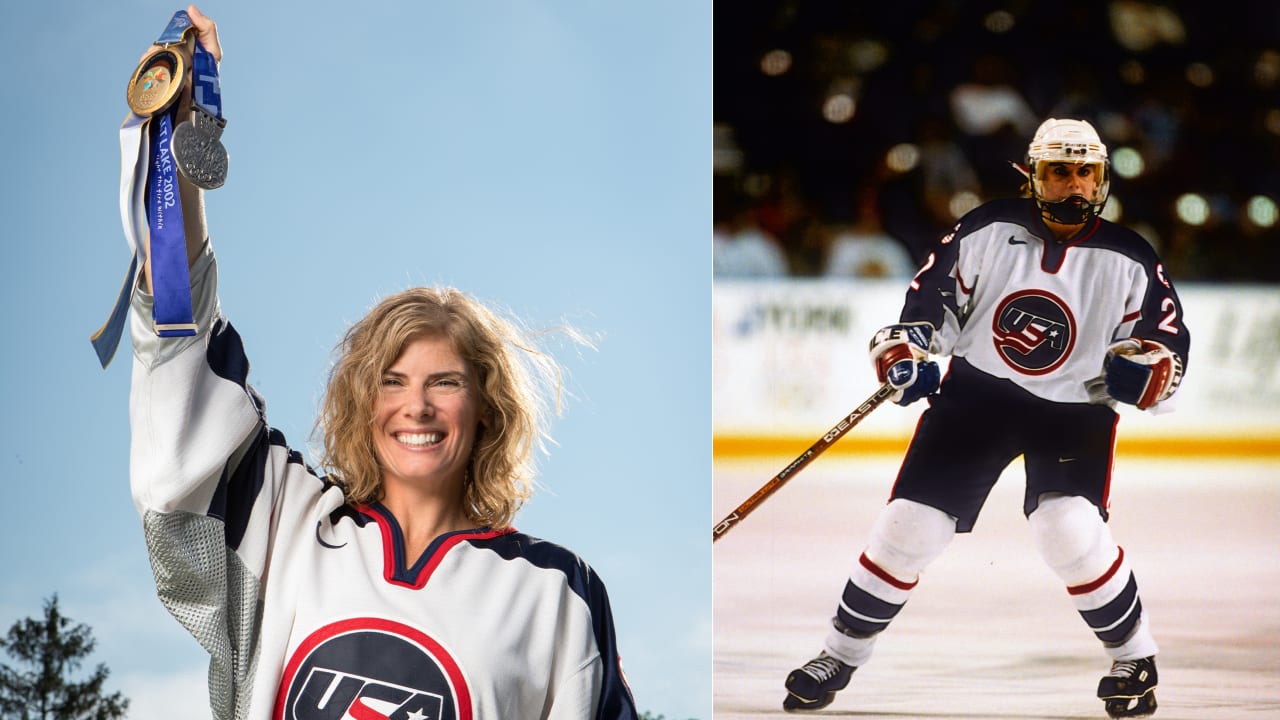
Mounsey developed into a top player before the New Hampshire Interscholastic Athletic Association added girls’ ice hockey as a varsity sport in 1999-2000. She played on Concord High School’s boys’ team and thrived, being named the 1996 New Hampshire Class-L Player of the Year.
“There weren’t robust women’s, girls’ programs back then, no stronger players, we had no choice,” she said. “I was good enough that I played right on through high school. Boys get big and strong, but I was big and strong back then, much bigger than I am now, and I held my own.”
Mounsey said her teammates welcomed her and made her captain her senior year. There were incidents along the way, but very few, she said.
“One guy decided, I was playing over him, and in practice he decides, instead of passing the puck at an appropriate speed, he’s practically slap-shooting it at me,” she said. “I’m, like, ‘Well, I’ll just catch your pass, even though it’s a slap shot, you knucklehead.’ The coaching staff saw it, took care of it. “I’m thankful for the fact that the coaching staff believed in me, accepted me, and the players believed in me and accepted me.”
Mounsey figured college hockey was in her future based on her high school performance, but another goal emerged on July 21, 1992, when the International Olympic Committee announced women’s ice hockey would be added at the 1998 Nagano Olympics.
“I had been a part of the (U.S.) national program and so once I started going in that route and getting invited to camps, I thought, ‘This is an achievable goal,’” said Mounsey, who was in eighth grade at the time. “’Yes, I’m on the younger side, but let’s do this.’ Then I just set it as a goal and worked and worked and worked to achieve it.”
Mounsey took a break from college hockey in 1997-98 to concentrate on her Olympic dream. Smith, who left his coaching job at Northeastern University to coach the 1998 U.S. women’s team, had seen Mounsey play and heard of the legend of the high-scoring, hard-hitting New Hampshire girl who took no guff and gave no quarter on the ice.
He learned quickly that she came as advertised.
“I didn’t realize she’d be as nasty as she was, that goes along with her competitiveness,” said Smith, who also coached at University of Massachusetts-Amherst, Yale University, Boston University and Dartmouth College. “Her battle approach was as good as I’ve ever been around. I’ve coached male Olympians, male pros and male college All-Americans, but the way she would stick her nose in at end of a play, work along the wall, block a shot or protect a teammate, she was just different.”
Mounsey laughed when she was told about Smith’s comments.
“I was clean, but I didn’t put up with anything out there, I was a bit of an enforcer,” she said. “Yeah, I kind of took competitiveness to the next level. I didn’t want to lose, and I took care of the people around me. My job? I protect the goalies. You don’t go near the goalie.”
Mounsey retired as a player in 2002 to pursue a career in medicine and because there was no place for her to go in hockey.