
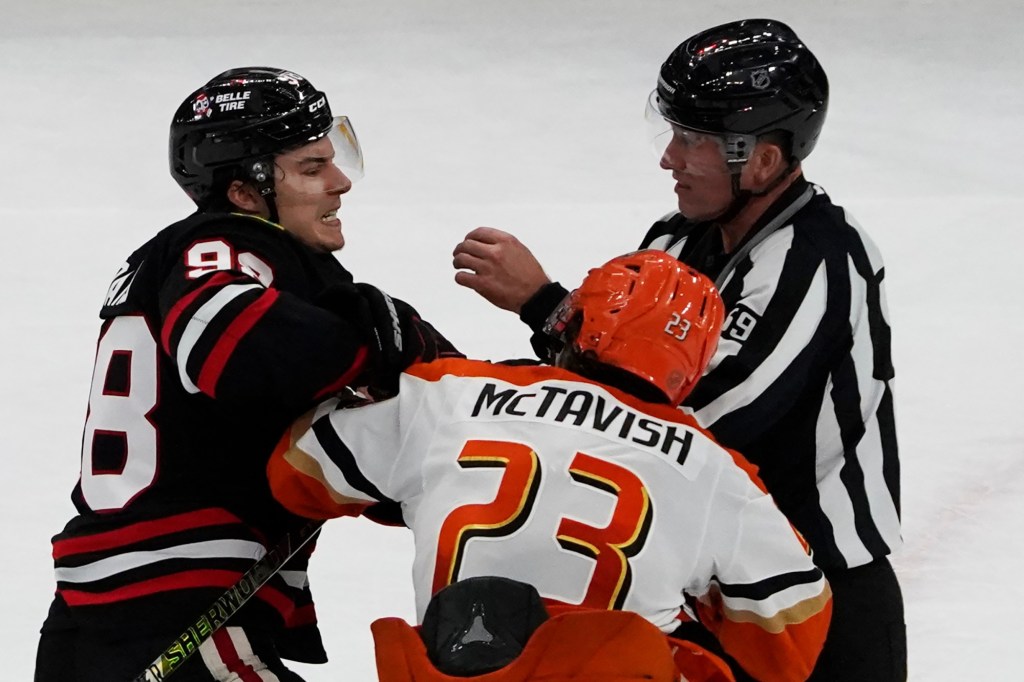
ANAHEIM –– The Ducks have spent seven years outside the postseason looking in and the Chicago Blackhawks haven’t qualified for a traditional Stanley Cup Playoffs in eight campaigns.
But in 2025-26, they have both moved from the NHL’s basement to its penthouse suite.
The two ascendant clubs will square off Sunday at Honda Center to conclude their season series.
That’ll mean Leo Carlsson lining up opposite Connor Bedard, with the two 20-year-old centermen evolving from Calder Trophy contention two years ago to vying for Art Ross accolades. Bedard ranked fourth and Carlsson placed seventh on the NHL scoring leaderboard entering Saturday’s slate of games.
Beyond those individual performers, both teams’ formidable young cores have stepped forward to the point where the Ducks lead the Pacific while the Blackhawks sit in a wild-card spot in the more competitive Central Division.
“We have a whole bunch of good young players and they have a bunch of good young players. They’re obviously ahead of it, in terms of the standings,” Chicago coach Jeff Blashill told reporters. “That’s a team that, if we want to climb the mountain in the Western Conference, we’re gonna have to battle, zero doubt about it.”
“Both teams have done a really good job scouting, both teams have drafted a lot of good players, and I think it’s going to be something that will be a good rivalry, not just next Sunday, but down the road for sure.”
Blashill made those comments after his club’s 5-3 win last Sunday, when the Ducks darted out to a 3-0 lead but then surrendered five unanswered goals.
“They taught us a lesson last time, and these are two big points,” veteran winger Chris Kreider told SCNG at Saturday’s practice.
Kreider’s presence near the net and all-around ability as a power forward have been welcome additions to a club that has lacked such dimensions since its 2019 buyout of Corey Perry. In addition to Kreider’s arrival via trade over the summer, the emergence of 19-year-old Beckett Sennecke has given the Ducks even more potency in the paint.
“He’s a threat every time he’s on the ice. With his skill and with his strength, he can make some things happen. It’s fun to watch,” Ducks forward Mikael Granlund said of his teammate.
Even as a prospect, Sennecke displayed a nose for the net and an array of means to arrive at the most contested areas of the ice. With each passing game, he’s finding new ways to adapt his attributes to the NHL and become a more menacing scorer, already leading all rookies in goals and points. In Friday’s triumph over the white-hot Washington Capitals, Sennecke started inside the blue line and worked his way down low to create something from not much on his primary assist to another aspiring star, Cutter Gauthier.
“With every game and every practice, you get more comfortable making those plays, especially at the top of the zone,” Sennecke said. “It’s something that you get used to with time, how much space you have and how much defenders are going to bite.”
Like Carlsson, Sennecke has deceptiveness in his game, feeding misinformation to opponents in order to dictate offensive sequences.
“He’s got an evasiveness that is a little bit unpredictable. A lot of guys haven’t seen him yet and I think they’re still trying to gauge what the next move could be, because he is so slippery,” said Ducks coach Joel Quenneville, who coached the ‘Hawks to Stanley Cups in 2010, 2013 and 2015.
Quenneville, 67, still has an appreciation for coaching singular young talents, from Jonathan Toews and Patrick Kane in the Windy City to Carlsson, Sennecke and company in Orange County.
“(Misdirection) is an art,” Quenneville said. “You appreciate when you have guys that are able to do it, and you get to enjoy it some nights.”
Chicago at Ducks
When: 5 p.m. Sunday
Where: Honda Center
TV: Victory+, KCOP (Ch. 13)