
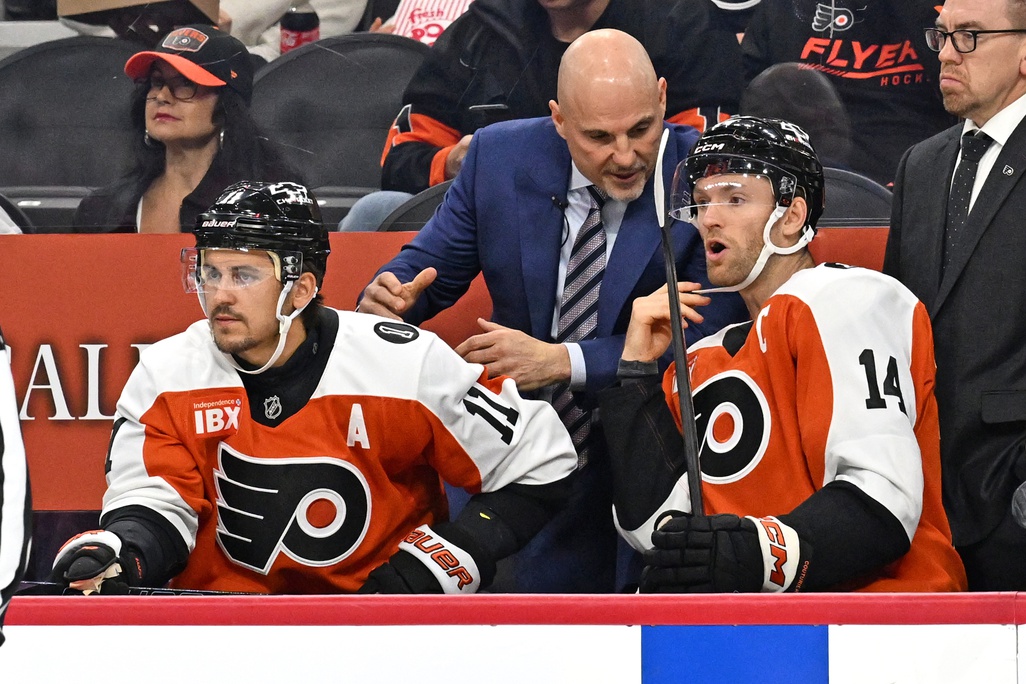
Sean Couturier has played all but approximately five periods of hockey this far. He took a shot off his upper body early in a game against the Predators on Oct. 30 and missed the next game against Toronto on Nov. 1. He’s been quite good so far in his various roles, with four goals and 12 assists thus far in 25 games. And, as it has been well established, Couturier and Flyers coach Rick Tocchet are far more on the same page than Couturier and former coach John Tortorella was in the nearly three previous seasons. The only commonality both the captain and Tortorella had was they didn’t see eye-to-eye. Except on their dislike for each other it seemed.
So far this season, Couturier has done it all: he’s played 5-on-5, he’s been on the power play, and he’s been on the penalty killing units. It might not seem like a revelation, but there are a few statistics that might shock some Flyers fans. Through 25 games Couturier has played in 2025-26, he has been on the penalty kill a total of 59:01. Last season, in 79 games, Couturier was on the penalty kill for 38:24. That’s a staggering (moronic?) statistic considering you’re talking about a former Selke Trophy winner. And still one of the better two-way defensive forwards around. Down one man on the penalty kill (5-on-4), Couturier has been on for 57:40 compared to 37:21 all of last season. The last of the possibly jaw-dropping stats? Couturier has been on the ice during three-on-three situations (predominantly the overtime sessions) thus far for 8:45. Last season it stood at 4:58.
Of course, some could argue some of those statistics are not surprising. The Flyers have been in overtime sessions for a huge chunk of this regular season, so naturally more overtime sessions means more playing time across the board. As well, the Flyers took a sizeable amount of minor penalties to start the year (and with some undisciplined spurts throughout), resulting in more penalty kills needed. But in short, Couturier has won the trust of Tocchet. In the other statistics, including playing at all strengths and five-on-five, the numbers right now after 25 games would be rather comparable to the ones in 2024-25 provided he’s healthy the rest of the way. Having said all that, it’s up to Tocchet to realize he’s still dealing with a veteran who in the last handful of years had major back surgeries.
Tocchet realizes the ‘grind’ on Couturier
Following Saturday’s practice, Flyers head coach Rick Tocchet was asked if Couturier wasn’t quite 100 per cent after taking a shot during the Oct. 30 game against Nashville. “I don’t know, I don’t think so,” Tocchet said. “It was sore for a bit. I just think that sometimes I’ve played him for 20 minutes I think and that can affect him. I think I got to manage his minutes. I think that will help him.
“I think that’s why it’s important you have balanced lines, I can’t always go over and have him take faceoff. It’s a grind, to take a faceoff and then come off, a penalty killing faceoff, five on five. It’s hard to always start in your own end. So I’ve tried it when he was playing with Michkov — he is playing with Michkov — I try to get them more offensive draws. I think that has helped Coots lately, but I can’t always just put him on defensively. There’s a lot of grinding back there when you’re always taking faceoffs in your own end. I think he’s done a nice job for us, I think a veteran player like that I just have to manage him a little bit better sometimes.”
Thus far, heading into the Colorado game this afternoon, Couturier has an average shift length of 42 seconds through 460 total shifts. That average is identical to Travis Konecny, Tyson Foerster, and Owen Tippett. It’s one second shorter than Christian Dvorak’s average and one second longer than Matvei Michkov’s average. As well, Couturier has had just 14 extra long shifts this season, namely one where he’s caught on the ice and often hemmed in his own zone. It’s something that doesn’t happen a lot, roughly one out of every 30 shifts for the veteran.
Diving deeper into Couturier’s usage
Without going period-by-period, or game-by-game, Couturier’s usage was sizeable in the opening month of the campaign. As Tocchet noted on Saturday, he was hitting 20 minutes. The center played over 20 minutes on six different occasions, including four of the first seven games. As well, he eclipsed the 19-minute mark also six different times. Throughout the first month, Couturier was often finding himself in the 14-minute to 16-minute range at even strength. But it was the special teams which was making his usage possibly a hair more (or a lot more) than anyone would care to like. Have a look.
GamePower Play Time On IcePenalty Kill Time On IceTotalOct. 9 – Florida0:593:454:44Oct. 11 – Carolina1:563:135:09Oct. 13 – Florida2:112:294:40Oct. 18 – Minnesota2:112:324:43Oct. 23 – Ottawa3:372:276:04Oct. 28 – Pittsburgh1:443:335:17Nov. 4 – Montreal3:222:075:29Nov. 12 – Edmonton2:182:334:51
As you can see above, that’s eight games where Couturier saw anywhere from 4:40 to 6:04 of ice time just on special teams alone. The Edmonton game seemed to be some kind of line in the sand when it comes to Couturier’s usage. Possibly the coaching staff realized they couldn’t risk using Couturier so much so early in the season without possibly burning out, especially after the Oilers game which saw him just under 20 minutes (19:51). After that game, Couturier saw his time dip somewhat. Not to the point where it was obvious or that he was being punished for his play, but enough to believe the workload was something the Flyers altered to help him and the team in the long run.
This included six games where he found himself on the power play for 61 seconds or less, including three games (New Jersey twice and Florida on Nov. 26) where he had no time on the man advantage. His even-strength time was reduced as well, with 11 to 12 minutes becoming more of the norm than the 14 to 16 minutes he was receiving earlier in the season. The workload was easing for Couturier, the Flyers were generally winning, everyone was happy. But then something happened which is surely going to test Tocchet’s management of Couturier’s workload.
Tyson Foerster’s injury
Without going into hyperbole, it’s evident that Tyson Foerster is a huge cog in Philadelphia’s special teams wheel. He plays both, and plays both quite effectively. Prior to his injury against Pittsburgh, Foerster had 48:36 of time on the power play and 31:19 on the penalty kill. He wasn’t leading either category, but that’s a chunk of minutes that the Flyers are going to have to fill by committee. And while it’s hasn’t even been two complete games, Foerster’s absence for between two to three months is going to test Couturier’s workload and Tocchet’s management of that workload to the utmost. A simple two-game sample size might not tell everything, but it could be telling. And it’s not ideal. Against Pittsburgh, Couturier was on the power play for 3:09 while on the penalty kill for 1:34. Combined that’s 4:43, or similar to the usage in the table above. Against Buffalo on Wednesday? He was on the power play for 3:38 and on the penalty kill for 5:27. Combined that is a whopping 9:03 on the special teams in one game.
So, with roughly a 30-game to 35-game span where Foerster won’t be available, Philadelphia need to do a few things to prevent Couturier from carrying far more than his fair share. Ideally, less penalties and more discipline would certainly curtail the penalty kill usage. Outside of that, Tocchet is going to have to rely more on some other penalty killers a bit more to ensure Couturier is used a little less sans Foerster. As well, while it’ll probably be impossible to not play Couturier on the power play at some point during a game, it’s crucial they limit that time much like they were prior to Foerster’s injury.
All of this becomes far more critical when you look at how condensed the schedule is, with 15 games in 31 days in December (which is actually 27 days when you remove the four-day Christmas break). That is a hell of a workload which leads into January which is, you guessed it, another 15 games in 31 days. As much as the three-week break will be welcomed by Couturier to reset and recharge, you ideally want to see him with some gas left in the tank when he hits the Olympic break. You don’t want to see him running on fumes in mid-January with four divisional games, Vegas, and Colorado all in the latter half of January.
What it all means
In the end, Couturier is going to be asked to do his part, like any other Flyer dressed each game. It will be quite interesting to see how Tocchet approaches his time management, especially when such a dependable two-way defensive-minded forward in Foerster is unavailable for the foreseeable future. With any luck, Couturier still has the same stamina the next seven to eight weeks that he did to begin the season. Or at least is able to communicate with Tocchet when he might need a maintenance day between games. Couturier in his heyday could eat those minutes up rather easily. Now the hope is both he and the Flyers coaching staff have the wisdom to dial things back a bit should he need it. An exhauster Couturier isn’t going to help Philadelphia towards a playoff push.