
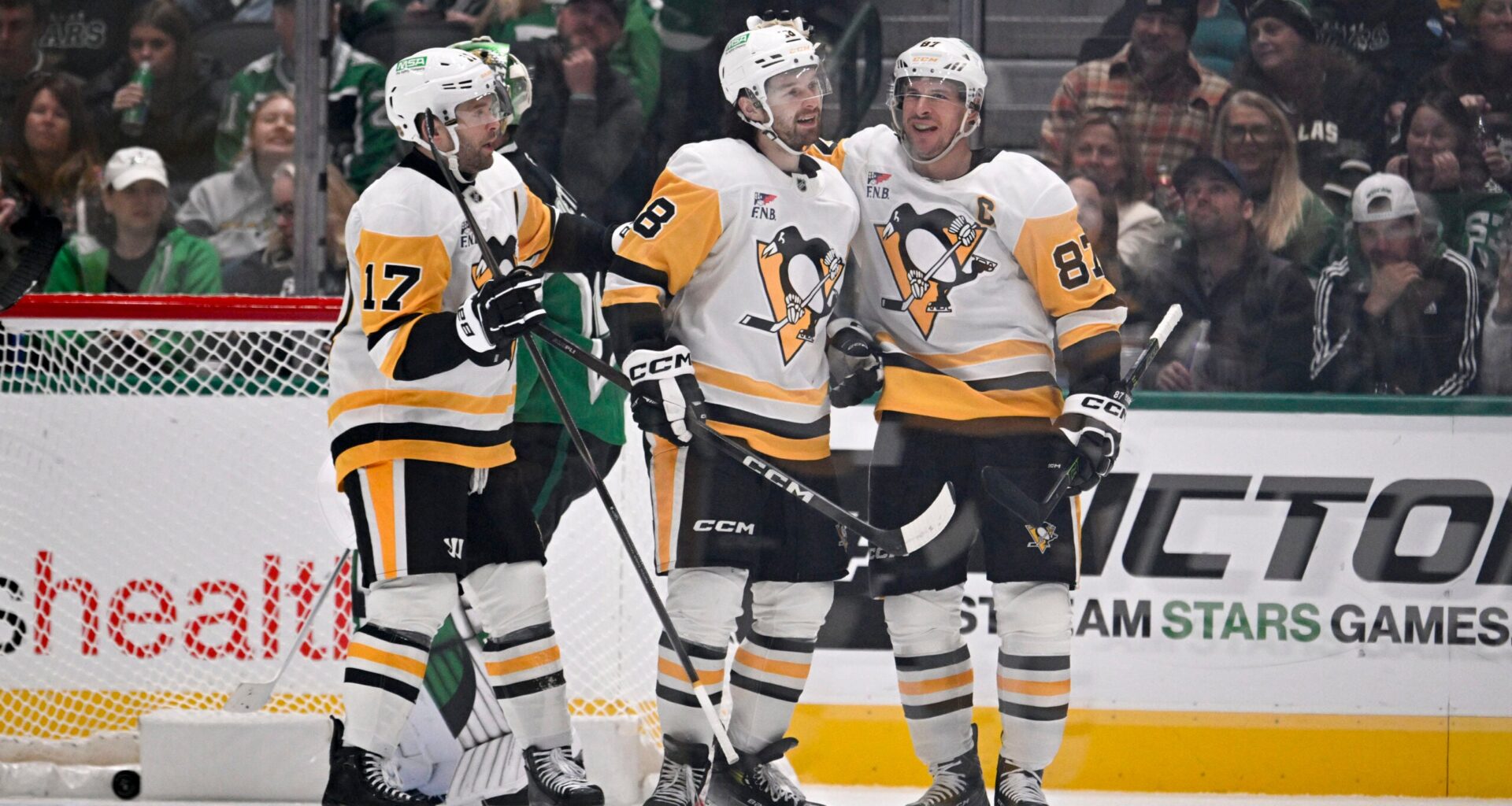
DALLAS — Pretty good, but not good enough. So close and yet another loss in extra time that snatched defeat from possible victory by failing in the NHL skills competition known as the shootout.
The Dallas Stars scored a late third-period goal with the extra attacker and then did what three other teams this season have done: beat the Penguins in a shootout. The final was 3-2, but once again the Penguins failed to score in a shootout, and even though starting goalie Tristan Jarry stopped the first two, the Penguins’ shooters whiffed on all three.
Bryan Rust, Sidney Crosby, and Kris Letang were unable to beat Jake Oettinger, dropping the Penguins’ shootout record to 0-4 this season.
The Penguins were the very definition of mixed emotions following the game. They played quite well against one of the best teams in the league. In fact, the Penguins had the better of the third period, rather than nursing a 2-1 lead.
The Penguins limited Dallas to just 18 shots in regulation, while putting 26 on Oettinger.
And yet, they failed to get two points. Again. They’re just 1-6 when the game goes past regulation.
“I mean, it’s so fresh. You walk away disappointed,” coach Dan Muse said after the game. “The overall game that we played, you want to come away with two points on that. Once we look at it, we get a little bit removed from it, I think that we will see that there were a lot of positives, but still, it’s a fine line. Those points are important, and there are still things that obviously we could have done to secure those two points.”
The conflict was obvious in the subdued locker room. Earning five of six points on a road trip that included perhaps the best team in the East (Tampa Bay Lightning) and second second-best team in the West, Dallas, would ordinarily be a feather in an upstart team’s cap.
But they don’t view themselves as upstarts, or rebuilding, or anything but a team that should win. And a good way to get some side eye is to approach their performance in that frame.
Perhaps a few more overtime or shootout wins would salve the wounds that were ripped open Sunday, but the compounding frustration of again leaving without a win despite leading after 58 minutes led to more than a few players skulking off the ice.
“I thought in the third, we didn’t really sit back. I mean, they’re a good team, they have skilled players, and stuff like that is going to happen sometimes at the end of the game,” said Justin Brazeau, who played his first game since Oct. 30 after being out for more than four weeks with an upper-body injury. “I don’t think that’s one of those things where we’re caving and letting them take it to us. I thought we did a good job of trying to push the pace and making sure we’re still playing responsibly, but still trying to get our looks.
“So, it’s just one of those things. It’s tough. You’d like to get the two points, but I mean it’s not because we sat back.”
The points add up, but so do the lost points.
Penguins Analysis
Dallas came to life with the extra attacker. The energy in the building rose, their play intensified, and the tying goal seemed a matter of when, not if. When Connor Dewar iced the puck, Dallas attacked … and attacked … and attacked more.
The Penguins’ fourth line was trapped on the ice for nearly two minutes as Coach Glen Gulutzan pulled Oettinger with almost three minutes remaining, and the swell of momentum made overtime feel inevitable. The exhausted Penguins forwards were simply hanging on.
From a coaching standpoint, Muse managed the Penguins bench effectively. The forwards were quite good despite missing Evgeni Malkin, who is out day-to-day with an upper-body injury.
Muse balanced the “second” line’s ice time with Kevin Hayes in the middle of Anthony Mantha and Brazeau, playing them only slightly more (10:18) than the kids’ line with Ben Kindel between Rutger McGroarty and Ville Koivunen (9:51).
The Kindel line was quite good throughout the game.
Tactically, the Penguins were able to find speed through the neutral zone into the Dallas zone, though they found the middle of the ice crowded. The Penguins were able to control the puck and more of the play with controlled zone entries, or short dump-ins, which they essentially controlled.
One note, for a spell in the second period, the Penguins also stretched the ice–much like Tampa Bay did to them Thursday. The Penguins were more spaced, looking for more two-zone passes and large chunks of territory to elude the Dallas neutral zone structure, which rarely breaks.
Overall, they were more successful than Dallas at even strength, and if not for a few missed tight-angle shots with a yawning cage or sprawled Oettinger, they could have had a multi-goal lead.
The forwards were better than the stout Dallas defense and created a few breakdowns in the Dallas end.
However, the Penguins’ defensemen were bad. Really bad, actually. The defensemen had far too many unforced errors and turnovers, especially in the first 30 minutes. The defensemen were not sharp on the breakouts, though they didn’t have many open targets. The pressure led to premature chips and bad breakout passes that were intercepted by green and black jerseys, not white.
While the Penguins played with speed, Dallas was also able to play on the rush as the defenseman raced back into position and the forwards dug into the ice to equalize numbers. The Penguins didn’t have a scoring chance on the rush, but Dallas had a few.
Penguins Report Card
Team: B
If they had won the game, it would have been an A grade. Several chances were achingly close, like Mantha chipping the puck through the crease with Oettinger out of position, or Koivunen chunking a one-timer that fluttered over the net instead of into it.
Tommy Novak: A
On paper, it looked like an absolutely terrible pairing, putting Novak, who is more of a perimeter player, with Crosby, who is probably the best downlow player in the game, if not the best ever.
“It’s pretty wild … I mean, it’s Sidney Crosby, you know? I just think of watching highlights of him when I was a kid. But I just tried to play my game and work hard for him. And I think I did that, just trying to work hard for him and see where it goes. So yeah, we had some looks, so I thought we were alright.”
Novak played the walls, dished the puck, and even scored a deflection goal on a shift on which he had multiple touches, including setting in motion the sequence that led to his goal.
Tristan Jarry: A
The shootout is the shootout. If the Penguins had simply scored one goal, perhaps they would have won it in extra rounds. Jarry was again quite good in overtime, stopping Jason Robertson on a breakaway. He made a couple of strong saves on the few defensive breakdowns in regulation.
Kids Line: A+
There was a lot to like about their play. Solid in the defensive zone while being creative and connected in the offensive zone. They may have been the Penguins’ best line in the offensive one.
Here’s the stat that jumps out: The line had seven shots on goal at even strength and allowed … ZERO.
Fourth Line: A-
They were close to a perfect game. They notched a pretty goal in the first period and were generally so close to Dallas forwards they could smell the pregame Chipotle salads. Dallas pinned them in with the extra attacker, and they just ran out of gas. It is their job to close out the game, but they were otherwise excellent.
Noel Acciari played in his first game since Nov. 3 and played–to steal a phrase from Bryan Rust–like his hair was on fire. He was all over the ice.
Bad Grades
Ryan Graves and Matt Dumba: They were a bit of a mess. Dumba especially seemed to struggle throughout the game and missed breakouts and played the Dallas rush badly, which led to Dallas’s second-period goal. Graves tried too hard to make something happen. He was pushing forward in offensive and neutral zones, but not as judiciously as a third-pairing D-man whose primary mission is to defend.
Parker Wotherspoon: He, too, was a bit out of sorts Sunday. Too many little mistakes and hurried puck movements.
Tags: ben kindel Dallas Stars noel acciari Pittsburgh Penguins tommy novak
Categorized: Penguins Analysis