

VANCOUVER — To focus on what transpired on the ice at Rogers Arena on Saturday night is to miss the story that matters.
In a peripheral game, sparsely attended despite this being a Saturday night during the holiday season, the undermanned Vancouver Canucks opportunistically throttled the red-hot Minnesota Wild 4-2 thanks to a series of against-the-grain goals scored by some of Vancouver’s youngest and most promising players.
The game itself was a ton of fun. It was a rare good night out for the beleaguered paying customers in this exhausted, voracious hockey market, especially relative to the standard of play that Vancouver has generally managed on home ice this season.
What mattered on Saturday, however, was less about the players skating around and more about the vultures beginning to circle a franchise in crisis.
Even before the puck dropped Saturday, the Canucks — who entered the night in last place among all NHL teams — were beset by a variety of new, troubling developments.
About 10 minutes before the team took the ice for the warmup skate, Sportsnet’s Elliotte Friedman reported on “Hockey Night in Canada” that he believes the Canucks will at least have a conversation with the New Jersey Devils about the future of captain Quinn Hughes.
Hughes, 26, is Vancouver’s best and most valuable skater. He’s the best defender in franchise history by a mile, and is among the best defencemen on planet Earth. The Devils, we should add, are the most interesting team that could be linked to Hughes, given that they employ both of his brothers, centre Jack Hughes and fellow defenceman Luke Hughes.
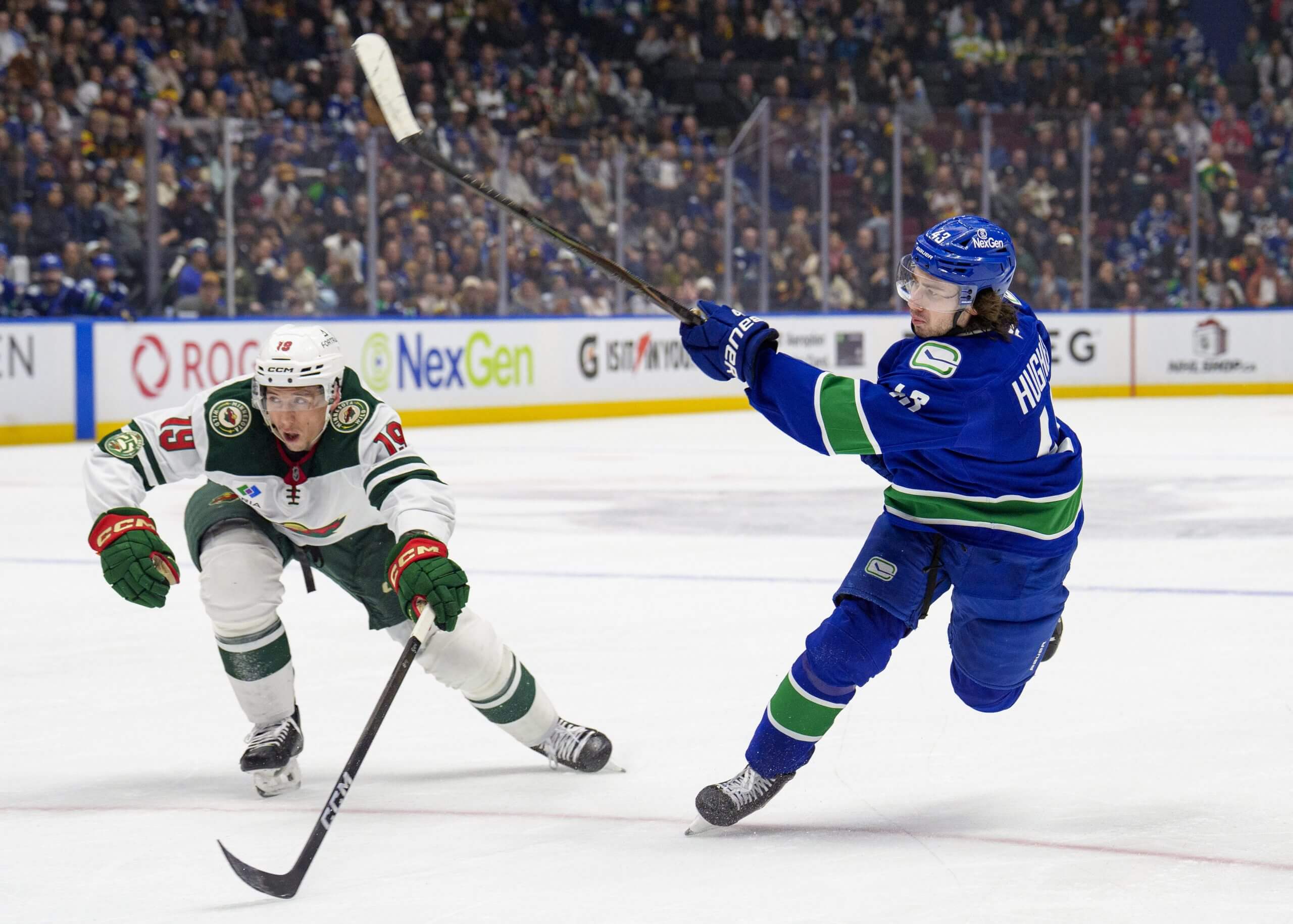
Quinn Hughes has one year left on his contract after this season and two brothers who play for the New Jersey Devils. (Jeff Vinnick / NHLI via Getty Images)
We are now only about six months away from Hughes entering the final year of his second contract. His future has been a nonstop topic of conversation in the Vancouver market, and for good reason, given the organization itself has acknowledged how the uncertainty impacts a season that has played out in mostly nightmarish fashion.
The moment July 1 hits and the next league year begins, Hughes will become extension-eligible and gain a fair bit of “pre-agency” leverage in dictating where he plays moving forward. We don’t know how this will play out, but we’ve seen in the recent past with players like Pierre-Luc Dubois and Matthew Tkachuk that gaining extension eligibility is a pressure point that players can, and sometimes do, use to exercise some control over where they play.
The Athletic asked Hughes postgame about the substance of the report and if he had a reaction to it. He didn’t, but noted that he wasn’t surprised.
“It’s not like me, Jim + Fitzy hopped on a call, I wasn’t a part of that,” said Quinn Hughes when I asked for his reaction to HNIC report about conversations about his future occurring between the #Canucks and Devils. “But obviously I’m aware that things like that could happen.”
— Thomas Drance (@ThomasDrance) December 7, 2025
Of course, the pregame dark clouds over Rogers Arena didn’t end there.
Almost as soon as Friedman’s report had dropped, Vancouver centre Elias Pettersson left the warmup skate early. Pettersson, whom the club later confirmed had an upper-body injury, didn’t participate in line rushes and was quickly ruled out for Saturday’s game.
Vancouver’s key centre, the last battle-tested centre left in the lineup, will be further evaluated on Sunday. Head coach Adam Foote told the media that Pettersson will undergo an MRI to determine the extent of his injury.
Pettersson’s status will bear close monitoring. Vancouver, which entered the season with insufficient centre depth, has already fallen below a baseline level of functionality down the middle of its forward group as a result of injuries to Filip Chytil and Teddy Blueger, who have combined to play just seven games this season. In-season moves to add David Kämpf and Lukas Reichel in an attempt to stem the bleeding have proven insufficient, with the club relying heavily on Pettersson to handle tough matchups, take a dizzying number of draws and log big minutes.
If the Canucks, who are already entrenched at the bottom of the NHL’s standings, hope to salvage this season, they cannot afford to be without Pettersson for any extended length of time.
The other spin on this, though, is that there’s an increasingly vocal section of Canucks fans who are not-so-secretly hoping that the Canucks can’t salvage this season. For these fans, the prospect of watching the team top the odds at the NHL Draft Lottery is a best-case scenario.
At some point, the organization’s tolerance for the club’s inept play and the apathy engulfing fans at this weekend’s games will dwarf concerns about Vancouver’s centre depth, or even Hughes’ future. Perhaps Saturday’s sunny Canucks victory, powered by the team’s younger players, will delay the seemingly inevitable palace intrigue for a little bit longer.
It shouldn’t, though. At some point, the Canucks will face the increasingly obvious reality that even with a healthy lineup, they don’t have enough talent to skate with the likes of Colorado and Vegas and Dallas and Edmonton, or the horses and prospect depth to measure up with the likes of Utah, San Jose, Anaheim and Chicago.
That realization, regardless of whether the Canucks string together a decent stretch of hockey over the next several weeks, will necessitate bold moves, a rethinking of long-sacred organizational assumptions like “just get in and anything can happen,” and a shift in thinking on player personnel.
Underneath it all, perhaps, the fun that was had at the rink on Saturday night could also be a better way forward for a franchise that has long been unwilling to prioritize the future or set goals much higher than making the playoffs. The organization might do well to recognize that its fans are just as eager to root for and celebrate the growth of players like Tom Willander, Linus Karlsson, Aatu Räty and Elias Pettersson (the defenceman), as they are to pine for a couple of playoff home dates. If the franchise is willing to let go of its win-now desperation and consider the big picture, NHL hockey in Vancouver can be fun again.