
Given the Maple Leafs’ underwhelming possession metrics over 100 games into his coaching tenure, it’s interesting to revisit Craig Berube’s comments about puck possession when he was first hired in Toronto:
Berube: “In St. Louis, we were one of the highest puck-possession teams in the league. We were a great forechecking team. You have to possess the puck in different ways. It can’t all be off the rush. If you watch the playoffs and how tight it is, there is no room. You have to put pucks deep and go get them. If you forecheck to get the puck back, that is puck possession.”
Over the offseason, we wrote that the key to the Leafs’ contention status this season was improving their five-on-five possession play. Under Berube, it has been an ongoing issue, and it hasn’t shown any improvement 28 games into the 2025-26 campaign. If anything, the problem is worsening. A season after finishing 29th in five-on-five shot attempt share, the Leafs are now ranked 30th, owning just 45.65 percent of the shot attempts, a considerable drop from last season’s 47.38 rate.
Injuries explain some of it, as demonstrated quite clearly in the team’s five-on-five shot-attempt chart this season:
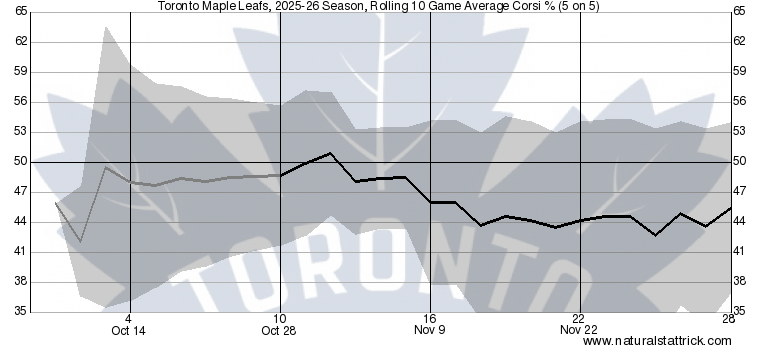
The Leafs started off okay, bottomed out with injuries, and have put together some decent showings lately as they’ve finally iced a fully healthy forward group for four straight games (along with the addition of Troy Stecher on the blue line). But it hasn’t been good enough to suggest that they’re in the clear as long as the team returns to health. Since Auston Matthews, Matthew Knies, and Nic Roy all returned against Columbus, the Leafs are dead-last in shot attempt share at a paltry 41.63%.
The Leafs‘ roster is too talented for these numbers to be so poor, as we’ve discussed in this space many times already. Berube now seems aware of the problem and has recently begun commenting on it for the first time (in-season) since he was hired.
After the Pittsburgh game:
Berube: “We talked about puck possession and a little more playmaking, and we did that tonight. There were a lot more entries, and we were making some things happen. We got rewarded for it… I liked the way we moved the puck tonight. It was better. We possessed the puck more tonight, which was good.”
After the Carolina game:
Berube: “We talked about puck possession, making some more plays, wanting the puck a little bit more, and working for each other. I think they’ve done a good job of grabbing that and going with it.”
So, what’s at the root of this team’s puck possession problems? There are many intricacies and factors involved, but at the most basic level, it’s the byproduct of the Leafs‘ inability to break out consistently as well as their inability to effectively forecheck consistently. Of course, both of those factors go hand in hand.
Let’s go through a few clips.
The Forecheck
We see this type of play far too often from this Leafs team on the forecheck:
The Leafs won the faceoff and put the puck deep, only for Buffalo to cruise through the neutral zone into the Leafs’ end. It starts with a complete lack of pressure up ice. Conor Timmins got to the puck first for Buffalo with the pick of the litter — either the wide-open winger on the wall, or the wide-open center. There wasn’t a second Leaf forechecker even close to closing down the two most obvious options available.
When Peyton Krebs received the puck, he flew through the neutral zone untouched. When Krebs dumped the puck in with speed, nobody in a Leaf sweater rubbed him out or ran interference; instead, Simon Benoit turned with him. He didn’t buy his partner, Philippe Myers, any additional time to retrieve the puck. Krebs arrived at the puck first, and Buffalo established possession in the Leafs’ end.
Remember, the Leafs started this sequence with the puck after a whistle. This is all down to structure and fundamentals.
Below is another example against a different opponent. It started with the Leafs winning a center-ice faceoff and putting the puck deep against LA. The Leafs didn’t even come close on the forecheck as the Kings strung together multiple passes, then skated through the neutral zone with speed and dumped it deep. Nobody in a Leaf sweater ran any interference, and the Kings recovered the puck and retained possession.
In the next clip, following a faceoff win against New Jersey, the Leafs’ forecheck was ineffective after a dump-in. The Devils beat it and left the zone untouched, then got it deep and actually forechecked with purpose. Their F1 tied up McCabe and had proper F2 support to retrieve the puck. They started to cycle from there.
I am picking out examples that didn’t end in goals for a reason. It’s the accumulation of these little plays throughout games that are adding up to a lack of five-on-five puck possession for the Leafs.
The Breakouts
There are regularly huge gaps and disconnects between the Leafs’ forwards and defense on the breakout. Here are two examples in one shift:
Jake McCabe did really well to kill the initial play at the blue line, and the Leafs recovered the puck. With time and space, McCabe gave it away. After the initial possession by Montreal, McCabe possessed the puck again with the opportunity to break out, but he threw another pass away. With McCabe in the corner of his own zone, all three Leafs forwards were up the ice already. There was no support option.
Too often, the Leafs’ forward support is nonexistent on the breakout. Here is another example against Florida recently:
The Leafs recovered the puck after the initial play, and Myers’ options were either to pass or simply put it off the glass. He made the pass on the tape, but it didn’t matter at all. Two Toronto forwards were out of the zone already. Roy had no options, leading to an easy turnover and a scoring chance against.
We’re seeing regular examples of the disconnectedness Brad Treliving mentioned in his quarter-pole media availability. There are too many times when the forwards don’t provide support on the breakout, and the team’s forecheck is completely disjointed.
One breakout wrinkle the Leafs have begun incorporating a little more lately is the winger on the wall bumping it back to the defenseman when they can’t turn up the ice. The Leafs are also doing a decent job of activating the far-side defensemen for outlet passes. Oliver Ekman-Larsson, in particular, is really effective at this, probably due to his time in Florida.
Conversely, what they don’t do well — or even attempt to do with much frequency — is use the middle of the ice. Their centers rarely swing low and collect the puck with speed in tight (we already showed a few clips of the forwards drifting up ice, seldom providing support). This applies whether it’s the defenseman or the winger with the puck. At times, we see a Leafs’ winger with a split second to make a pass to the middle, but a bump to the middle is not their read at all. They will more often than not flip it out to the center, or attempt some kind of chip play off the wall, rather than looking for the bump pass.
The middle of the ice can be a risky play at times, but it’s also a route to generating the speed and space necessary to attack. The Florida Panthers love the bump to the middle, and they also ran a clinic on the Leafs last playoff when it came to running picks on dump-ins to buy their defensemen time to retrieve a puck and make a play.
Five-on-five structural issues are weighing down the 2025-26 Maple Leafs
Auston Matthews has the worst five-on-five shot share of his entire career this season. It’s not even close. So far, he’s owning just 45.8 percent of shot attempts, when his previous low was 50.05 percent (in his second NHL season). You can argue that he’s not the same player anymore — and there’s probably some truth in that — but Matthews is hardly an isolated example, so much so that it’s fair to wonder how negatively he’s impacted by the team’s systems and structure.
John Tavares is tracking for the worst possession season of his career. His previous low came last season, Berube’s first at the helm. In his first six seasons as a Leaf, Tavares was on the positive side of the ledger every single year. William Nylander is the exact same story.
Chris Tanev made a career out of clever breakout plays and a good first pass, and yet his numbers cratered in his first season as a Leaf.
The list goes on and on and on. The Leafs are all generally struggling to drive play, and there are far too many periods like their most recent second period against Montreal, where they are straight up dominated for a full 20 minutes.
The Leafs’ defense isn’t particularly talented or mobile. Troy Stecher got picked up off waivers and looks like a godsend compared to most of the group, thanks to his basic ability to skate pucks out or complete a pass. But the Leafs are asking their defense group to solve difficult problems on a shift-to-shift basis — to beat unencumbered forechecks on their own, or attempt long stretch passes through multiple forecheckers. Otherwise, the defense goes off the glass and out, or hard rims the puck on the walls, where the Leafs’ wingers are often jammed up.
When a team can’t move up the ice cleanly, it can’t put itself in positions to succeed on the forecheck due to a lack of speed through the neutral zone. Even when the Leafs possess the puck cleanly, their dump-in placement isn’t giving them enough chances to retrieve, curtailing their ability to aggressively attack with numbers.
On a dump-in, the goal is either a hard rim that beats the goalie, ringing all the way around to the far-side forward, or a soft chip into the corner. Half of the Leafs’ forechecks are over before they begin due to the placement of the puck (right at the goalie, into outnumbered situations, etc.).
Like all teams, this Leafs roster has its warts — there isn’t a single team in the league without some — but now that the forward group is fully healthy, it’s clear they have a playoff-calibre forward corps. Should Chris Tanev return sooner rather than later, we’ll be able to say the same about the defense.
To this point, though, regardless of who has dressed in the lineup, the Leafs have generally struggled to effectively break out or forecheck consistently. Their game needs to be a lot more connected and sharper in general, and they must adapt soon. The opposition is jamming them on the wall, and they keep banging their heads against it. Their forecheck is solved consistently by quick bumps d-to-d and to the middle of the ice; their F3 is positioned way too high, probably a result of getting frequently burned in transition earlier in the season. The Leafs will spend entire periods hemmed in, struggling to break pucks out or sustain pressure in the offensive zone.
As a team attempting to climb out of an early-season hole, the Leafs must fix these structural issues if they have any chance of stacking up points and returning to a playoff spot. A good power play would go a long way, too, but that’s a novel for another day.