
There are two major reasons the Toronto Maple Leafs are fighting uphill in the Eastern Conference this year.
The first is a major regression in goaltending performance, which has been complicated by multiple injuries at the position. The second is a shockingly feckless power play.
There was a reasonable point to be made that the tandem of Anthony Stolarz and Joseph Woll would not be able to replicate last year’s outperformance in net — neither goaltender had a long track record of playing at such a dominant pace. Their exceptional play in net helped smooth over the major decline in 5-on-5 possession and scoring chance rates that started a season ago.
The goaltending has reversed sharply this season, the 5-on-5 play is still poor, the team is giving up heaps of scoring chances and zone time every night, and, as a result, they’re bleeding goals. It’s a key reason they’re stuck near the bottom of the Eastern Conference.
But Toronto’s investment with respect to the salary cap is disproportionately tied to the offence, and a reasonable hope for this Leafs tandem was probably league-average performance. With some better injury luck, perhaps Stolarz and Woll get there and relieve some of the defensive pressure.
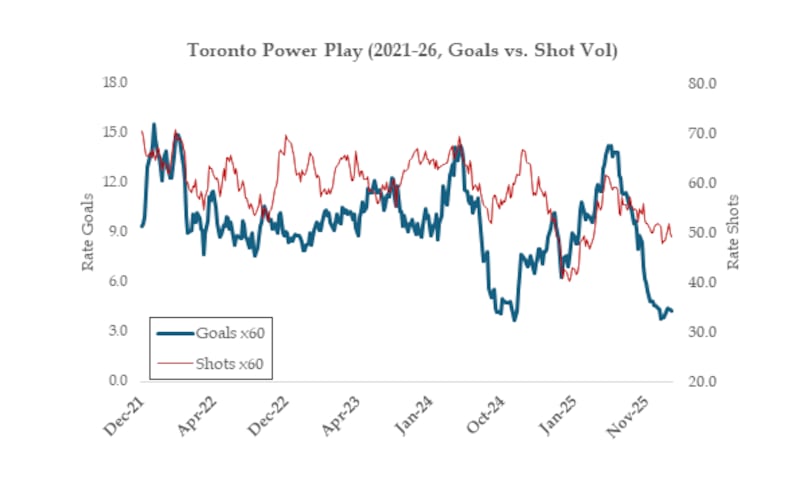
What’s mystifying, and far less acceptable, is the woeful state of Toronto’s power play. Even with Mitch Marner gone, there is heaps of playmaking and shooting talent to be found on the first unit, and yet they’re generating fewer goals than any team in the league.
The multi-year trend is harrowing to say the least, and it’s been straight down since Craig Berube assumed command of the team:
 Yost1
Yost1
The Toronto power play, for much of the past decade, has buoyed the team in the standings — an electric unit that made teams pay for undisciplined play that only slowed (inconveniently) come playoff time.
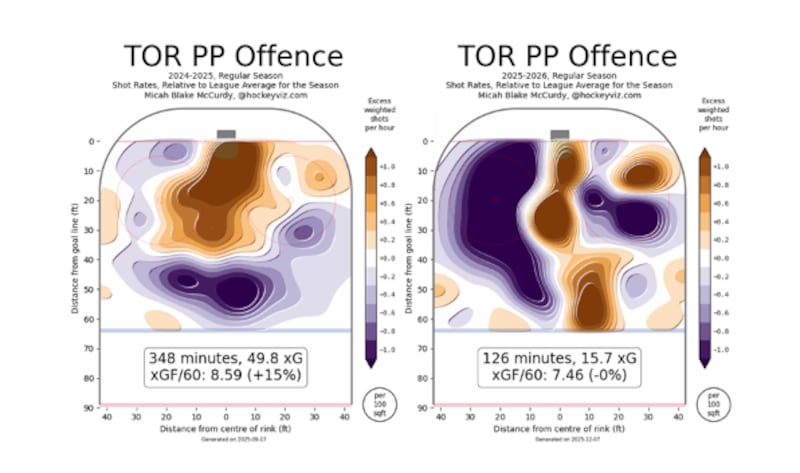
This year, it’s a feeble attack with little plan. The coaching staff has tried a myriad of lineups (including five-forward sets), but the results remain challenged. What’s doubly concerning is this isn’t just about poor shooting luck. Both of Toronto’s units are having a much more difficult time generating offence from the dangerous areas of the offensive zone, near league averages in both shot and expected goal rates.
Their shot profile year over year tells a compelling story (via HockeyViz):
 Yost2
Yost2
It’s easy (and fair) to point to a player like Auston Matthews, who has carried such a scoring burden for so long, only managing one power-play goal this season and the outsized impact it has on Toronto’s overall performance. But no one is picking up the slack. Not a single Leafs’ skater has three power-play goals on the year, something that has been accomplished by a half-dozen defencemen around the NHL.
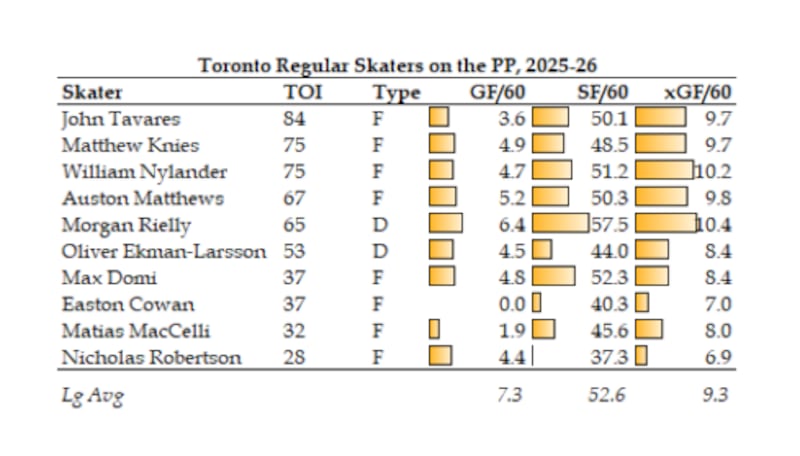
If we look at just the regular power-play fixtures this year (many of whom represented the same unit a year ago), shot and goal rates are effectively down across the board, indicative of a unit that’s ailing structurally more than any one player’s individual slumping.
It’s notable to me the Maple Leafs do appear to have marginally better results with defenceman Morgan Rielly on the ice (i.e. first unit, and not a five-forward setup for the time being):
 Yost3
Yost3
Setting aside personnel changes, there’s a lot of good video work to be done here. Watching samples of Toronto’s man-advantage opportunities, there’s no rhythm in the offensive zone – it’s a lot of slow, free-floating passing around the zone that doesn’t challenge defences and certainly doesn’t get goaltenders moving post to post.
You can’t fix the lineup overnight, but Craig Berube and power-play coach Marc Savard surely have an opportunity in front of them here to restore what was once a threatening attack that could sustain pressure and create those multi-shot shifts that lead to dangerous scoring chances and goals.
Notably, Berube has inferred the team may be gun-shy right now, not taking shots available to them in the zone. That could be structural, but that could also be confidence erosion starting to creep in.
Whatever the case, this is a significant failure, and Toronto needs to address it with urgency. They are simply too talented a team to be this bad in a critical game state.
Data via Natural Stat Trick, NHL.com, Evolving Hockey, Hockey Reference
Related Stories