

Not every NHL player is a hockey historian. Heck, some of them barely even watch the game if they’re not playing in it.
But had The Athletic been around and doing our annual player polls in the late 1990s at the end of Wayne Gretzky’s career and the nadir of the dead-puck era, it’s a pretty safe bet which records players would have deemed unbreakable.
First, Gretzky’s 2,857 career points. It’s one of the most famous stats in sports. Take away every single goal Gretzky scored, and he’d still be the all-time leader. Following on that, second is Gretzky’s assists. Nobody is within 800 of his 1,963. Lastly, Gretzky’s goals. Eight hundred and ninety-four seemed untouchable in an era in which a 40-goal season was jaw-dropping.
Well, that last one got broken, of course. Alex Ovechkin scored No. 895 last season and is now at 911. So anything’s possible — including, it seems, breaking Ovechkin’s mark.
The Athletic asked 120 NHL players — granted anonymity so they could be brutally honest — what the next supposedly unbreakable record to fall will be. And the top pick was that once-unbreakable record that just got broken.
Why do players see Ovechkin’s mark as susceptible? And do the stats agree?
Let’s take a look at the unbreakable records most players said they can see falling, and why, with a reality check from analytics experts Dom Luszczyszyn and Shayna Goldman as to how breakable each is.
Note: Some player quotes have been lightly edited for length and clarity. Not every player surveyed answered every question.
Career goals (22 votes)
With 22 votes, the career-goals record was by far NHL players’ most common answer to which unbreakable record will fall next. Again.
Scoring is up, and so are expectations.
“That’s a lot of goals, and it’s going to be hard to beat, but now that I’m thinking about it, maybe it could be broken,” one player said.
“I don’t really know the record book too well,” another said. “It seems like guys are scoring a ton of goals.”
“If Ovechkin can do it, maybe there’ll be someone that comes up.”
“I don’t think points will ever get broken, but I think sometime in our time, goals will get broken again.”
“If scoring keeps going up, it could happen. Goaltending isn’t as good as it used to be, and guys are playing forever now.”
Toronto’s Auston Matthews, with 412 goals in just 652 games through Sunday, including a 69-goal campaign in 2023-24, was a popular pick to be the one to do it.
“I think Auston is the most realistic one,” one player said.
“Matthews is on pace and not a bad choice,” said another. “If there’s one to do it, it’s him.”
“Maybe Ovechkin’s record gets caught. It’d have to be Matthews, but he’d need to have a couple of huge seasons.”
“I think Matthews has a chance.”
At least one player zagged. Macklin Celebrini, perhaps? Connor Bedard? Some kid currently dominating in a Bantam league somewhere?
“I don’t think it’s gonna be Matthews like everybody else does,” he said. “I think it’s going to be part of this next wave of players. It might be a name we don’t know yet.”

Alex Ovechkin has the all-time goals mark and doesn’t seem to be slowing down. (Patrick Smith / Getty Images)
Reality check
In Matthews’ favor, he is roughly on track with where Ovechkin was at the same age. But you have to weigh that against Ovechkin’s longevity, which creates significant doubt given Matthews’ health and the decline in his productivity already.
Matthews was on pace for just 36 goals through Sunday. He’s scored 0.48 goals per game and has already missed five games, so the maximum he can play is 77. Using an age curve relative to his current baseline, Matthews’ days as a 40-goal threat probably only have a five-year shelf life remaining. And it could be even shorter, considering his goal-scoring decline is already more rapid than expected.
Matthews would need 500-plus goals over his next 12 seasons to catch Ovechkin. That means scoring a lot more in his prime or consistent excellence in his late 30s. Both feel like a tall order right now.
As for the two kids mentioned above, Celebrini is on pace for 41 goals at age 19 and Bedard for 50 at age 20. Ovechkin scored 52 as a rookie at age 20, so that tracks — but by 22, he had exploded to 65. Projecting that type of goal-scoring improvement from either is a tough bet, as obviously is projecting any 19- or 20-year-old to have the longevity Ovechkin has had. Their best bet is a material scoring environment change, which is not impossible thanks to likely NHL expansion.
Could it happen? Maybe. Let’s see one of them finish a single season with more than 30 goals before we get too far ahead of ourselves. With Ovechkin still piling on goals to this day and his biggest threat already waning, the all-time goals record, whatever it ends up being, looks safe right now.
Ironman streak (12 votes)
Another popular choice for the next unbreakable record to fall is a little more realistic: most consecutive games played.
Phil Kessel is the current record-holder with a run of 1,064 straight games, which ended at the end of the 2022-23 season. Kessel knocked off Keith Yandle, who had just set the mark in 2021-22. So this one’s falling pretty regularly these days.
Colorado Avalanche defenseman Brent Burns needs 111 more games to pass Kessel. So it could happen as soon as next season.
“Kind of an easy answer,” one player said. “The ironman goes down every once in a while.”
“I don’t see anyone beating Ovi’s record, or Gretz,” another said. “But maybe the ironman streak. The game’s not as physical as it was before, so maybe that could be something.”
“Isn’t Brent Burns on the way?”
“I think Brent Burns will get it.”
Reality check
There is really only one player in contention for it right now, and that’s Burns at 954. That is almost double the next longest streak, 483 games from Nick Suzuki, and projecting whether Suzuki could maintain that over another 582 games to pass Kessel — or more to pass whatever Burns ends up at — is impossible in a sport that is played on a slippery ice surface where players have knives on their boots and are blocking 90-plus mph shots.
Burns has another 53 regular-season games in Colorado this season, barring injury. The real question then is what happens next season and whether he has another 58 games left in the tank. The 58th game of the 2026-27 season will come around late February, by which point Burns will be a few weeks from turning 42 — an age only 19 NHL skaters, all-time, have hit.
If Burns’ play this season is any indication, though, it does seem a little more probable. He has been solid defensively for the Avs, without having to be sheltered or have his workload reduced dramatically. He’s below the 20-minute mark for the first time in over 10 years but is still averaging 19:52 of ice time per game in all situations. So there’s still room to limit his usage, if necessary, to preserve his game and extend the streak.
Career games played (11 votes)
Like Kessel’s mark, Patrick Marleau’s record of 1,779 career games looks catchable.
Marleau passed Gordie Howe during his final season in 2020-21. Burns, again, is the closest active player at 1,526, with Ovechkin just five behind him. They’re both 40, though. Anže Kopitar is next among active players at 1,478 through Sunday, but he’s retiring after this season. Sidney Crosby is still 400 games away at 38. So this one could take a while.
“How close is Burnsy?” one player asked.
“That’s a good one. What’s the record?” another said. “Marleau 1,700? What’s Ovechkin … 1,500? I think that would probably be the next big one to be broken by him.”
“We have multiple guys with 1,400-plus games, so I think someone’s gonna break the all-time games record,” added another.
If it happens, more history could accompany it.
“I don’t think anyone is going to play with their kid, like Gordie Howe,” one player mused. “That seems pretty impossible. But we’ll see. I guess LeBron just did it.”
Reality check
If any of these players has the motivation to keep going into their 40s, it’s probably going to be the lone OGWAC in the 1,400-plus club. Burns has 254 games to go to pass the mark. He can cross off 53 with a healthy rest of the regular season, leaving him with 200 more to play, which would require another 2.4 seasons of action. That would mean Burns playing until he’s 44 years old, which only six skaters have done in NHL history.
It’s not that outlandish in today’s NHL. Zdeno Chara played until he was 45, despite logging heavy minutes through the bulk of his career. And again, Burns is still very capable at 40. But it’s obviously a very rare feat, so this one seems a little less attainable.
Ovechkin will have a role on the Capitals as long as he wants one, which works in his favor. Like Burns, it helps that he is still performing, too, with 14 goals in 30 games. He could keep going until the goal scoring starts to dry up. He needs to play 259 more games to pass Marleau. But he already has The Record he was striving for, so it seems a little less likely he plays another 2.5 seasons after this one just to hit Game No. 1,780.
In third place, Corey Perry has 1,414 games played. He has already changed up his game and role to extend his NHL career, and at times he looks more like a 16-game player than an 82-game player, so asking the 40-year-old to play another 4.45 seasons to break this one seems like a long shot.
Crosby has an even longer road to 1,779, with another 400 games to go. If he plays all 55 remaining Penguins games this season, it will take 4.2 more seasons. The difference is, he’s still in his late 30s, so he has a little more juice. Most players decline steeply in their late 30s and early 40s, but Crosby’s peak was so high it gives him more leeway. His level right now is still elite. That obviously helps his chances, too.
The reality, though, is that all four of these players have some strikes against them: lockouts and two shortened seasons due to COVID-19, plus significant individual absences in Crosby’s case. So it won’t be shocking if this group doesn’t ultimately reach the mark.
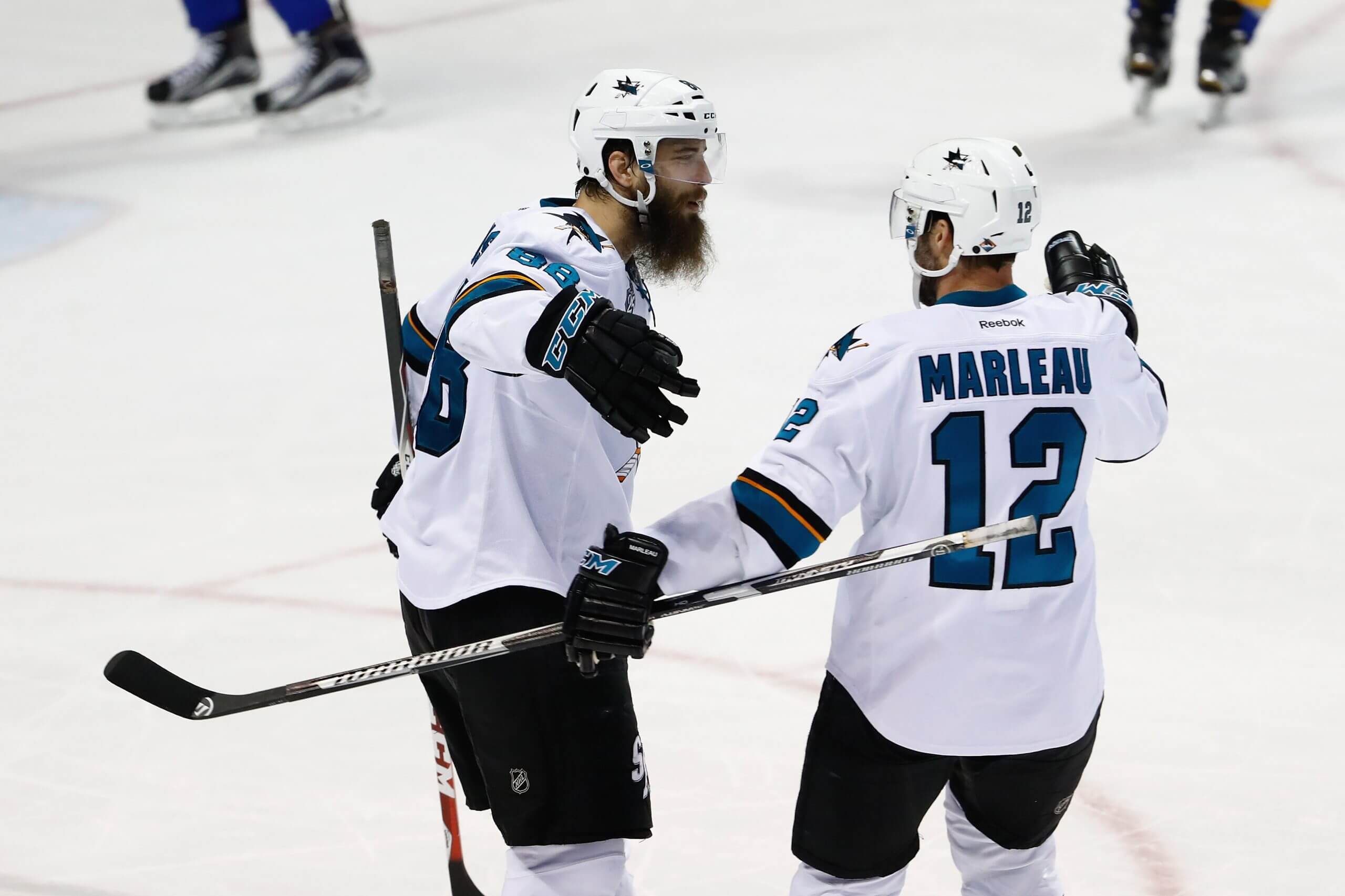
Brent Burns has a shot at former teammate Patrick Marleau’s games played record. (Jamie Squire / Getty Images)
Career (7 votes) and single-season (4 votes) points by a defenseman
With Cale Makar putting up Bobby Orr-like numbers and Matthew Schaefer doing things we’ve never seen an 18-year-old blueliner do, are Orr’s single-season mark of 139 points and Ray Bourque’s career mark of 1,579 in peril?
Erik Karlsson is the only active defenseman with a 100-point season, posting 101 in 2022-23. Burns — him again — is the nearest active defenseman in career points, but at 40 with just 924 career points, that’s not going to happen.
The 27-year-old Makar, coming off back-to-back 90-plus-point seasons and with 463 points in 424 career games, is the bet.
“I think we’ve got a lot of skilled D now, so they might have a chance,” one player said of the single-season mark. “I see Cale Makar doing it.”
“I think Cale Makar will get there,” another player said of the career mark. “I think he’s got 10 good years left in him.”
“Guys are getting more and more skilled every year.”
Reality check
The chances of Orr’s single-season mark falling feel incredibly slim. Using Makar’s odds of earning a point or more in any given game with a baseline of 90 points in a simulation suggests a ceiling of around 117 points. For even a small chance at 139, we’d probably need to see a defenseman whose consistent baseline is around 120 points having a career season. Think of Makar, and then think of a player who is somehow several levels above him. That’s tough to fathom.
Could that be Schaefer? It’s improbable but not out of the realm of probability. We don’t yet know what Schaefer’s “leap” could look like when he’s at full power, but the fact that he’s this good already (21 points in his first 30 NHL games) sets a remarkable precedent. His current baseline is a 60-point defenseman at age 18, which leaves a lot of room upward as he matures.
The more interesting question for both players is Bourque’s career point mark.
If Makar finishes this season with 100 points, he would be 1,051 points shy of Bourque, with 13 seasons left until he hits 40. That would require 81 points per season. Makar’s average projected points-per-82 over that time based on an age curve is 78. That puts him on the wrong side of the ledger at the moment, but not that far off. Health and how long he can be a point-per-game defenseman will be the two biggest factors.
Schaefer coming into the league three years younger than Makar gives him a strong head start. We’ll need to actually see him peak at 90 points or higher to have a shot, but the math to catch Bourque is much more in his favor at a 69-point average over 22 more seasons. No pressure, kid.
Other popular picks
The single-season standings points record of 135, just set by the Boston Bruins in 2022-23, got five votes, with one player pointing out Colorado’s “ridiculous pace” during what’s now a 21-2-6 start this season.
Five others picked the record for points in a single postseason. Gretzky has the mark at 47 (1984-85). Connor McDavid got to 42 in 2023-24.
“You’ve got to think McDavid breaks something crazy,” one player said. “It’s hard to say because (career) assists and points are insane.”
For what it’s worth, four players did go out on a limb and pick Gretzky’s career points record, absurd as it seems.
“McDavid is probably the only guy you can think,” one of them said.
“The way that the top guys are scoring these days, if they can have that longevity that Ovi had, I think the points could be chased down eventually,” said another.
Reality check
Colorado’s current chance of hitting 136 points or more this season is 4 percent. The Avalanche are expected to slow down from their current pace, but there’s definitely some chance that they don’t. Overall, in the “loser point” era, the Bruins’ record falling isn’t tough to buy — even if it doesn’t happen this year.
Gretzky’s points record feels far more unlikely unless there is a drastic change to league scoring. McDavid, the best chance we’ve got, is about to turn 29 and is only 39 percent of the way there. He’s slowed down to a 120-point pace over the past two seasons and would need to maintain that average for the next 14 years to have a shot. Good luck!
Maybe the playoff points record has a chance, but even in a lightning-in-a-bottle run, McDavid was still five points short. That also feels extremely unlikely.
Also receiving multiple votesCareer hits (3 votes)
Reality check: Ovechkin is 242 away from passing Cal Clutterbuck’s mark of 4,029 but is starting to slow down when it comes to hits. It doesn’t feel like he’ll get there. Radko Gudas is 908 away, but at 35, it’s unlikely he gets another five full seasons to get there. One player to watch here is Will Cuylle. He’s 23 and is on pace for his third season with 240-plus hits. Just 17 more seasons at 200-plus and he’s there!
Career overtime goals (2)
Reality check: This is a savvy call with the advent of three-on-three hockey. Ovechkin currently has the record with 27, but Crosby is only three behind and 30-year-old Leon Draisaitl is only seven behind. The best threat, though, might be 24-year-old Cole Caufield, with 11 through only 315 games. That’s one every 28.5 games compared to one-per-56.3 for Ovechkin and one-per-41 from Draisaitl.
Career assists (2)
Reality check: Gretzky has more assists than anyone else has points. Not happening.
Single-season hits (2)
Reality check: Kiefer Sherwood, who set the mark at 462 last season, was on pace for 112 fewer in 2025-26 through Sunday despite almost getting three more minutes of ice-time per game here. The reality check should be on last year’s record — we demand an audit.
Career shutouts (2)
Reality check: Martin Brodeur had 125 shutouts. One hundred and twenty-five! Jonathan Quick is the active leader with 64. Behind him, it’s Sergei Bobrovsky (51) and Connor Hellebuyck (45). The reality is that the landscape of NHL goaltending has changed, and it’s more of a two-goalie league. So if a true workhorse goalie like Hellebuyck is that far off the mark, good luck to the rest of the field.
Also receiving one vote
Goalie wins, fastest to 50 goals, career playoff wins, consecutive games with a point, career blocked shots, career 50-goal seasons, consecutive point-per-game seasons and career shorthanded goals.
Reality check: At first glance, career short-handed goals felt like a record that could be beaten, considering how much penalty kills have changed over the past few years. With the rise of four-forward power-play units, a lot of teams have taken a more aggressive penalty-killing approach, first with strategy and now with actual deployment, with offensive stars like Jack Eichel getting more short-handed reps. The problem is that the record belongs to Gretzky, with 73. So unless a Leo Carlsson can emerge into one of the best power killers out there, this one won’t be broken anytime soon.
Career blocked shots, on the other hand, could be caught pretty soon. John Carlson is only 49 back from Marc-Edouard Vlasic’s record. Ryan McDonagh was only 147 back, too, heading into Monday night’s game. The fact he still plays some of the toughest minutes in the league could help him reach that number sooner than later.
Counterpoint to all of it
One player put it this way: None of the big ones are going down. Not again.
“The goals one, which obviously no one ever thought would be broken (before Ovechkin did) … I don’t think that will be broken again,” he said. “And I don’t think the assists one will be touched either. Maybe I’m wrong, but I just don’t think those obvious records are there. Old-school penalty minutes, I don’t think will be touched. There’s a few records that are just (untouchable). Unless the game changes, but assists, even McDavid would have to play until he’s 45 to get there. Those ones are pretty untouchable.
“That’s why it’s so big for Ovi. It’s huge. Nine hundred goals is ridiculous. And to stay healthy during that and play the way he did is nuts.”