
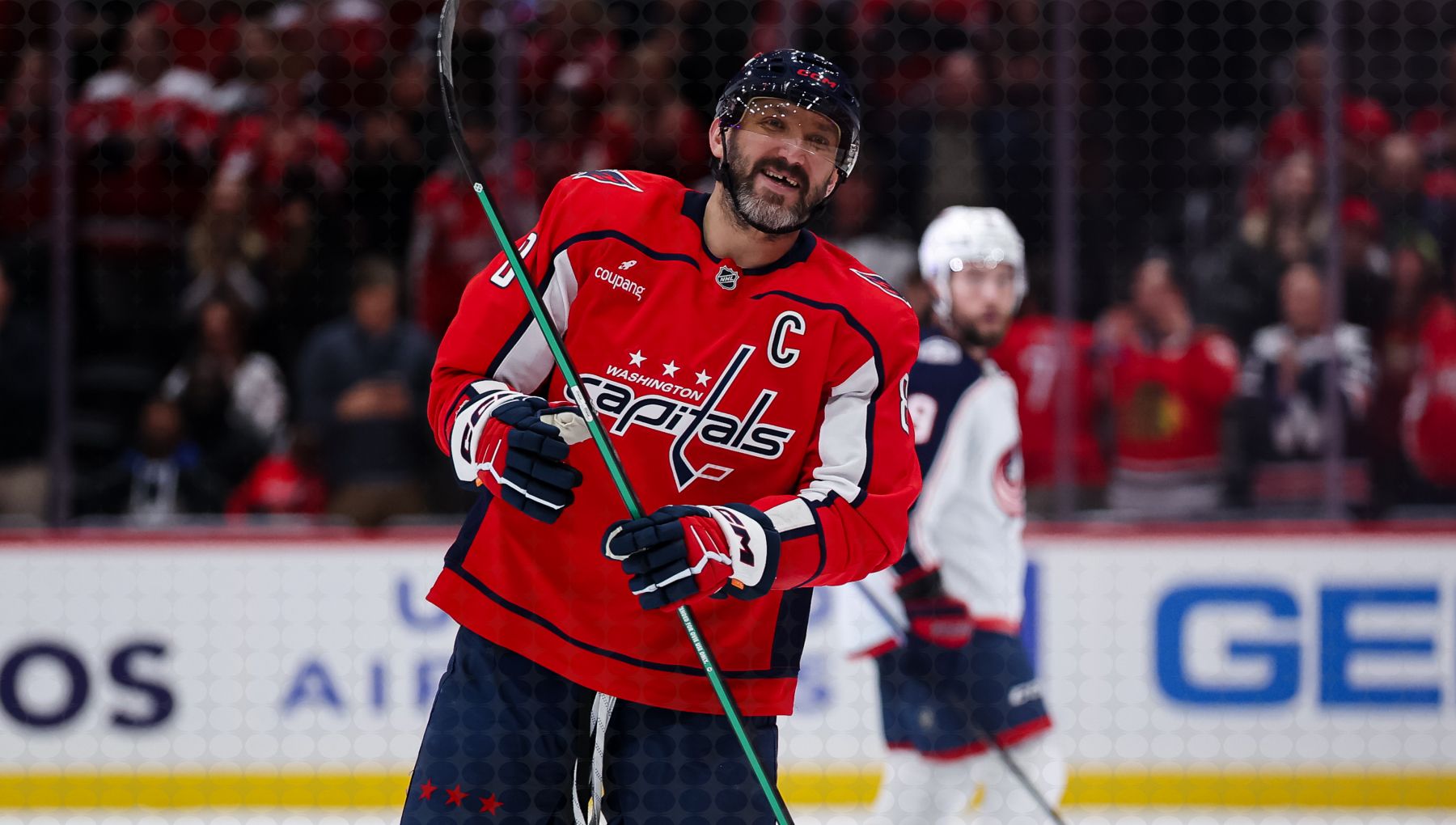
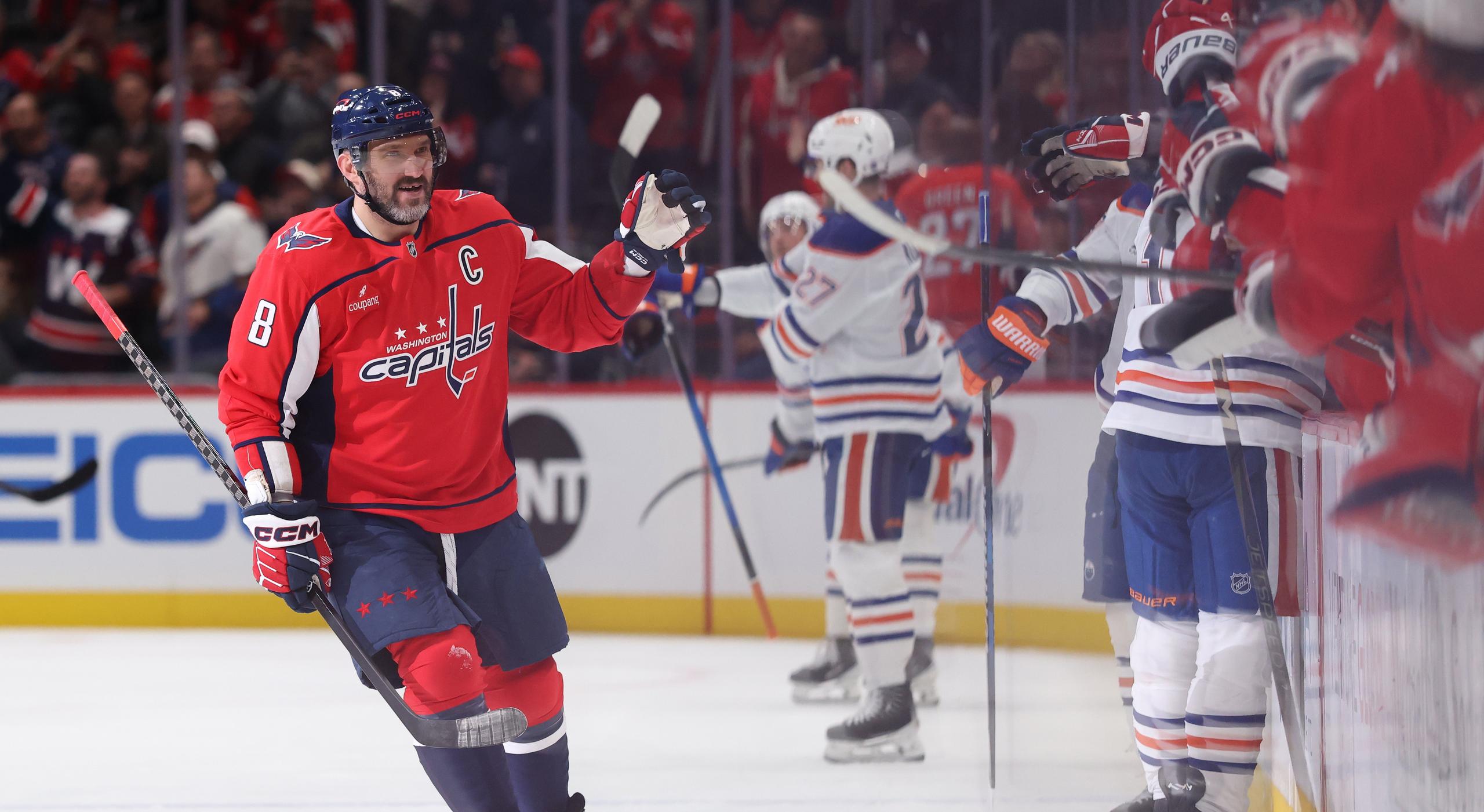
Alex Ovechkin (Photo by Patrick Smith/Getty Images)
Emblazoned across his back are bold letters that scream, “WELL, I’M NOT MICHAEL JORDAN.”
But Alex Ovechkin might be the closest approximation the NHL has to His Airness on ice.
In a contract year captaining a Washington Capitals team that has executed a reload to near perfection, Ovechkin–– and some more loquacious friends–– spoke exclusively with RG Media during the Caps’ recent West Coast swing.
He said he planned to play this season and then reassess his future. That future has always included, in his mind, a return to Dynamo Moscow, his hometown club with which he maintained a close relationship. Whether that would be a traditional arrangement of a season or more, or something more ceremonial like a game or two, as he hinted at recently to Jeff Marek, were questions for another moment.
“Right now, I’m not thinking about it, to be honest with you. I’m focused on the season, I’m focused on the next game and we’ll see what’s going to happen in the future,” the NHL’s all-time leading goal-scorer said.
Chasing History, Choosing Joy
Ovechkin could be forgiven for having a bit of media fatigue, as his quest to break Wayne Gretzky’s career goals record, once thought untouchable, last season attracted a circus that would have made Barnum & Bailey blush.
This season, Ovechkin has been content to cast aside any personal benchmarks or triumphs– he’s blown past 900 goals, currently 89 shy of 1,000, and the Caps could contend for the second Stanley Cup of his career and their history– and stay focused on the jubilation of competing.
“I just play and enjoy the game,” Ovechkin responded when asked if there were any individual or team achievements he’d still like to pursue in his 21st season.
The Capitals were one of the top teams in the Eastern Conference last year and have repeated that success thus far, going 10-1-1 in their past dozen games.
They’ve set aside hype and expectation, zeroing in on a common destiny as they did in 2018. That was a title year and delineating period in the career and reputation of Ovechkin, according to former opponent and current Philadelphia Flyers GM Daniel Briere.
Briere, during the leadup to one of Ovechkin’s innumerable milestones, his 700th career goal, said even before he hoisted the Cup, Ovechkin presented a near-singular melange of menacing attributes. His game was defined by more than just shooting or even scoring, Briere said.
“Ovi, to me, what he is is a power forward with the hands of a finesse player. You don’t see that very often. You watch him play, he can hit you with his shoulder or turn around and score an amazing goal off the rush or blast a one-timer from the top of the circle,” Briere said.
“You see guys that are power forwards who can play hard and can hit. Or you have the opposite, guys who can score goals with finesse. Or you have guys who have a great shot and can beat you from the outside,” Briere continued. “He’s at the top level of all those three ways of playing the game. That, to me, is what’s very impressive.”
Washington’s Reload and Ovechkin’s Role
The Caps’ prosperity this season has come without last year’s bounceback performer, Pierre-Luc Dubois, among others, due to injury.
“The most important thing is picking up wins. At the end of the road, if you’re not taking those points, it’s probably going to cost you the playoffs,” Ovechkin said. “Right now, the team’s doing well. Obviously, we have some injuries, but the guys are stepping up big time.”
Ovechkin himself has 14 tallies, courting a 40-goal pace that would match the number of years he has spent on earth. While he was relieved to put the record, the 900-goal benchmark, and more behind him, inquiries about 1,000 tallies are already beginning in earnest.
“The way he’s playing and, touch wood, if he doesn’t get hurt, if he ends up with 35 to 40, people are going to ask him if he wants to play again next year [and if 1000 is possible],” said Bruce Boudreau, who coached Ovechkin from 2007 to 2011 and has remained close with him. “I can see those questions being asked a lot in the second half of the season.”
When Ovechkin signed his current contract, whose season-end expiry will fuel much of that speculation, he communicated that he did not want to be part of a rebuild. Instead, GM Chris Patrick and company have changed components on the fly, building a competitive parent club as well as organizational depth that would be the envy of many teams picking in the lottery.
Leadership, Culture, and Longevity
Beyond getting back to their winning ways, Washington’s success has reinvigorated its silver-haired captain.
“We try to help each other a lot, on the ice and off the ice, and the communication is there, so it’s a very good situation,” Ovechkin said.
Boudreau said that sort of resilience and reciprocity were not simply serendipitous.
Ovechkin was named captain at a young age, much like his longtime foil Sidney Crosby in Pittsburgh, and at the time it was because he was the team’s top player and centerpiece. No longer a great performer who happened to be a captain, Ovechkin took greater ownership of the role over time.
“He’s created an atmosphere in that room that is second to none, where they all play for the team,” Boudreau said. “Sometimes you see superstars, that, when they do something great, that the team just says, ‘yeah, yeah, yeah.’ But everybody on the Washington Capitals genuinely loves when good things happen to Alex, but he responds in kind and supports them.”
While Ovechkin was widely misunderstood early in his career, thanks in part to the long shadow Crosby cast from Canada and, as Boudreau said, a bit of envy in some cases–– his genuine traits have ultimately permeated public perception.
He even plans to open a museum largely dedicated to his career, in Moscow, a place where Boudreau said he only recently learned the extent of Ovechkin’s stardom after nearly 20 years of knowing him. If another household name like baseball’s Barry Bonds or footballer Cristiano Ronaldo were to do the same, it would likely be perceived as pompous.
“He’s not the type of superstar that –– he knows he’s good, he knows what he’s got and everything –– has that air [of arrogance] about him,” said Boudreau, who lauded how charitable and magnanimous Ovechkin had been behind the scenes. “He’s so down to earth, it’s crazy. He wants to play video games and all these fun things, he’s just a big kid, and that’s what makes him so lovable.”
When Ovechkin was asked about plans for the museum, his tone became more excited.
“It’s gonna be cool, the fans are going to love to see it. It’s going to be pretty big, with a lot of history,” he said.
Ovechkin has compiled mementos from his own storied career, as well as plenty of memorabilia from other athletes he admires, with his historic gear set to star at the museum one day.
“Whatever I have is going to be there. My stuff, obviously, like I have lots of stuff, my hockey sticks, jerseys, helmets, medals and a lot of things, it’s gonna be cool,” Ovechkin said.
Olympic Absence and International Pride
While the museum will be in Russia, Ovechkin and his countrymen will not head overseas to Milan this winter. Nor will teammates Aliaksei and Ilya Protas, as Russia and Belarus were both barred from competing in the Olympics due to the ongoing conflict between Russia and Ukraine.
Last year’s 4 Nations Face-Off placed Ovechkin in a similar position of being excluded from a best-on-best competition, instead having nearly a month in the middle of the season to rest. A broken femur in November 2024 made the time off more welcome then, but he said “you have to be careful with it” when players have lengthy downtime during the season.
In 2018, the Olympic Athletes from Russia won gold, but Ovechkin, who’d contemplated defying the NHL to participate, wasn’t on the roster, nor were any players from the world’s best league.
“There’s nothing we could do. We’re just going to follow the rules, and see what happens [in the future],” Ovechkin said of being unable to participate this coming February.
Before Ovechkin was the goal king of the NHL, he was the goal king of Europe, a mantle previously carried by Jaromir Jagr, Teemu Selänne and Jari Kurri.
“He wants to represent Russia every chance he has, paying it back to his home country where he grew up as a hockey player,” said Kurri, ahead of Ovechkin’s 700th goal. “He’s a very proud player, and I think that every player should be that way.”
Boudreau, however, pointed out that the Olympics, while desirable for every player, could sometimes be disruptive. He coached a then-44-year-old Selänne in 2014, when Finland won bronze, and Selänne was the tournament MVP. Boudreau said resting Selanne for the playoffs didn’t go over well. Selänne was furious when he was scratched for a game, leading up to the Anaheim Ducks’ second-round exit to the eventual champion Los Angeles Kings.
Still Playing With Boyish Joy
Like Selanne, Ovechkin’s 40s haven’t slowed him to anywhere near the point of ineffectiveness, and his ebullience has endured even as the calendar has turned and turned and turned.
“He’s scored some goals this year, whether it was his 900th or whichever, where you could see in the smile on his face that he’s really happy, he’s in a really good place,” Boudreau said. “Over the years, like, I mean, something like (two seasons ago), when he only scored 31 goals, I was thinking, ‘geez, he doesn’t look happy.’ I was so used to him smiling and everything, and I find that is back now.”
“He had this boyish attitude that he brought that everybody loved,” Boudreau elaborated. “I think everybody knew when he was 20 years old that he loved to play the game, and now, it’s coming out that he still loves to play the game.”
Or it could read:
“He’s scored some goals this year, whether it was his 900th or whichever, where you could see in the smile on his face that he’s really happy, he’s in a really good place,” Boudreau said. “I think everybody knew when he was 20 years old that he loved to play the game, and now, it’s coming out that he still loves to play the game.”