
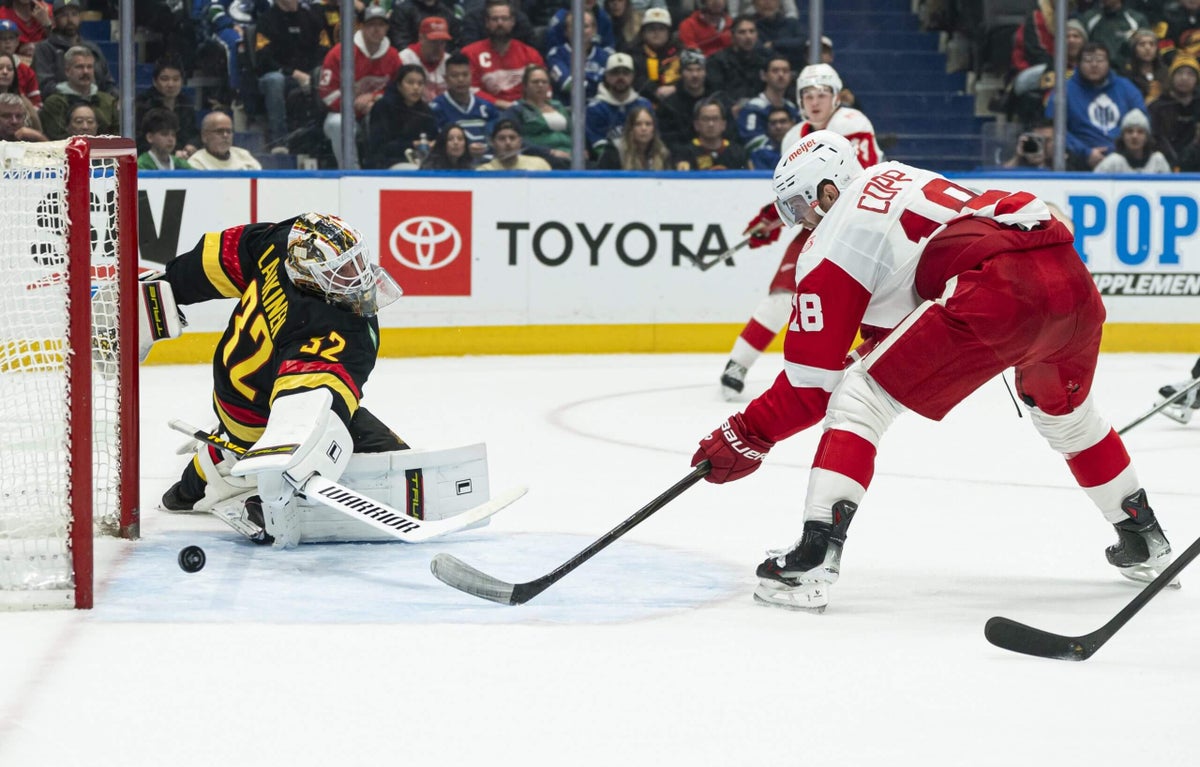
VANCOUVER — Does it matter to anybody that on Monday the Vancouver Canucks fell, once again, to the absolute nadir of the NHL standings with a 4-0 loss to the Detroit Red Wings?
If it does, there was little evidence of it at Rogers Arena.
The crowd itself was understandably sparse, as it has been throughout this holiday-season homestand. There was a wide variety of empty seats dotting the lower bowl, the sense of negative space enhanced further by the atypical volume of fans sporting the sweater of the visiting team.
And as the game spun out of control for Vancouver in the second period, with a pair of cataclysmic breakdowns, both of which resulted in a Detroit skater, all alone in the slot, quite easily depositing a puck past Kevin Lankinen to break the game open, the crowd’s reaction was disturbingly muted. There was little but scattered booing until the final minute of the third period, when some halfhearted expressions of disappointment trickled down on the home side.
In what’s reputedly this tough, pressure-cooker Canadian hockey market, the crowd reacted to yet another dispiriting Canucks loss on Monday with a claustrophobic sense of resignation. It was like a message to the hockey club, sent via the wisdom of crowds, that the Vancouver fan base isn’t angry, just disappointed.
The game itself was a sloppy, low-energy affair, in which both teams seemed at war with the puck for extended stretches. The Canucks weren’t demolished territorially and had sufficient scoring chances to make this contest closer than it ultimately was. This wasn’t a game Vancouver deserved to win, however, regardless of what the head coach, or your preferred Russian fancy stats, might suggest.
Vancouver may have had a higher volume of shots and looks, but the chances that the Red Wings found were of a more threatening variety than anything the Canucks ever mustered. A cross crease deke from James van Riemsdyk right across the goal mouth, off a won battle behind the Vancouver net. An Andrew Copp tap-in to finish a gorgeous passing sequence initiated by Patrick Kane off a turnover that occurred when Filip Hronek and Quinn Hughes collided, which was finished when Red Wings rookie defender Axel Sandin-Pellikka found Copp disturbingly alone in front of goal with a perfect pass for the absolute gimme.
When Nate Danielson scored to make it 3-0 and seal Detroit’s victory less than a minute later, he deflected home a Sandin-Pellikka shot as he stood unopposed and unbothered with four feet of space on either side of him at the top of the Vancouver crease.
The Canucks’ defensive form, which has been train-wreck level permissive for much of this season, had been trending in a more favourable direction in recent weeks. It still is, probably, despite the sheer, head-shaking magnitude of the breakdowns that cost them on Monday.
If Saturday’s result against the Minnesota Wild demonstrated the upside case for icing an overmatched team filled with young players learning to succeed at the NHL level, Monday’s loss to Detroit showed us the other side of that. In fact, the dichotomous linkage between the two games was a bit on the nose.
On the Red Wings’ first goal, for example, it was Saturday night’s hero Aatu Räty, a genuine bright spot for Vancouver in the first 30 games of this campaign, who was pick-pocketed behind the Canucks net. It was a key moment, a mistake that turned a not especially dangerous forechecking sequence for the Red Wings into a five-alarm scoring chance, and a first-period Red Wings lead.
On the third goal, it was Tom Willlander — who scored his first career goal on Saturday, which underlined what’s been a very promising start to his NHL career — getting worked for an extended sequence along the wall by Elmer Söderblom that led ultimately to Danielson’s deflection tally.
What seemed sweet on Saturday turned sour rapidly on Monday. That’s life too, however, at the bottom of the NHL standings, with a team that really should be living comfortably with the mistakes of young, developing players and perfectly fine with the accumulation of disappointing results.
The reality of rebuilding, of doing what’s necessary at long last to begin to turn this ship around, isn’t some romantic hypothetical concept when it’s put into practice. No, the act of tanking is a grimy, embarrassing process. Losing for the long-term benefit of the franchise is a true perversion of competitive incentives. It’s an abhorrent, ugly thing. A necessary evil.
It’s something to be endured, and to manage carefully so as to minimize the still-inevitable pain and scar tissue that can so easily accumulate in a losing environment.
There are games where every (ultimately) successful rebuilding team will have been said to have gone too far. To have lost control of the process. To have embarrassed themselves.
That’s fine, in the big picture. In fact, that’s the true cost of chasing the sort of elite talent at the top of the draft order that can turn this franchise around.
Of course, the factors at play in Vancouver at the moment are more complicated than this formulation implies. It’s one thing to play the sort of template, disappointing rebuilding game when you’ve done the work to make the pain worthwhile, but of course, the Canucks haven’t just yet.
Despite the recent memo making Vancouver’s pending unrestricted free agent players available for trade, the club has yet to begin the work of unmaking this roster with the future in mind. In fact, at this point in the season, the Canucks are still operating at a draft pick deficit — the result of sending a fourth-round pick to the Chicago Blackhawks for Lukas Reichel back before Vancouver had sunk to the bottom of the NHL standings.
The inevitable struggles and frustrations, the trials and tribulations, of a rebuilding effort are never easy to swallow. The medicine goes down somewhat more easily, however, once a detectable, coherent plan for the future is in place. That’s still lacking from Canucks ownership or management for the moment.
Then, of course, there’s the Quinn Hughes of it all. Hughes, the Vancouver captain, exists at something a maelstrom of speculation and overreaction across the hockey world at the moment. The Norris Trophy-winning defender will become extension eligible at the end of this season, and wants desperately to win, so much so that this season was billed as a campaign in which the club had to find a way to be competitive to enhance its chances of keeping Hughes around for the long haul.
Now that the Canucks are losing repeatedly, Hughes’ future is an understandably constant topic of discussion, both locally and across the NHL.
It’s ironic that Hughes is precisely the sort of superstar-level talent that any tanking team is praying to land as they go through that process, and remains the Canucks’ captain at this moment in time when it’s become increasingly clear that the club will need to tear things down — whether he opts to stay or not — to build something worthwhile.
Unfortunately, throughout Hughes’ Canucks tenure, he’s been insufficiently well supported. He’s lacked support from his teammates, the most talented of whom proved unable to form a durable partnership, clashed and caused the detonation of the 2023-24 core last season. He’s lacked support too from an organization that, despite spending years picking at the top of the draft in the previous decade, lacked the vision, discipline and patience to accumulate enough of the sort of star-level, needle-moving players that any NHL team requires if it’s hoping to contend year over year.
You can see it when you watch the Canucks play at the moment. The glorious chances that Hughes creates with his pinpoint passes, set up by a series of shimmies and ankle-breaking dekes, that are put well wide. Or the move he’ll put on a forechecker, leaving him in the dust as he skates up ice, all in the service of setting up a low-danger outside look from a teammate with 14 career NHL points. It hasn’t been for a lack of opportunity that Hughes is currently mired in a six-game pointless streak, his longest such stretch since mid-April 2023.
Big picture, it takes a fair bit of doing to make a selection in the top 10 of the NHL Draft order five times in six years — as Vancouver did between 2014 and 2019 — come away from that era with a truly elite, one-of-a-kind Norris Trophy level defender, and squander it. That’s what the Canucks have done already, regardless of how the uncertainty surrounding Hughes plays out in the coming weeks, months or years.
This highfalutin stuff, from the team-building strategy angle to the cruel vacillations of developing players at the NHL level, however, lacks teeth when compared to the existential threat that the Canucks organization faces from the growing sense of resigned apathy that’s readily apparent among fans in this usually rambunctious and engaged hockey market.
It should matter that the Canucks fell to dead last in the NHL standings with a shutout loss on home ice against Detroit. On Monday night, however, it didn’t really feel like it did.
That, more than anything, is the intolerable reality that this franchise has to begin to grapple with.