

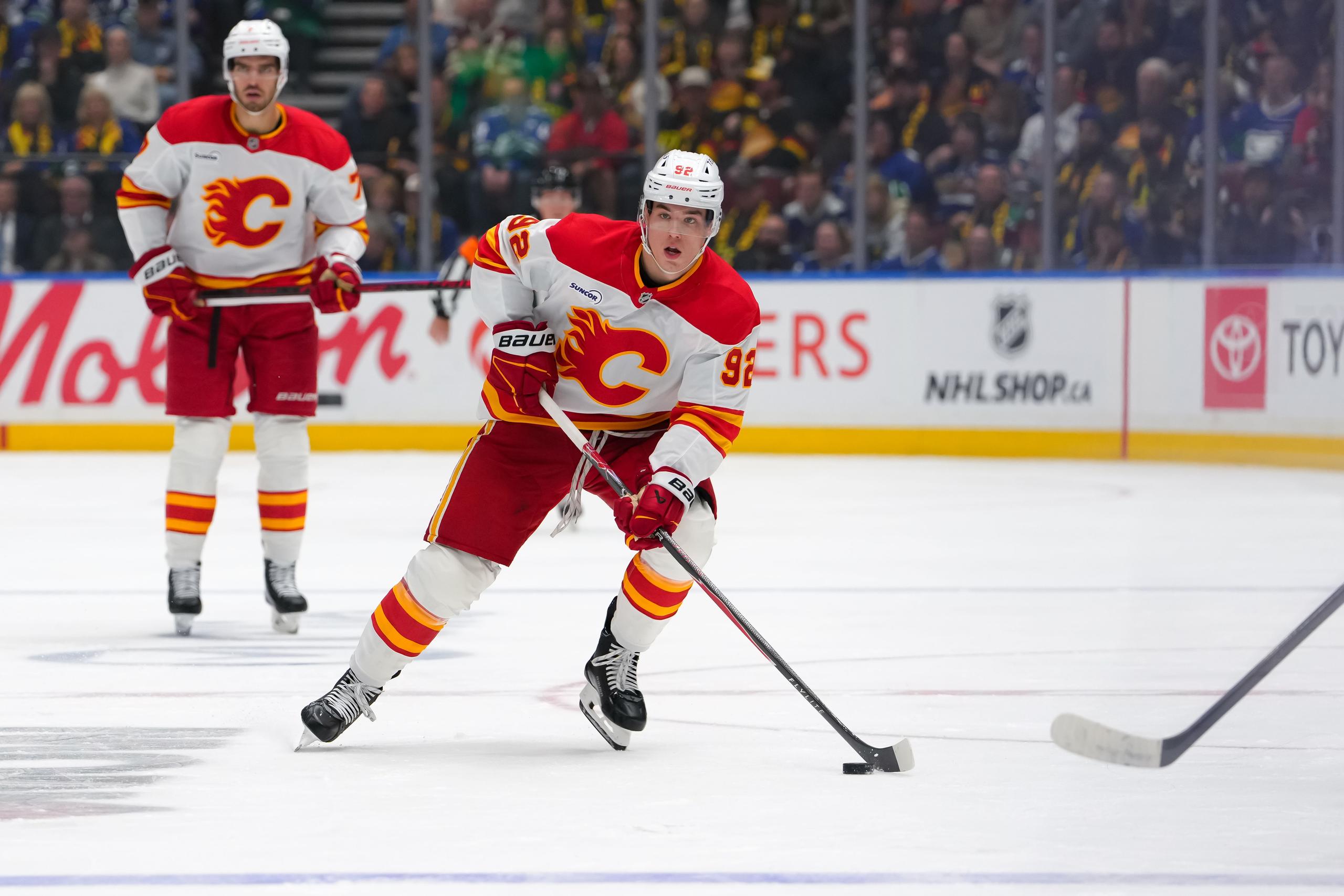
Matvei Gridin (Photo by Derek Cain/Getty Images)
Calgary Flames prospect Matvei Gridin doesn’t talk like someone trying to sell you a perfect season. The former 1st-round pick in 2024 talks like a 19-year-old learning, adjusting, and getting an accelerated education in what pro hockey actually demands, especially when you are a first-round pick with a bright spotlight attached to your name.
The Flames have already given him a quick taste of the NHL, and the AHL has become his lab for everything that comes next. The minutes are heavy, the responsibilities are real, and the goal is simple: turn flashes into habits, and habits into a player the Flames can rely on when the time comes.
Finding Consistency
Gridin doesn’t tiptoe around what separates prospects from everyday NHL players. Skill matters, but the league quickly exposes nights where your details drop or your pace slips. He knows coaches want the same version of you every game, not just the highlights. That, he says, is the bar he is still chasing.
“Consistency is probably the most important thing an NHL coach will look for, and I think if you can find consistency, you’re going to play lots of minutes. I can’t say I’ve really found consistency in my game yet; I play great on some nights, but others are a little tougher,” Gridin told RG in a one-on-one interview.
That honesty also frames how he views his early NHL experience. Those games did not make him comfortable. They made him quicker. The reads tighten up in the NHL, and once you’ve seen it, it’s hard to unsee it. In the AHL with the Calgary Wranglers, he’s trying to bring that same urgency, especially in the small moments that decide whether you keep the puck or give it away.
“I think having gotten to play those four games in the NHL at the start of the year has helped my game in the AHL for sure. I make decisions quicker, I move the puck up faster, and I try to keep an eye on the defensive side too; but I’m still working on that.”
The learning has also come directly from Calgary’s veterans. Gridin described a moment at practice when a simple piece of advice carried a big message: the NHL is played before the puck arrives. Processing has to start early, or you are already behind. It’s the kind of detail that doesn’t show up in a box score but can change a player’s entire rhythm.
“I had Michael Backlund come up to me at practice to tell me that I need to scan the ice before receiving a pass, so that I can know what I want to do with the puck before I got it on my stick. You have to think faster.”
For Gridin, the defensive side is not a weakness so much as a standard he wants to meet every night. He believes he can be reliable away from the puck, but he also knows when his game drifts, it usually drifts in one direction. The temptation to chase offense is real, especially for a young player who has scored at every level, but that can come at a cost.
“I think I’ve shown an ability to be good defensively; using my stick, being well-positioned, and that. It’s just about doing it with more consistency. Sometimes I play great defense, but sometimes I focus too much on offense, and that’s bad.”
That push-and-pull is where he’s trying to grow up quickly. He’s learning that strong defense is not something you do only when you’re not producing. It can be the engine that creates your offense, because it keeps you involved and keeps you on the ice. He wants his confidence to come from the full shift, not just the scoring chance.
“I’ve understood that if I play good defense away from the puck, the offense will come. Even if I don’t score or get an assist on the play, I’ll feel good when I make a good defensive play, because it means I’m playing strong away from the puck.”
The Gridin Signature
Even as he leans into the serious side of development, Gridin’s personality still peeks through, especially when the conversation turns to his first NHL goal. It was one of those moments that becomes part of a player’s early story right away: a creative play, a bounce off a defender, and a puck that found its way past Stuart Skinner. The goal counted the same as any other, but the way it happened made it unforgettable.
And while teammates were thrilled for him, they also did what teammates do. The NHL room celebrates you, then it laughs with you, usually within the same period. Gridin said the jokes didn’t come for the goal itself, but they arrived soon enough, and at the worst possible time.
“I didn’t get chirped on my first NHL goal, the team was good to me. But they did chirp me later in that same game for missing a shootout goal.”
That shootout attempt matters because Gridin isn’t just winging it out there. He has a move he believes in, a quirky route to the net that starts wide and snaps back to the middle to catch a goalie leaning. It’s a pattern he’s comfortable with, and one that has worked for him enough times that it has earned a name. Sometimes the best parts of a prospect’s story are the small things, the little signature moments that teammates latch onto and keep bringing up.
But as Gridin learned, a signature doesn’t mean automatic. Once the room knows what you call it, the room also knows what to say when it fails. And in Calgary, he quickly found out the nickname was going to have a long shelf life.
“During the preseason. I scored a goal in the shootout against the Seattle Kraken, and I called it the ‘Gridin Signature’ for laughs because of my wide path toward the net. And then, in the regular season, I missed a shootout goal, and Rasmus Andersson came over to me and was like ‘Hey, Gridin Signature didn’t work?!’ and it was pretty funny.”
A Big Part of the Flames’ Future
For all the humor and highlights, Gridin’s current reality is grounded in development and minutes. He understands why his NHL stint ended, and he describes it in practical terms. A roster opened because of injury, then tightened when a key player returned, and Calgary chose the route that would keep him playing in big situations.
“I knew I would likely be sent down because (Jonathan) Huberdeau was injured and would be coming back. They wanted me to play in the top-six and get power play time, but when Hubby came back there wasn’t a spot for me. The coaching staff decided it would be better for me to get more ice time in the AHL.”
When Gridin talks about the AHL, he doesn’t talk about it like a demotion. He talks about it like a benefit. Ice time is currency for a young player, and at 19, there is value in being out there constantly, touching every situation, learning what your game looks like when you have to carry it for long stretches.
“I play 23 minutes in the AHL, and I’d likely only be playing 12 minutes in the NHL. At 19 years old, it’s probably best for me to be playing a lot so I can be ready when they need me soon.”
His motivation, at its core, still sounds simple. It’s not complicated language, and it’s not a performance. It’s a reminder that the path is long, and the point is to keep moving.
“Just follow the dream, that’s all the motivation you need.“
Of course, he also admitted the hard part out loud. Development is rarely linear, and call-ups don’t always match your best stretches. There are nights you feel you’ve proven something, then you look up and nothing changes. That can mess with your head if you let it, especially when you’re piling up points and wondering what else the organization could possibly want to see.
“But, I’m not going to lie, it’s tough sometimes. I’ve gone on a few runs, long point streaks and I didn’t get called up yet. Sometimes, you can doubt yourself and asking yourselves what more you need to show to earn a call-up. But, you would rather play 23 minutes in the AHL than getting called up and watching from the press box.”
What keeps him steady is how he views Calgary’s direction and its opportunity. He sees a franchise that wants young players to grow into real roles, and he sees a runway for players like him to force their way into the picture. He even laughs at the contrast, describing Calgary as a place where development is part of the plan, not an inconvenience.
“It’s a great environment to be in, they want us young players to improve to be part of your future. It’s better than being in a place like Vegas. Calgary looks like they’ll be rebuilding soon, and that means opportunity for us younger guys to find a spot on the team.”
That’s why the message keeps circling back to preparedness. Not hope, not hype, but readiness. The Flames will make decisions, openings will appear, and when they do, Gridin wants to be more than a talented option. He wants to be an easy decision.
“When the time comes to make decisions (in Calgary) I want to be ready.”