
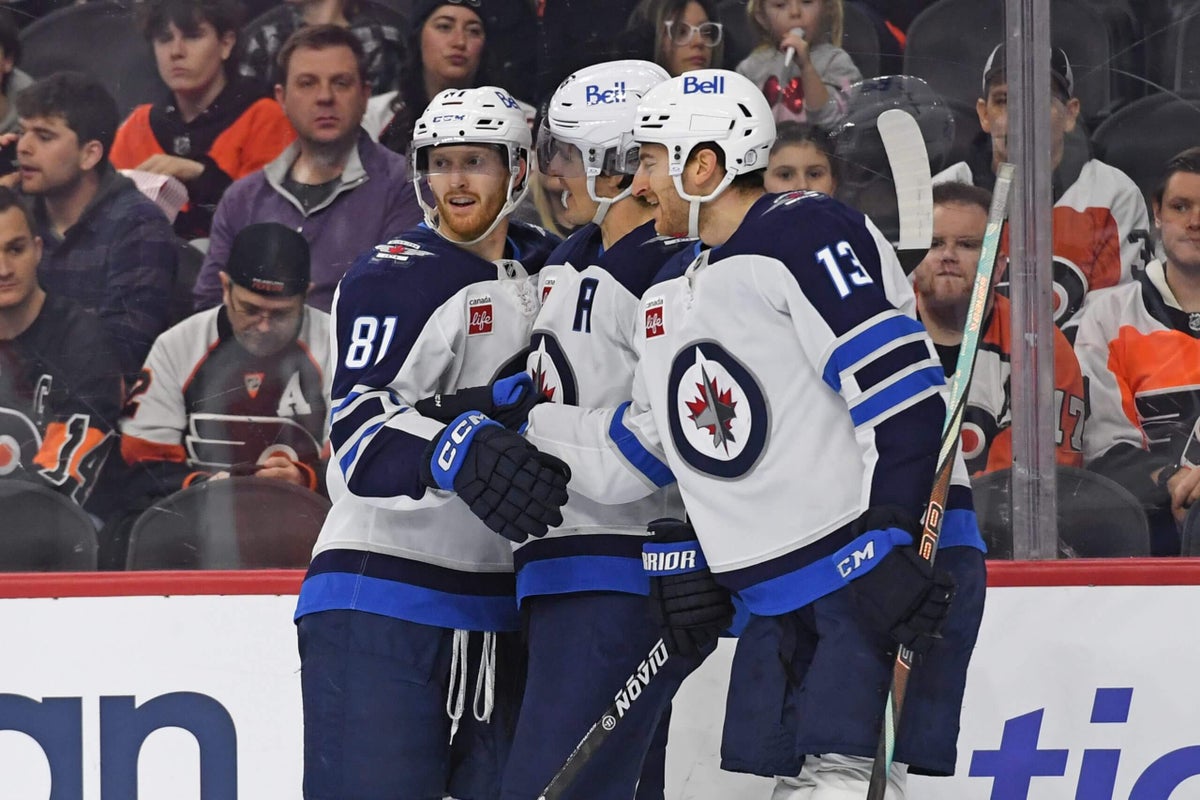
Kevin Cheveldayoff, Scott Arniel and the rest of the powers that be who influence the Winnipeg Jets must believe they have time to fix what ails the club.
Otherwise, we would be seeing more commitment to change.
Even as Arniel has broken up the Jets’ top line of Kyle Connor, Mark Scheifele and Gabriel Vilardi — a trio that has played more together than any other line in the NHL this season — it’s clearly a half-measure. Connor and Scheifele are the two most dangerous forwards on the team. They’ve produced so much — Scheifele with 38 points, Connor with 37 — on the 26th-ranked Jets that they’re still among the league’s top scorers.
But the 14-14-1 Jets are outside the playoffs. They made it close against Dallas after disheartening losses to the Edmonton Oilers, Buffalo Sabres and Carolina Hurricanes but fell 4-3 and are 2-7-1 in their last 10 games. There are two players on the team who can drive results by themselves on any given shift — Scheifele and Connor — but they play almost exclusively together on what’s become a one-line team.
It’s still an enormous deal that Winnipeg broke up its top line at all, so let’s dig into Arniel’s reasoning, the Jets’ hopes and what it all means. This is a major move, a half-measure and not a likely solution — all at the same time.
Why Arniel’s changes make sense
The degree to which Winnipeg has become a one-line team is extraordinary. Nino Niederreiter is the only forward outside of Connor, Scheifele and Vilardi who has even close to half as many points as Connor and Scheifele do. The other eight forwards on what used to be Winnipeg’s second, third and fourth lines all have less than one quarter of Scheifele’s 38 points.
Nikolaj Ehlers’ absence has cut the offence out of last year’s line with Vladislav Namestnikov and Cole Perfetti. Adam Lowry’s slow return to form has eroded the Jets’ shutdown line’s ability to generate goals off of a heavy, grinding cycle game. Jonathan Toews’ lack of footspeed, combined with a lack of game-breakers on his wing, has limited him to nine points in 29 games — the worst scoring rate of his career.
Add it all up and the storyline in Winnipeg all week has been about a lack of confidence. The crisis goes beyond the standard tropes of squeezing the stick too tightly and misfiring on scoring chances and into the hallmarks of Winnipeg’s team play. Niederreiter told The Athletic it’s affecting the reads the team makes on the ice, on everything from zone exits to the consistency with which the team sticks to its game plan when games get tough.
“You’re second-guessing your instincts,” Niederreiter said. “That’s where we’re at right now.”
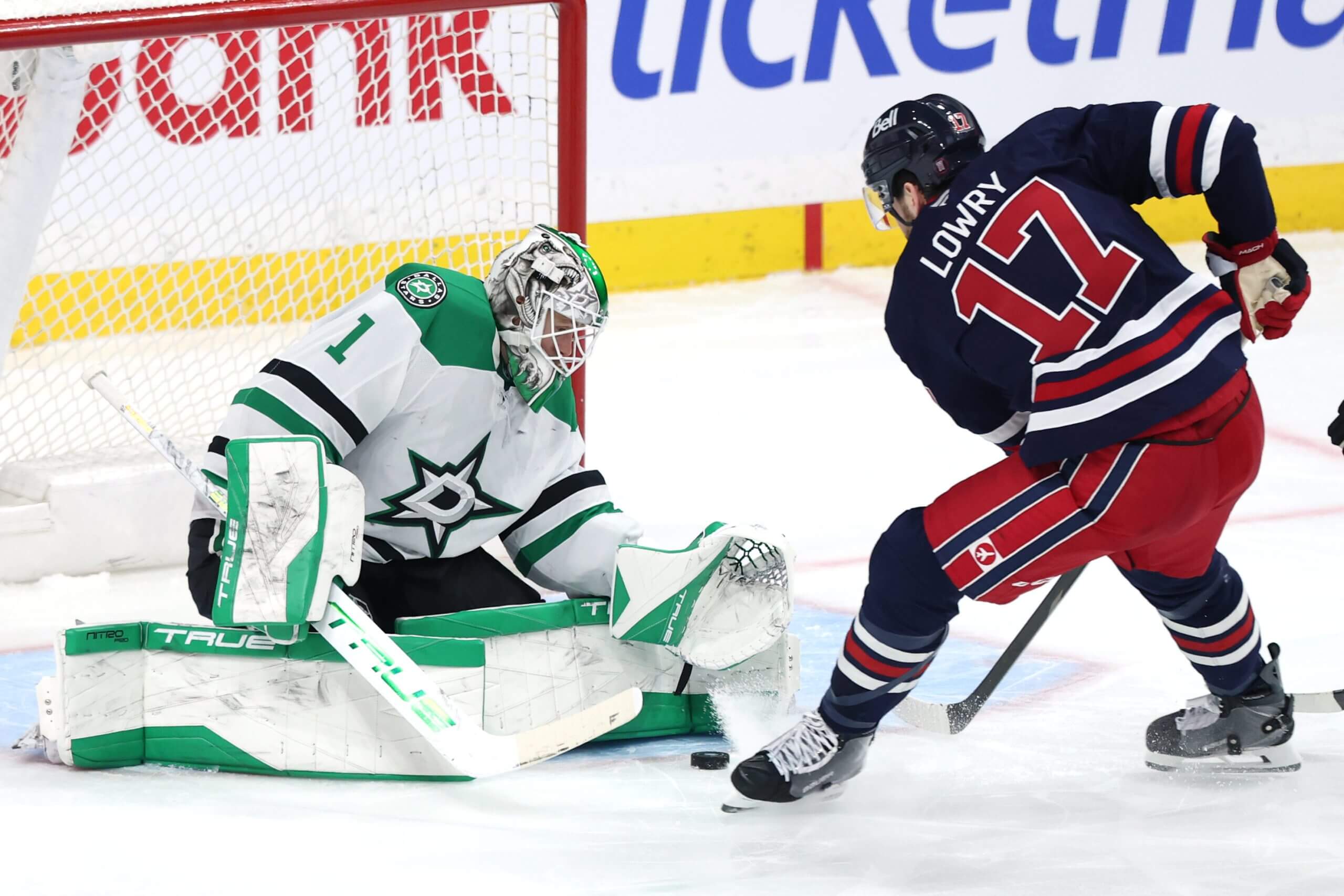
Adam Lowry is still getting up to speed after missing a chunk of time while recovering from offseason surgery. (James Carey Lauder / Imagn Images)
The Jets, who were tied with Dallas for the NHL’s third-most potent offence last season, clearly needed to do something. Arniel’s rationale is that Connor and Scheifele are the one thing Winnipeg has going for it in the offensive zone right now, and Vilardi may be good enough to spark other players.
But Connor and Scheifele are on another level, even compared to Vilardi. They’re likely to be able to spark other players by themselves. Even so, that’s a tough sell for a coach who knows Connor and Scheifele create results — and who clearly hopes to be able to keep them together even as the team struggles.
“One thing that happens when those two are on the ice (is) they are in the offensive zone a lot,” Arniel said on Tuesday. “I can break those two guys up and then three games from now, we are not scoring goals and now all of a sudden KC is not scoring, and I have to try and get him back going again. I’ve got two guys up and running that know how to play with each other, and we will work it that way for now.”
Like it or loathe it, Arniel’s reasoning is clear and he’s communicating clearly about it: He hopes to create a spark on lines two, three or four without losing the goals Connor and Scheifele are creating for him on line one. He sees risk in separating the one successful duo he has going for him right now.
Why the change falls short
Connor and Scheifele have become a little bit like Winnipeg’s equivalent of Connor McDavid and Leon Draisaitl — except the Jets don’t break them up. The Jets’ biggest need is a second line that can also win its minutes. They know Connor and Scheifele win their minutes together. They don’t know if Scheifele can drive one line while Connor drives another because Arniel hasn’t tried it.
Nathan MacKinnon and Martin Necas are the only forwards to play more total minutes together than Connor and Scheifele have this season. The Colorado Avalanche have beaten their opponents 35-9 with MacKinnon and Necas on the ice, so one understands the dedication. The Jets have beaten teams 31-21 with Connor and Scheifele on the ice — a figure that is impressive, the best on the club, and not so otherworldly as to render the duo untouchable. They’re in a class of their own, well above Vilardi, Perfetti, Niederreiter, Toews and whomever else may be looked to as secondary scorers on the Jets.
It seems possible, although not guaranteed, that Winnipeg could find two viable forward lines by splitting them up. The guaranteed part — at least until Lowry gets up and running, Toews finds his game or Perfetti takes his next step — is that no other combination of forwards seems to work. Vilardi’s addition to Lowry’s line on Tuesday did give Winnipeg a new look, but Vilardi is the third-most dynamic of Winnipeg’s top three forwards. He was good on Tuesday — just not good enough to fix things by himself.
A quick look at the Jets’ most common forward lines shows that Connor-Scheifele-Vilardi is the gold standard— and that nothing else seems to be working.
Winnipeg’s common forward lines
LineTOIGFGA
Connor-Scheifele-Vilardi
363:06
28
18
Namestnikov-Toews-Perfetti
104:15
2
4
Niederreiter-Lowry-Iafallo
102:19
4
6
Koepke-Barron-Pearson
66:01
4
2
Namestnikov-Toews-Iafallo
50:28
3
2
Niederreiter-Namestnikov-Nyquist
47:31
2
1
Niederreiter-Toews-Nyquist
35:37
1
2
In a world where they split their two best forwards, the Jets don’t need each of Connor’s and Scheifele’s new lines to be better than the Connor-Scheifele-Vilardi trio was. That seems like an impossible ask. Instead, they need their new top two lines to add up to what their old top two lines did. That’s much less difficult.
There may be human reasons to keep Connor and Scheifele together. They’re clearly great together and Winnipeg’s Plan A has always been to play them together. There may also be human reasons to spread the wealth. What must it feel like to play on any of the other three lines and know that even if you work your tail off, the best you can hope to do is survive your shift until the big guns get back out there? The team needs more than two forwards to be able to feel good about their contributions to the scoresheet.
What we saw against Dallas
Winnipeg opened its Tuesday night battle against the Dallas Stars with the following lineup.
Tonight’s constellation 🌌@PlayNowManitoba | #GoJetsGo pic.twitter.com/9CzfLHqBdC
— Winnipeg Jets (@NHLJets) December 9, 2025
It took Dallas 44 seconds to score against the new-look top line after a long shift in Winnipeg’s zone, but the Connor-Scheifele chemistry was on display later in the game. Connor was Winnipeg’s most dangerous forward on the night, followed closely by Scheifele on his line and Vilardi, who started the game with Lowry and Niederreiter. Arniel swapped Vilardi with Pearson midway through the second period.
The Jets were much happier with their game than they were against Edmonton over the weekend — and I agree with that assessment — but they lost again, even though Connor and Scheifele connected for two more goals.
This duo is DYNAMIC 😮💨 pic.twitter.com/qJaYvWzwTh
— Winnipeg Jets (@NHLJets) December 10, 2025
The trio was reunited with six and a half minutes to go in the third period with the Jets down by one, showing Arniel still has the option of running out his big guns in key moments down the stretch.
“We’re still going to need other people to step up,” Arniel said. “I really liked a lot of what happened tonight but I still think there’s more from other people. We’re a team, we’re 20 guys, everybody has to be pulling their weight.”
What else the Jets might try from here
With no disrespect to Vilardi, there is an angle through which the Jets haven’t broken up their top line at all. I instinctively sit forward when Morrissey, Connor or Scheifele have the puck on their stick. That seems like too short a list.
It may be that the Jets simply do not have the horses.
There is a segment of the readership that just responded with a wholehearted “duh, Murat” but I hold that key Jets will improve individually as this season goes along. I think it makes sense that Lowry, Perfetti, Dylan Samberg and yes, even the 37-year-old, fourth-line Toews will improve incrementally throughout the season. There may be internal gains available.
It doesn’t look like enough, though — and that’s the part that’s most concerning. In the past, we lauded Cheveldayoff multiple times for a hot streak that included the 2022 Andrew Copp trade, the P.L. Dubois trade and the acquisitions of Niederreiter and Namestnikov for great prices. His biggest offseason acquisition, Toews, is a fourth-line winger right now. His second-biggest offseason acquisition, Gustav Nyquist, is a healthy scratch, while Brandon Tanev signed elsewhere and Luke Schenn is not having success on the third pair. It may be that Cheveldayoff’s bet was that he had the talent in-house and just needed playoff experience.
These Jets look like they need more talent, too.
The line changes we’re seeing right now are not the end step. If they don’t work, we may see Winnipeg make bolder lineup decisions, including trying to find out if Connor and Scheifele can drive their own lines. If that doesn’t work, we may see minor trades or even something major. The Jets will likely work through those steps in sequence.
In the meantime, one example of forward lines with Connor and Scheifele split could include:
Iafallo — Scheifele — Vilardi
Connor — Barron — Perfetti
Niederreiter — Lowry — Namestnikov
Pearson — Toews — Koepke
It’s all guesswork, but the theory is that the second line would improve by more than the first line got worse. By all means, make your own suggestions in the comment section.
Final thoughts
There were two other Jets news items on Tuesday. The first was Darren Dreger’s report that Connor Hellebuyck could be back in net as soon as next week.
Dec. 20 would mark four weeks since Hellebuyck’s arthroscopic procedure. It was described as “minor” at the time, with a four-to-six week suggested timeline. If Hellebuyck is ready to go ahead of schedule — assuming full health, without setbacks — then Winnipeg is in a better position to win games without finding instant solutions to its forward troubles. Perhaps the Jets feel like all they need to do is buy time, given they feel like they’re playing better and they know their No. 1 goalie is coming back soon.
The second item was that Winnipeg assigned Elias Salomonsson to the Moose in the wake of Haydn Fleury’s return to health. The Jets have yet to find a third pair that wins its minutes this season, with Logan Stanley and Colin Miller outscored 5-0, Fleury and Luke Schenn outscored 4-0, and Stanley and Schenn outscored 4-3. Salomonsson’s underlying numbers were no better, but the 21-year-old showed promise and has a brighter future than the veteran right-handers in front of him. The Jets remain all-in on their veterans.
Every decision appears to be a doubling down on the existing process — even the ones Winnipeg makes to mix things up.