
One month ago in this space, we lamented that the Caps’ lousy special teams were literally costing the team points in the standings. Since then, they’ve gone on a torrid 11-2-2 run and, unsurprisingly, their special teams have been better, posting a perfectly respectable middle-of-the-pack 20 percent efficiency on the power play and 82.1 success rate on the penalty kill over their last ten games.
What’s noteworthy about the special teams’ rise from the dead is that it hasn’t simply been fueled by a shooting percentage bender or unsustainably stout goaltending – their percentages there have been pretty mid. As we noted in that previous piece:
Lest you wonder if the Caps are simply victims of bad puck luck and due for some friendly regression any day now… don’t hold your breath. Per Natural Stat Trick, the Caps are currently ranked 27th in the League in 5-on-4 expected goals-for rate and 26th in actual goals-for rate, and 27th in both 4-on-5 expected and actual goals-against rate. Maybe the distributions change a bit, but these results are what the Caps have fairly deserved. Simply hoping for better results ignores that the underlying process is completely broken.
Right on cue, we can see that both the power play and penalty kill have gotten better, and not just better results. Here are the ten-game rolling expected goal rates for each unit:
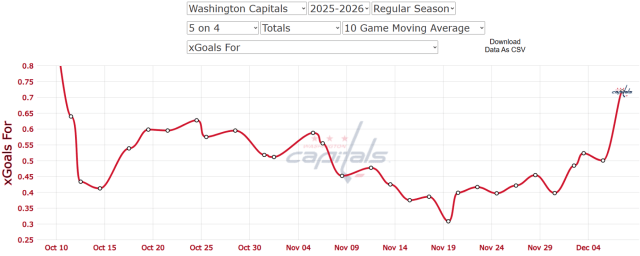 via MoneyPuck
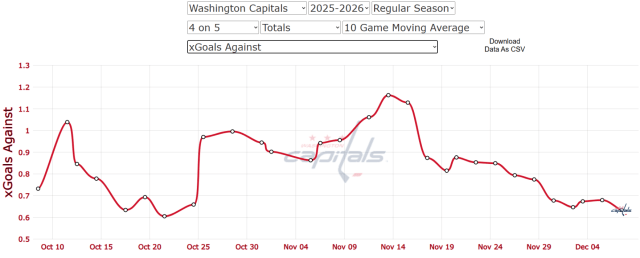 via MoneyPuck
What, then, has changed?
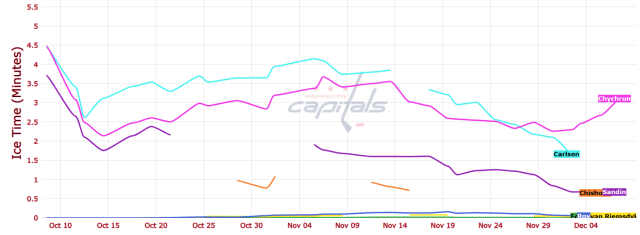
Well, correlation doesn’t imply causation and there are almost certainly more tactical and personnel tweaks that have been made that won’t be covered here, but let’s start with the power play, where one significant shift has been a reduction in ice time for John Carlson:
 via MoneyPuck
Does that mean that Carlson was The Problem? No, not necessarily. But what’s interesting is that his drop in ice time on the power play coincides with less pronounced drops for Jakob Chychrun and Rasmus Sandin. In other words, the Caps appear to have gone from a three-forward/two-defenseman alignment to a four-forward/one-defenseman set (generally accepted as more effective).
But couldn’t it just be that the team is getting fewer power plays driving everyone’s time down?
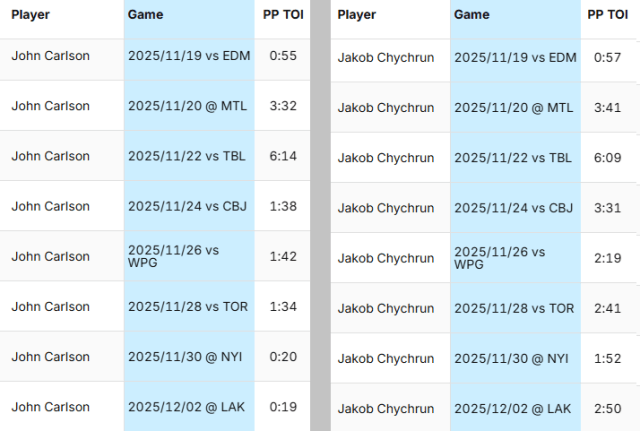
It could, but if we look at the games they’ve played together since 11/19 (“rock bottom” in the graph above), we see the shift:
 via NHL.com
Those first three games look like 3F/2D sets on the PP, then there’s a shift to Chyrchrun getting more significantly more (PP1) minutes. And over the last three games with Carlson out nursing an injury? Chychrun has played 2:42, 3:30 and 5:24 on the power play, while Sandin has skated 1:00, 1:14 and 0:36 (no other D had more than 12 seconds in any of those games).
There have been other, smaller ice time changes over the last month on the power play (slight upticks for Ryan Leonard and Anthony Beauvillier, and a continued realization that maybe Alex Ovechkin doesn’t actually have to play the full man advantage), but it sure looks like the driver here is the change from 3F/2D to 4F/1D. Could they have found the same modest success with Carlson as the sole defender instead of Chychrun? Perhaps. We’ll see what Spencer Carbery thinks soon enough, as Carlson nears a return from his injury.
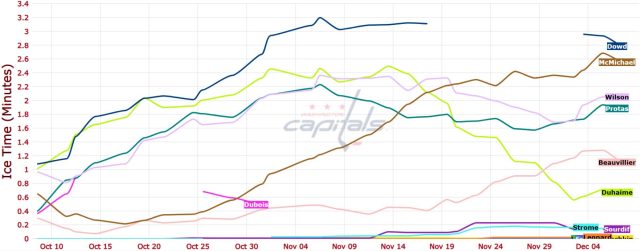
As for the penalty kill, the noticeable role (TOI) changes have come up front:
 via MoneyPuck
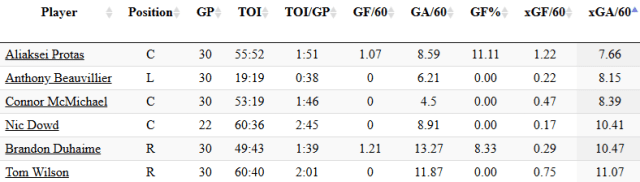
Here, we see Nic Dowd’s injury and a drop in ice time for Brandon Duhaime on the kill, with that void filled mostly by Connor McMichael and Anthony Beauvillier (the other penalty-killing forwards, Tom Wilson and Aliaksei Protas, have been pretty stable in ice time). That’s more time for two of the three most effective penalty killers up front, and less for a couple of less-effective forwards:
 via NatStatTrick
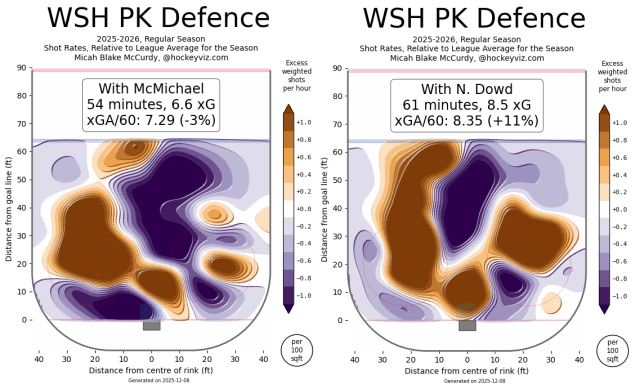
Now, that lacks a lot of context, such as who’s facing PP1 vs. PP2, etc. But McMichael has been more effective man-down this season than Dowd:
 via HockeyViz
And we’ve seen that play out over the last month or so. That’s not to say that McMichael is better than Dowd shorthanded… but he certainly has been, which should earn him more time in the role.
The bottom line with both of these turnarounds is that Spencer Carbery was proactive in making changes (some perhaps necessitated by injury) rather than stubbornly hoping for a change in fortune and the results have been solid. As Carlson and Dowd get healthy, it will be interesting to see if roles revert to where they were before… and, if so, results follow.
Like this:
Like Loading…
Related