
Mark Wagner
Special to ICT
When Skyler Coard was six years old, his parents took him to a skating rink. He was fitted for a pair of skates, and before anyone could say GO, Skyler was on the ice and sliding every which way.
“Forwards. Backwards,” Skyler’s father Richard recalls with a chuckle. The manager of the rink asked how long he had been skating.
“They guy was amazed when I told him this was Skyler’s first time on skates. First time on ice. Period,” Richard Coard, a gifted athlete and vice president of the Shinnecock Golfers Association, told ICT.
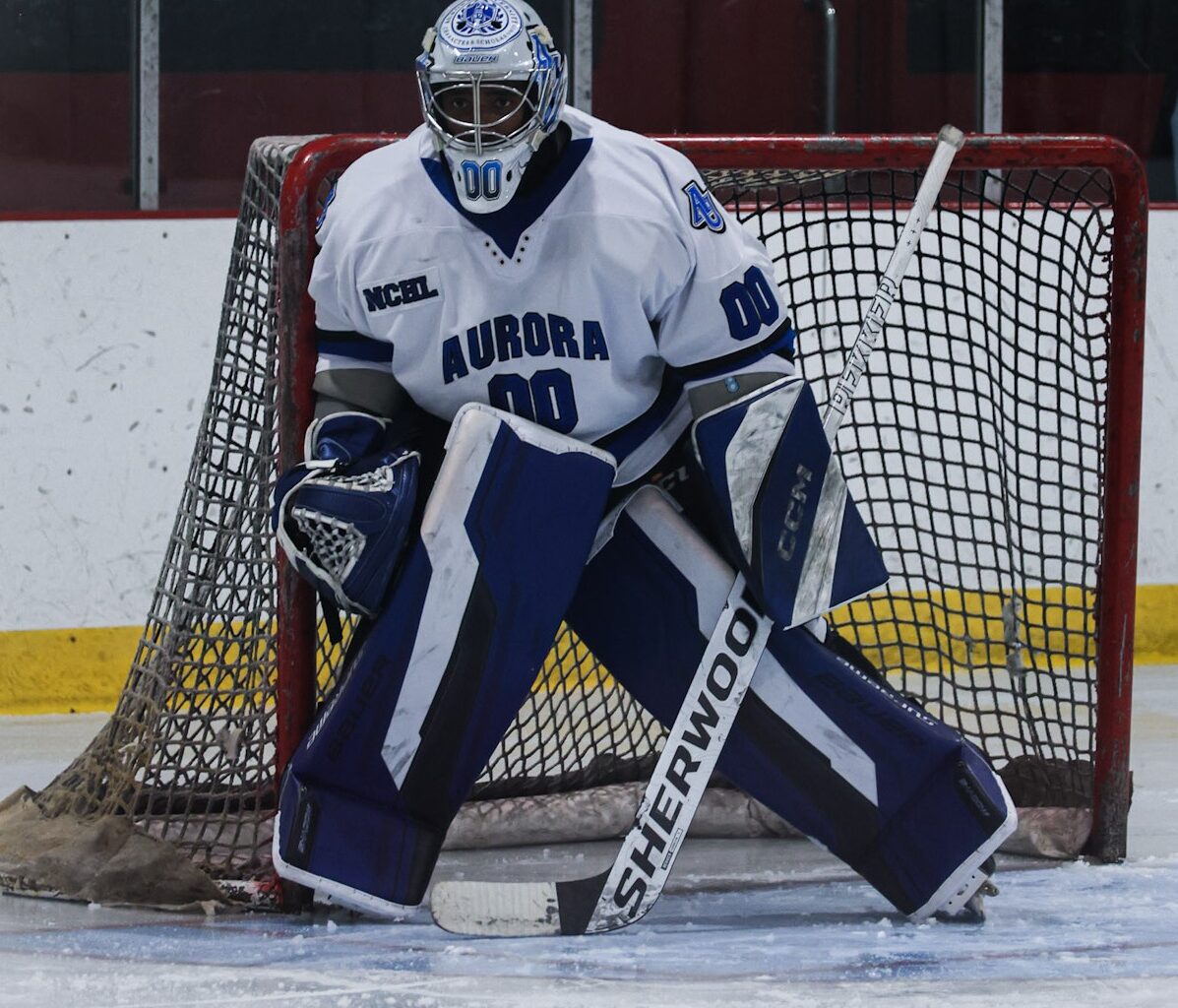
Nearly 20 years later, Skyler has given a lot of time to the “fastest game on ice.” And the game has given back. After playing through the winter season as a goalie for Aurora University in Illinois, Skyler will spend the spring term in Massachusetts doing an internship in athletic training at Harvard University.
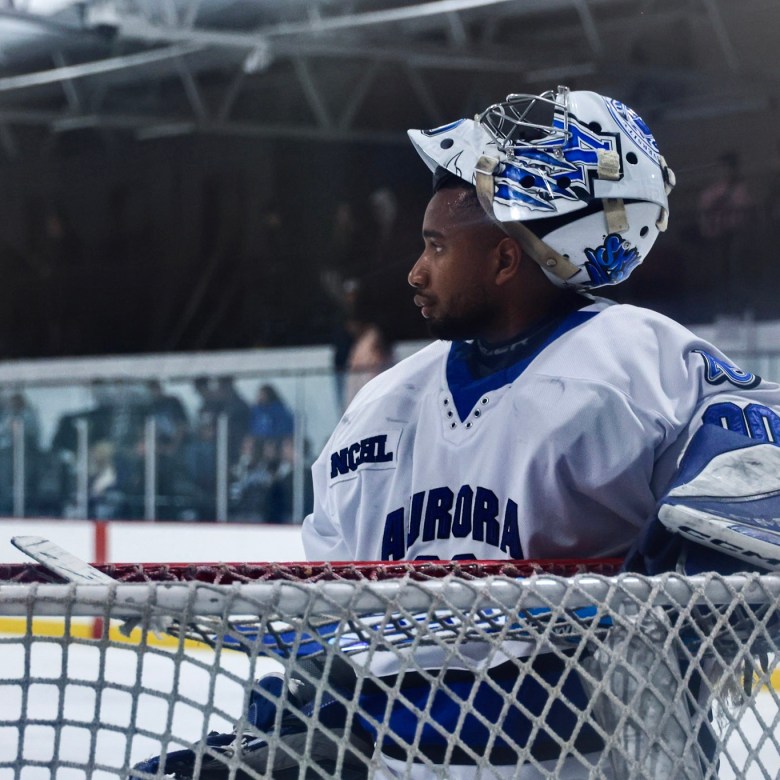 Shinnecock hockey player Skyler Coard plays goalie for Aurora University in Illinois. He’s weighing his options before he graduates in May 2026 with his master’s degree. Credit: Photo courtesy of the Coard family
Then he has decisions to make.
He will graduate in May with a master’s degree in athletic training, and is considering whether to go to school to become a physician’s assistant or begin a practice in athletic training.
And then there’s the option of playing professional hockey in Sweden.
“I was at a showcase in Boston,” Skyler recalled. “A scout from a club in Sweden came over and asked if I thought about playing overseas. They weren’t even looking for goalies, but he liked what he saw and we’ve stayed in touch.”
NCAA graduates who are not draftees for the National Hockey League are the players who receive interest from European clubs, and this, in turn, deepens the talent pool of those leagues.
A question of origins
Native American representation in collegiate and professional hockey — and the origins of the game itself — are open to discussion.
The game is widely believed to have its roots in the Mi’kmaq game known as Oochamkunutk, or later called Duwarken, meaning “ball played on ice.”
In a 2022 blog post, National Indigenous Peoples Day – A History of Canadian Indigenous Peoples and Hockey writer Katie Lakusta reports that Indigenous scholar, Dr. Jerry Lonecloud, believed the traditional Mi’kmaw game, originating in Nova Scotia, created the elements of what we know now as modern hockey.
Fred Sasakamoose, Ahtahkakoop Cree Nation, who played with the Chicago Black Hawks in the early 1950s, is recognized as the first Indigenous player in the National Hockey League, though Taffy Abel, Ojibwe from Michigan, played in the NHL in the 1920s but kept his Native heritage secret at the time. His nephew is now fighting for his recognition.
Since then, at least five Indigenous players have lifted the Stanley Cup, most recently Brandon Montour, Mohawk from Six Nations of the Grand River, who won with the Florida Panthers in 2024, and Zach Whitecloud, Sioux Valley Dakota Nation, who won in 2023 with the Las Vegas Golden Knights. Other Indigenous players who have hoisted the cup include Bryan Trottier, Cree/Métis; Reggie Leach, Ojibwe, Berens River First Nation; and Grant Fuhr, Enoch Cree Nation.
While this history is not well known among his generation, Skyler says in his lifetime the number of Native Americans in ice hockey has been increasing.
“I see more of it now when I go to Shinnecock and Southampton,” Skyler said. “They’re used to it now. I mean, there are still a lot of lacrosse players on Long Island. But there are efforts to bring more hockey.”
Taking root
There are other surprises to the Coard family’s journey in ice hockey.
Skyler’s skills and experience received a notable lift when he joined NYCRoots, a program developed by Sean Grevy in 2015 that focused on diversity in hockey in the New York urban communities.
As a youth hockey coach in Manhattan, Grevy channeled his desire to make a difference and help kids seeking to find their place in hockey in the hopes they could develop an alternative path through life.
Both Skyler and his father credit this program with opening doors in many ways.
“We went to a tournament in Quebec (in 2017),“ Skyler said. “The Canadiens were surprised to see a team of diverse American players. They were also surprised when we won the tournament.”
Richard Coard remembers considerable hesitation on the part of the Canadiens to deliver the trophy.
“They didn’t want to give it up,” Skyler’s father recalls with a sigh.
Skyler recalls these events with some humor.
“We won every single game up there,” Skyler says with some glee. “I still talk to my teammates from that program. Guys from Long Island. . . from NYC. One guy of Native heritage from Virginia, he played for the [Los Angeles Junior Kings] in 2017. Another goalie is playing professionally in East Coast Hockey League.”
NYCRoots morphed into Nextgen Hockey, which expanded the vision of coaching and training and preparing challenged young athletes in hockey. In 2017, Nextgen changed again when Grevy launched 43 OAK Foundation, a project focused on assisting underprivileged and minority athletes who wish to further their education through ice hockey.
The foundation is a nonprofit organization serving student-athletes ages 12-22. Although it’s based in New York City, the organization aids players from 16 states. They continue to provide Skyler with gear and motivational support.
“They keep in touch,” Richard Coard notes. “Skyler keeps in touch with the program and his fellow juniors.”
The program has achieved positive case after positive case with so many players over the past decade. In a USA Hockey feature on Grevy’s work, Grevy expounds on the deeper skills developed by ice hockey.
“This is life-changing; this isn’t just about ice hockey and getting to go out and have fun and shoot the puck,” he said.
Considering his options
Following his junior hockey and high school experience, Skyler received All Star recognition at Hockey Night in Boston before going on to Aurora University, where he received Rookie of the Year honors in 2021. From 2021 to 2024, Aurora University’s men’s team posted winning seasons every year and regularly reached their conference playoffs.
Now in graduate school, and beyond his four-year NCAA eligibility, Skyler is between the posts for the Aurora University Club team, which complements the Division 2 NCAA program.
“We’re a few games in and are doing okay,” he said. “We’ve had a lot of senior flight. And now have 70 freshmen figuring out how we gel. So, we have some good things happening.”
While Skyler focuses on the task at hand — to record shutouts — he also has an eye on the future. After this spring’s internship at Harvard, and with his master’s degree in hand, he has notable options.
“Hockey is a luxury,” Richard Coard said. “Education first and is something to fall back on if professional hockey doesn’t come through.”
For Skyler, a gig in professional ranks in Sweden is not off the table.
“I would consider it,” he told ICT. “Overseas is where I’ve gotten the most looks, and I want to travel. From what I’ve been told, they take care of Americans pretty well over there.”
Mark Wagner is a golf historian and the founding director of the Binienda Center for Civic Engagement at Worcester State University in Massachusetts His book, “Native Links, the Surprising History of Our First People in Golf,” was published in 2024 and is available from Back Nine Press and Amazon. Native Links – Back Nine Press. He can be reached at markgwagner@charter.net.
Related