
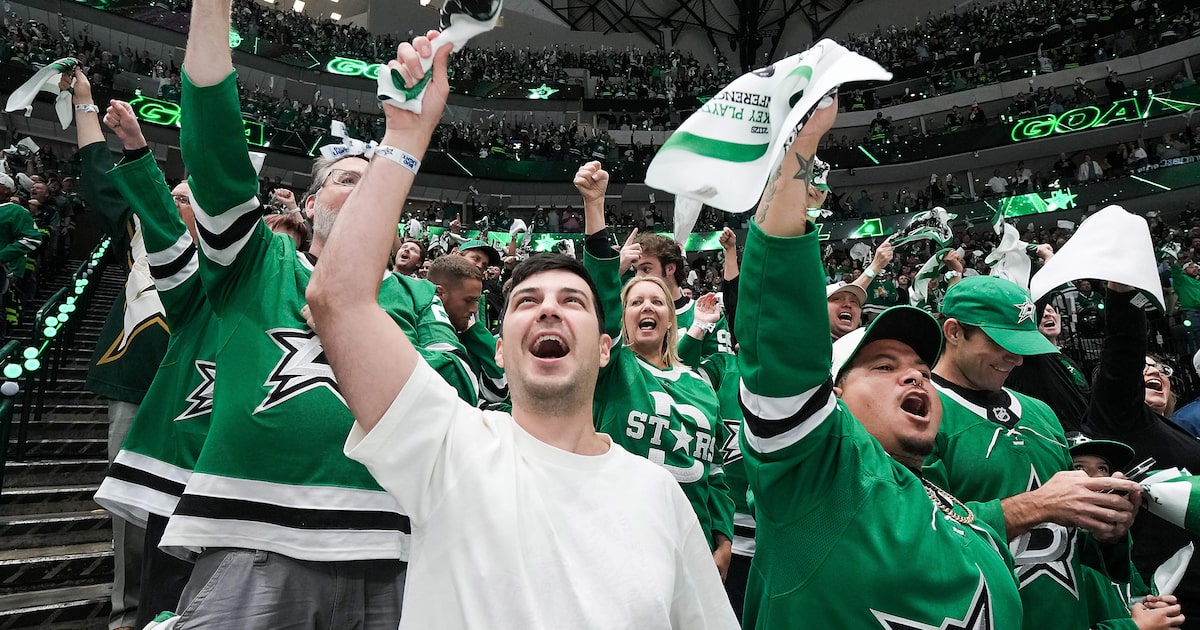
FRISCO — Inside the Dallas Stars’ corporate headquarters sit NHL-issued documents the franchise believes underpin its financial argument for a potential departure from the American Airlines Center, the team’s home for the past quarter-century.
The documents, which team executives showed The Dallas Morning News, lay bare specific economic pain points the Stars say may be best addressed by building an 18,000-seat arena at the Shops at Willow Bend Mall in Plano.
Brad Alberts, Stars CEO and president, said a potential $1 billion Collin County home could unlock new revenue streams to position the franchise for long-term sustainability: tapping into dollars from a 75-acre mixed-use development; cutting luxury suite inventory in half to 50; innovating sponsorship assets; and increasing premium seating inventory by as many as 4,000.
Inside his Frisco office, The News asked Alberts whether he believes it is possible to sufficiently address the team’s four economic pain points with the American Airlines Center as currently constructed.
Business Briefing
“If we’re going to stay in a hockey-only arena [if the Dallas Mavericks leave when the AAC lease expires in 2031], you’ve got to significantly reimagine that arena,” Alberts said. “You’ve got to be prepared to position this arena for the future, not where it’s been — and that’s going to take a significant financial investment in order to do that.”
Barring unforeseen large-scale renovations to the American Airlines Center, which would likely cost more than half a billion dollars, the Stars believe they need to move or they will be left behind. The Stars need new revenue streams to enhance the fan experience, ensure long-term financial success and field a perennial Stanley Cup contender. Industry experts say the AAC is growing outdated — a new arena is needed for a generation with different expectations.
As the Mavericks are poised to move out of the AAC when their lease expires in 2031, the Stars sat down with The News for three exclusive interviews totaling nearly 2½ hours to lay out why it might be best for them to leave the American Airlines Center and move into a new hockey-specific arena for long-term sustainability.
Local revenues are key
Premium seating for Stars games is located behind the glass and on the suite levels. It affords those fans other perks that a growing number of consumers expect from general seating: high-end hospitality experiences, enhanced food and beverages and premium club access.
The Stars would like fewer luxury suites — which are located between the upper and lower bowls and usually seat 12 to 18 people in their own private space — to create more space for bars, restaurants and social areas.
Premium seating inventory and revenue are significant issues for the Stars in the American Airlines Center.
One document in particular illuminates an area where the Stars significantly lag behind fellow NHL teams: revenue per game from premium seating. Those seats afford fans high-end hospitality experiences, such as enhanced food and beverages and premium club access.
Despite the size and affluence of the D-FW market, here’s where the Stars rank: 29th out of 32 teams, generating $257,000 per game. That’s less than half the league average of $520,000 per game.
Why does that financial shortfall matter?
“Local revenues are more crucial to our financial stability than in the other three major sports,” Alberts told The News.
National TV deals for the NFL, NBA and MLB dwarf the NHL.
The Stars typically rely on local dollars for more than 60% of their annual revenue, which makes it critical to maximize dollars from ticket sales, concessions and parking.
Here’s why that local revenue is so important for NHL teams in particular: the unique makeup of an NHL team revenue pie. In a typical year, the Stars generate between $230 million and $245 million in revenue — roughly middle of the pack among NHL teams — team executives told The News.
Alberts declined to comment on the Stars’ profit margin.
Comparing different sports
Much like professional teams in the MLB, NBA and NFL, revenue pie slices entail ticketing, sponsorship, local media, national media and other ancillary dollars.
But when comparing revenue pies from different sports, the primary difference is the size of each slice. MLB and especially NFL and NBA teams rely far more heavily on national media dollars because of lucrative rights deals.
The NBA last year secured an 11-year, $76 billion rights deal with the Walt Disney Company, NBCUniversal and Amazon Prime Video. The NHL in April announced a 12-year, $7.7 billion deal with Rogers Communications in Canada that will kick in next year, and in 2021 announced a seven-year, $4.5 billion deal with ESPN and Turner Sports.
As a result, the NHL revenue pie relies “much more” on ticketing revenue than that of the NBA, as Mark Cuban, who still owns 27% of the Mavericks, told The News in an email in recent weeks.
Here’s the breakdown of the Stars’ pie, according to the hockey team: ticket sales (35% of total revenue); television, radio and advertising (34%); Center Operating Company — which operates AAC — dollars (15%); game related revenue — concessions, merchandise and parking (9%); NHL-related dollars (5%); and other ancillary revenue (2%).
With ticketing as the Stars’ most substantial revenue generator, the Stars point to financial documents as an indictment of the current configuration and construct of the American Airlines Center, which opened in 2001. Alberts believes it is hindering their ability to tap into new revenue streams or make better use of established ones.
Bob Heere, a University of North Texas professor of sport entertainment management and director of UNT sports innovation space, said consumer habits and advancing technology have rendered the American Airlines Center outdated in the 25 years since it was built.
“American Airlines Center is beautiful, it’s historic, but it’s very limited in meeting the demands of the 21st century,” Heere said. “I understand that even if they [Stars] would be the sole operator of the building, that does not solve all their challenges, because it’s still a somewhat outdated facility that doesn’t meet all consumer demands.”
Premium seating shortfall
With 41 regular-season home games, the Stars generate $10.5 million in revenue from premium seating during the regular season, according to league documents viewed by The News. That pales in comparison with even the league average in that category — $21.3 million — to say nothing of the league’s top team performers in premium seating revenue.
Alberts believes the shortfall in premium seating revenue points directly to the incongruent match between the turn-of-the-century construct of the American Airlines Center and the modern-day demands of the NHL team business model.
Here’s why: The Stars rank 29th in the league in premium seating inventory with 1,198 seats. That is barely more than half the league average of 2,300.
Daniel Venegas, the Stars’ senior vice president for ticketing and strategy, said the NHL defines premium seating as non-luxury suite seats that have access to arena clubs.
Fan demand exists for more premium seats, Alberts stressed, but what is handcuffing the franchise is the design of the AAC, constructed before in-venue clubs became en vogue.
Now, clubs are what’s hot, appealing to fans who seek and expect a more social, less stay-in-your-seat arena experience. Team executives said the Stars’ club offerings aren’t adequately meeting that need.
For instance, the Stars’ VIP lounge, which does not have a sponsor, grants access to only 250 sponsors and fans seated behind the glass each game, Venegas said.
Then there is the Stars’ Angel’s Envy Bourbon Club, which is essentially a private bar for lower-bowl season-ticket holders who can purchase memberships, Venegas said.
If they choose to build a new arena, the Stars would seek to create as many as 4,000 more premium seats, Alberts said. In turn, the added inventory would require additional in-venue premium clubs.
“Dallas is a premium market,” Alberts said. “We want to be able to meet that expectation, meet that demand.”
Stars executives point to AT&T Stadium, albeit a much larger venue than the American Airlines Center, as a stadium that sufficiently addresses fans’ expectations for high-end, spacious premium social spaces.
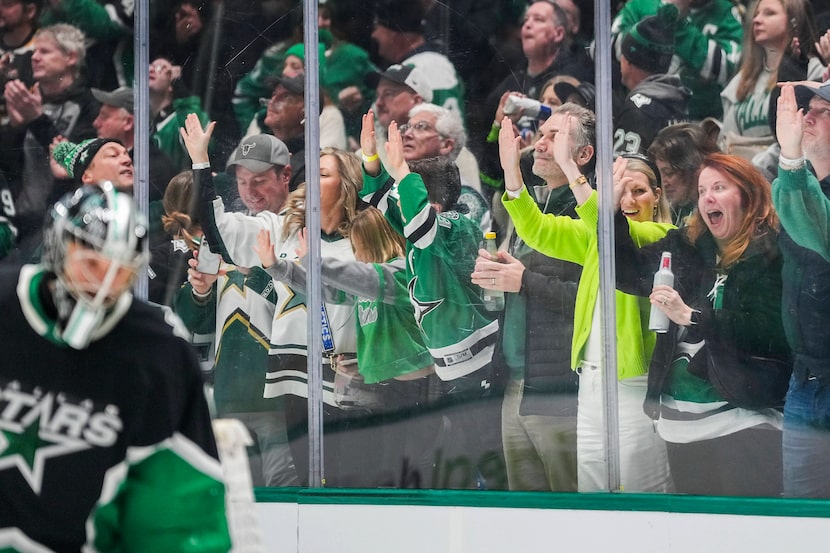
Dallas Stars fans celebrate a goal by center Wyatt Johnston behind goaltender Casey Desmith during the second period of an NHL hockey game against the Ottawa Senators at the American Airlines Center on Sunday, Nov. 30, 2025, in Dallas.
Smiley N. Pool / Staff Photographer
Across the NHL, the Edmonton Oilers are among the pre-eminent franchises replete with high-end club offerings inside their arena, Rogers Place. It offers an array of premium clubs, including CIBC Chairman’s Club, located just outside the Oilers’ locker room, and Sky Lounge, offering a two-level social ambience.
Heere, the UNT professor, echoed Alberts’ sentiments regarding the AAC’s premium club offerings, saying there are “very few” inside the arena.
The issue is particularly pronounced when one considers the trend lines for in-venue fan experiences. As Heere detailed, there’s been a consequential shift in recent years toward creating more open, communal hospitality spaces. That’s what fans, especially younger ones, want and expect, he said.
“The butts-in-seats [model] is really the 20th-century model,” Heere said. “Now, the younger generation, they don’t want to sit in their seat for three hours. They want a more hospitality-driven experience. So you see that with the new Globe Life Field [in Arlington] being a very good example of it. There’s much more standing — you can see the field from everywhere. You can walk around …
“It’s a party, and there happens to be a game. You see that even in stadium design — it’s changing. So American Airlines Center is a very old-fashioned model. The concourse, they’re completely separated from what’s happening on the [ice or court]. If you get a drink or food, you have no clue what’s going on, other than on these tiny little screens. In new arenas, it’s much more flowing and open and you can grab food without having to miss what’s happening.”
Substantial renovations can be costly
If the Stars leave the AAC after their lease expires in 2031, the 107-acre mall property at 6121 W. Park Blvd. in Plano has emerged as the favorite to land the franchise after discussions with cities, including Frisco, The Colony, Arlington and Fort Worth.
The exploration of a potential new home continues as legal wrangling persists between the Stars and their fellow AAC tenant, the Mavericks. In October, the Mavericks filed suit against the Stars in Texas Business Court, alleging the hockey team is in breach of a clause in its 1998 franchise agreement that requires its corporate headquarters to be located within the city of Dallas. The Mavericks also claimed in the request for an injunction that the Stars have obstructed further maintenance and improvements to the American Airlines Center.
To address the Stars’ economic pain points, Alberts believes AAC would need virtually a full internal makeover rather than upgrades on the margins — aside from the arena’s outer shell, little would remain untouched.
It could be a heavy — and pricey — lift.
Capital One Arena in Washington, D.C, is undergoing a multi-year renovation expected to be completed by 2028. Premium seating will increase from 15% to 30% of total capacity; some 30 new premium spaces will be added, including a dual-level 24,000-square-foot club.
The price tag? Approximately $800 million.
New York’s Madison Square Garden, albeit several decades older than AAC, underwent a three-year transformation from 2011-2013 to modernize the fabled venue. Among the litany of wholesale changes were the additions of the Delta Sky360 Club, 1879 Club and Madison Club.
The project’s price tag: $1 billion.
Because the three-phased renovation occurred over consecutive summers, MSG was shut down for three consecutive off-seasons. Such a multi-year process can necessitate arenas essentially shutting down their third-party, off-season business until completion.
Absent similar large-scale AAC renovations, the only way for the Stars to catch up to even middle-of-the-pack NHL teams in the premium seating rankings, Stars executives said, is for the team to slap a price increase on AAC premium club members.
Too many suites and upper-deck seats
The dearth of premium seating has the Stars lagging behind fellow NHL teams in another area.
Alberts said the Stars raised ticket prices 14% each of the past two seasons. Even with those price bumps, he added, the Stars rank in the middle or just below the middle in league rankings of all teams in average ticket price, which concerns the franchise.
Here’s the reason why they fall below more than half the league in average ticket price: the scarcity of premium seating and the surplus of upper-deck seats (7,112).
The top teams in league rankings for average ticket price, Alberts said, have more premium seats than the Stars and fewer upper-deck seats.
The upper-deck seats don’t warrant a high price because of their distance from the action. And team executives said you can pull the lever to increase ticket prices only so many times before agitating the fan base.
Another issue is the number of luxury suites.
When American Airlines opened in 2001, there were 144 luxury suites, Stars ticketing executive Venegas said. Showcasing suites were all the rage around the turn of the century. Since then, some suites have been retrofitted into theater boxes. The AAC now has 105 suites — 103 18-person suites, one 22-person suite, and one 32-person suite, the Stars said.
Alberts said 105 is excessive if the Stars are the lone team in the arena. In a hockey-only arena, he said 50 suites is the ideal target.
“You’d want to replace that [excessive luxury suite inventory] with more premium hospitality spaces,” Heere added.
When companies or individuals purchase suites for all AAC events together — Mavericks’ and Stars’ games and concerts — those dollars are filtered through Center Operating Company, which operates AAC, before being split 50-50 between the Mavericks and Stars, executives said. The AAC shared revenue pot includes revenue from third-party events as well as dollars from brands that sponsor both teams.
As their dispute has escalated, the Mavericks have held the Stars’ 50% share of the AAC dollars in escrow with Chicago Title Company. Without that 50% share — which the Stars say is in the “tens of millions” of dollars — they say there is “significant financial pressure,” though it has not yet affected decisions on player salaries.
Currently, nine other NHL teams share arenas with NBA teams — Los Angeles, Denver, Detroit, Washington, New York, Chicago, Philadelphia, Toronto, Boston — but most of those marriages are not nearly as complicated financially as the one that exists in the AAC.
In Chicago, both the Wirtz family with the NHL’s Blackhawks and Jerry Reinsdorf with the NBA’s Chicago Bulls have owned their respective franchises for decades. The teams have shared arenas for more than a half-century, and co-own the United Center, which opened in 1994. There is a strong relationship between the families, who are now working on The 1901 Project, a proposed $7 billion mixed-use development that will surround the arena.
The Mavericks and the city of Dallas say the Stars backed out of a $300 million deal to renovate AAC, according to interviews and documents obtained by The News. In the deal, according to the city and the Mavericks, the Stars agreed to remain in AAC through 2061 and would have paid no renovation costs, with the city and Mavericks footing the bill 50-50.
The Stars strongly deny they agreed to the deal and say that had it gone through, the Mavericks and Stars would have shared half of the renovation costs. The Stars maintain they agreed to a different deal that would extend the existing lease with both teams staying at AAC through 2035.
A replica of The Battery
What the Stars seek are revenue streams not entirely dependent on success on the ice. That’s where a mixed-use entertainment district comes in.
Victory Park, the entertainment district surrounding the AAC, doesn’t provide the Stars revenue because they do not own the real estate.
When brands advertise outside the AAC in Victory Park, the Stars receive none of those dollars. When fans frequent Victory Park restaurants before and after games, they receive none of those dollars either.
Numerous franchises nationwide have gone the mixed-use development route, surrounding venues with everything from restaurants and retail to hotels, apartments and offices.
In particular, Alberts said, what the Atlanta Braves have done with The Battery Atlanta, the more than 60-acre development surrounding Truist Park, is a blueprint the Stars are examining.
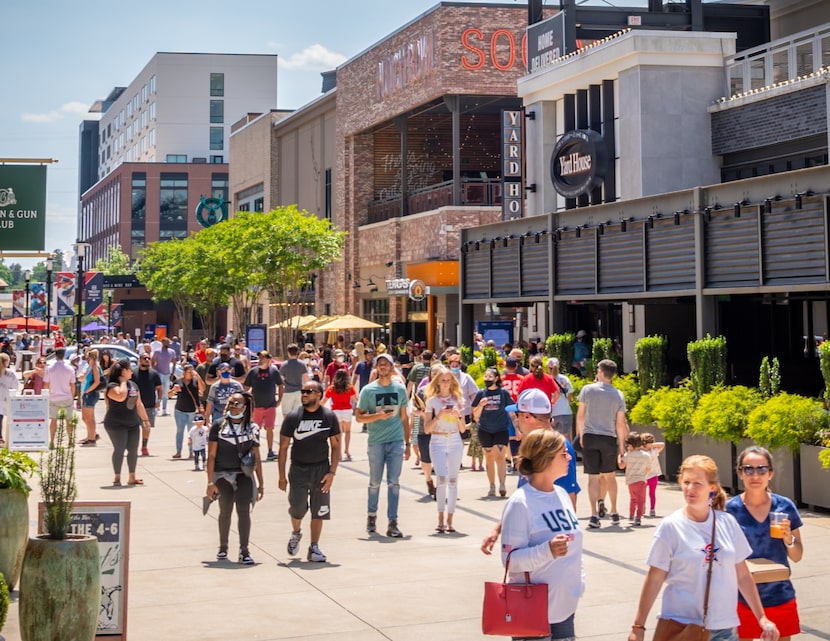
The Atlanta Braves play at Truist Park in a complex called The Battery, a multi-use district owned by Liberty Media, owner of the team. The district features shops, restaurants and hotels.
Courtesy Atlanta Braves
Atlanta Braves Holdings, Inc. reported mixed-use development revenue increased 56% (to $27 million) in the third quarter of 2025 compared to the prior year period, primarily because of increases in rental income from various lease commencements, the acquisition of real estate assets as well as higher sponsorship revenue.
Heere said mixed-use developments can give franchises “very reliable” extra year-round revenue sources. Franchises typically establish separate entities to manage the real estate assets.
“If done well, it can be an economic dynamo for the whole area — 365 days a year,” Heere added. “I would think it’s a slam dunk for the Stars to be there. Great location in the middle of these growing suburbs. A lot of wealthy people — a lot easier for them to get there than to go downtown.”
The Stars harbor ambitions larger than what the Texas Rangers created with their mixed-use district, Texas Live!, in Arlington. Restaurants, apartments and a hotel are on the Stars’ wish list, along with a brick-and-mortar Stars’ Hall of Fame. Even more than the in-venue experience, the mixed-use development would be the critical element for the long-term sustainability of the arena project. And within that development, executives said, it would be critical to find the sweet spot for the appropriate retail mix for the demographic.
“You want to be very purposeful in your design on how to develop it so that it actually maximizes the spin off,” Heere said. “And people want to be there regardless of whether there is a game going on or not.”
If they build a new arena, the Stars envision innovative, improved digital assets for sponsors, plus the ability to weave brands — much like the Dallas Cowboys have done at The Star in Frisco — into the mixed-use development. It creates non-game day opportunities for sponsors, Alberts said, expanding brands into experiences beyond hockey.
Alberts believes sponsorship assets — the value brands receive through deals, including visibility and signage — are outdated in the AAC. That makes it difficult to persuade brands to give year-over-year spend increases.
“It’s much more difficult to find appropriate year-over-year growth from that line item because we’re essentially selling the same asset mix in inventory today that we sold 25 years ago,” Alberts said. “There’s been a few changes, but nothing material. So if you’re a marketer, it’s going to be hard to justify paying us five to 10% year-over-year [increases] for the same inventory, right? So that’s why it’s a grind to find year-over-year growth. We really have to be aggressive. So, yes, it is a bigger challenge.”
Heere said the sponsorship model for aging arenas is based on fans sitting in their seats and watching — being passive. The only way to interact with fans in those settings is through traditional signage and promotions.
“But if you make more communal spaces, more interactive, people walk around and you can do more of the hospitality angle,” Heere said. “You can actually approach people. People can approach you. They can walk by your activation booth. They can walk into your hospitality space. There’s a lot more opportunities now to sell assets.”
How will new and enhanced revenue streams benefit fans if the Stars build a new arena?
Team executives point to the NHL salary cap: $95.5 million for the 2025-26 season. In two years, the cap will be $113.5 million. Alberts believes it’s critical to tap into new revenue streams to continue to field a championship-level team.
There’s another component — the in-venue fan experience.
Alberts painted the picture of a potential future inside a new arena. Today at the AAC, you feel a Stars’ brand, a Mavericks’ brand and an arena brand.
With a new arena, he said, you could see a lower venue ceiling, have more seats closer to the ice, enjoy more premium club experiences, benefit from more audio and entertainment bells and whistles, as well as high-quality food and beverage offerings both within and surrounding the arena — all coming together for an immersive environment that projects as the home of the Stars.
“If we were to create our own immersed environment [in a new arena], you are really going to feel that this is the home of the Stars in a much-improved fashion than what you do now,” Alberts said. “There’s a lot of things — not just how can we generate more money — that would lead to people that love Stars hockey to go, ‘Wow, this is incredible.’”
 SMU athletics launches own division for NIL deals
The revenue, NIL and brand unit will pursue revenue and brand opportunities in the fast-evolving age of college sports.
 Did Jerry Jones, Mark Cuban crack the list of the 125 most influential sports biz leaders?
New Sports Business Journal list highlights several influential sports business figures with D-FW ties.